
SemAwareIN: Bridging the Semantic Gap in Web Recommendations through Ontology and Tags
Ontology-based Web Recommendation from tags
The paper introduces SemAwareIN, an ontology-based Web Recommendation System (WRS) that maps user-provided tags to domain-specific ontology concepts. By leveraging semantic relations and a novel LCA-based dimensionality reduction, it achieves SOTA performance in tag-based recommendation without requiring explicit user ratings or item clustering.
TL;DR
Traditional recommendation engines often fail when data is sparse or when a new user arrives without a history. SemAwareIN solves this by shifting the focus from "what you clicked" to "what your tags mean." By mapping user-generated tags to a formal Domain Ontology, the system provides highly accurate recommendations (82% accuracy) and utilizes a unique dimensionality reduction method to keep the system fast and scalable.
The "Blind Spot" of Current Recommenders
Most Web Recommendation Systems (WRS) suffer from two chronic issues: Sparsity (users only interact with a tiny fraction of items) and the New User Problem.
Current solutions often rely on clustering or shallow hierarchies (is-a relations). While helpful, these methods are "semantically blind"—they don't understand that a "Video Camera" requires a "Video Film" or has-a "Lens." They treat tags as mere strings of text rather than concepts within a knowledge web.
Methodology: Mapping Tags to Meaning
The core innovation of SemAwareIN is the transformation of the recommendation task into a vector space search within a Domain Ontology.
1. Clickstream Mapping (The PC Matrix)
Instead of a User-Item matrix, the authors build a Product-Concept (PC) Matrix. Each item is represented by its similarity to various ontology concepts. Similarity is calculated using the Wu and Palmer measure against WordNet, ensuring that synonyms or related terms (like "Lens" and "Camera") are correctly linked.
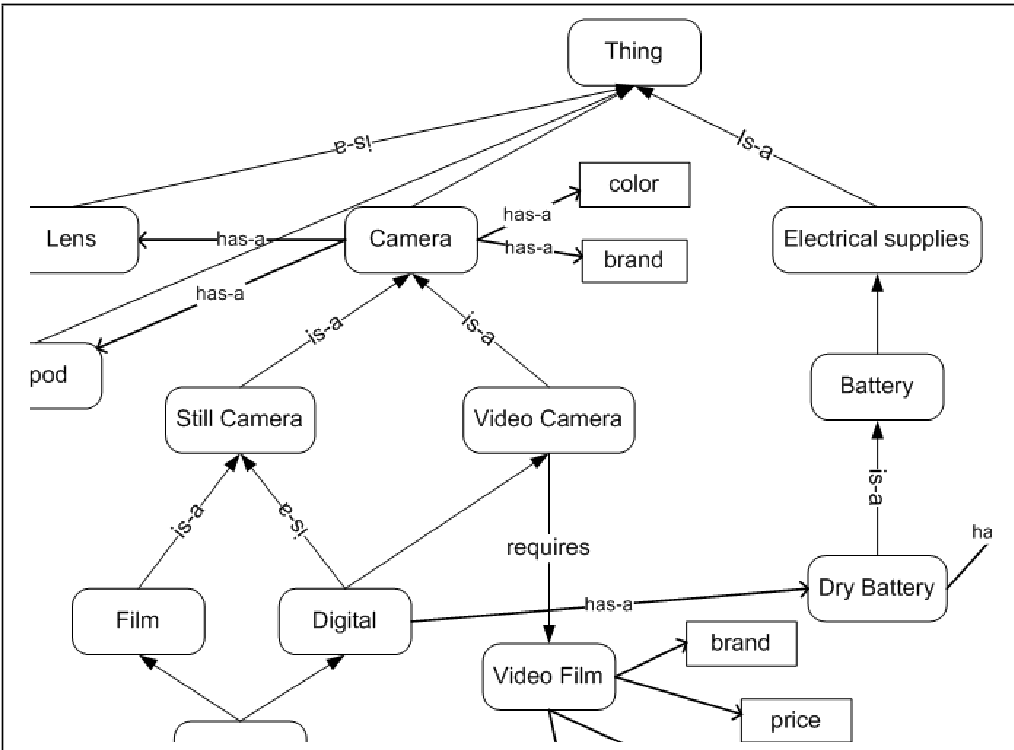 Fig 1: A Camera Domain Ontology showing complex relations like 'has-a' and 'requires'.
2. Dimensionality Reduction via LCA
To solve the sparsity of the PC matrix, the authors introduce Lowest Common Ancestor (LCA) reduction. Instead of keeping every leaf concept as a column, they merge columns by moving up the ontology tree. This uses a weighted average decay factor based on the distance to the LCA, preserving semantic integrity while slashing computation time.
3. Spreading Activation
Unlike "shallow" systems that only use hierarchical "is-a" links, SemAwareIN uses Spreading Activation. If a user is interested in a specific concept, the system traverses all ontological relations (has-a, requires, etc.) to find complementary items, effectively "reasoning" about what the user might need next.
Experimental Results: Precision and Recall
Testing on the MovieLens dataset (82,454 cleaned tags) showed that SemAwareIN is a powerhouse.
- Recall@10: Reached 0.61, nearly doubling the performance of popular baselines like TopPop (0.28).
- Efficiency: The LCA reduction method reduced recommendation time by 22% with negligible impact on accuracy.
- Expansion Benefit: Using "Spreading Activation" to expand the recommendation set increased recall from 0.75 to 0.86 at n=15.
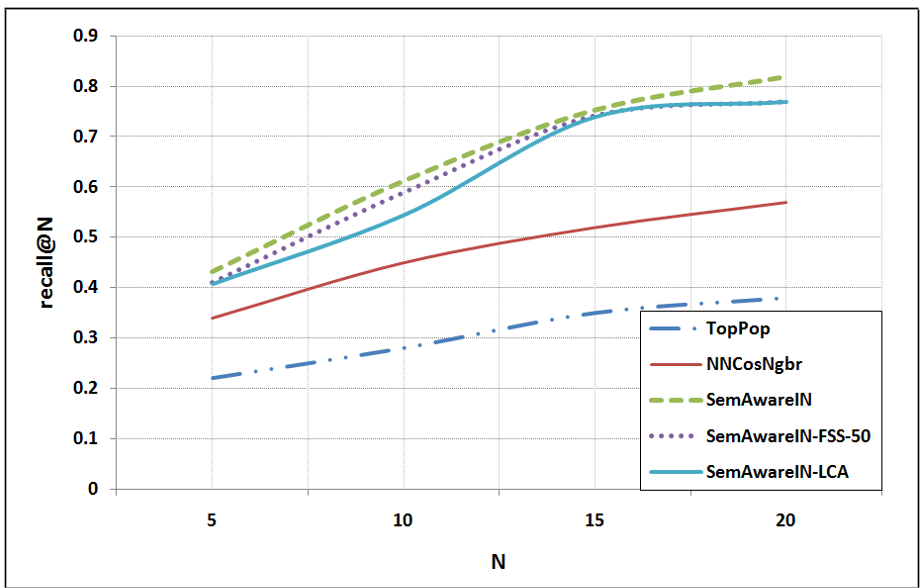 Fig 2: Recall-at-n comparison showing SemAwareIN significantly outperforming item-based baselines.
Critical Insight: Why This Matters
The shift from Collaborative Filtering (finding similar users) to Semantic Content-Based Recommendation (finding similar concepts) is vital for the modern web. As users provide more metadata (tags, reviews), the ability to map this "Folksonomy" (user-created taxonomy) onto a "Formal Ontology" allows for recommendations that are not just statistically likely, but logically sound.
Limitations & Future Work
While the system is robust, it currently depends on the quality of the underlying Domain Ontology and the WordNet thesaurus. Future iterations could benefit from Dynamic Ontology Learning, where the system automatically updates the ontology based on emerging user tagging patterns (evolving Folksonomy).
Conclusion
SemAwareIN proves that domain knowledge is not just a "nice-to-have" but a powerful tool for solving the most stubborn problems in recommendation systems. By understanding the why behind a tag, we can provide users with the what they actually need.