
Refactoring Logic with Space: Ontology Cleaning via Mereotopological Reasoning
Ontology cleaning by mereotopological reasoning
This paper introduces a formal mereotopological semantics for ontology cleaning, utilizing the Region Connection Calculus (RCC) to manage and repair provisional ontologies. By mapping Description Logic (DL) concepts to 2D spatial regions, the method provides a consistent framework for identifying logical anomalies and refining concept relationships through human-in-the-loop spatial arrangements.
TL;DR
Building ontologies is often a messy process prone to logical gaps and "notions" that aren't quite fully defined. This paper proposes a unique solution: treat concepts as 2D shapes. By using Region Connection Calculus (RCC), the authors allow users to "clean" an ontology by physically moving shapes on a map, which then translates back into consistent Description Logic (DL) axioms.
The Problem: Provisional and "Messy" Ontologies
In the quest for a Semantic Web, ontologies act as the backbone of knowledge management. However, early-stage ontologies are rarely perfect. They suffer from:
- Incompleteness: Missing roles or logical definitions.
- Notions vs. Concepts: Concepts that exist in the user's mind but aren't explicitly distinguished in the code.
- Lack of Explainability: Most cleaning tools don't tell you why a change was made.
The authors argue that if a set of concepts cannot be represented spatially in a clear way, the ontology is effectively "messy."
Methodology: The Space-Logic Bridge
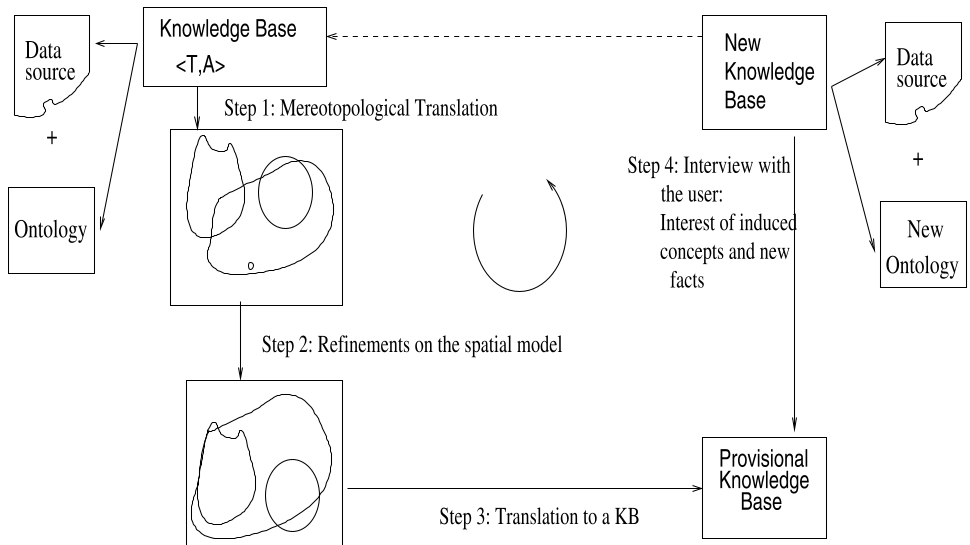
The core of this paper is a cycle that bridges the gap between abstract logic and human spatial intuition.
1. From Logic to Geometry
The process begins by taking a TBox (the conceptual definitions) and translating it into a Constraint Satisfaction Problem (CSP). For example, an inclusion axiom like is translated into a spatial constraint , meaning the "Woman" region is a part of the "Person" region.
2. Interactive Spatial Arrangements
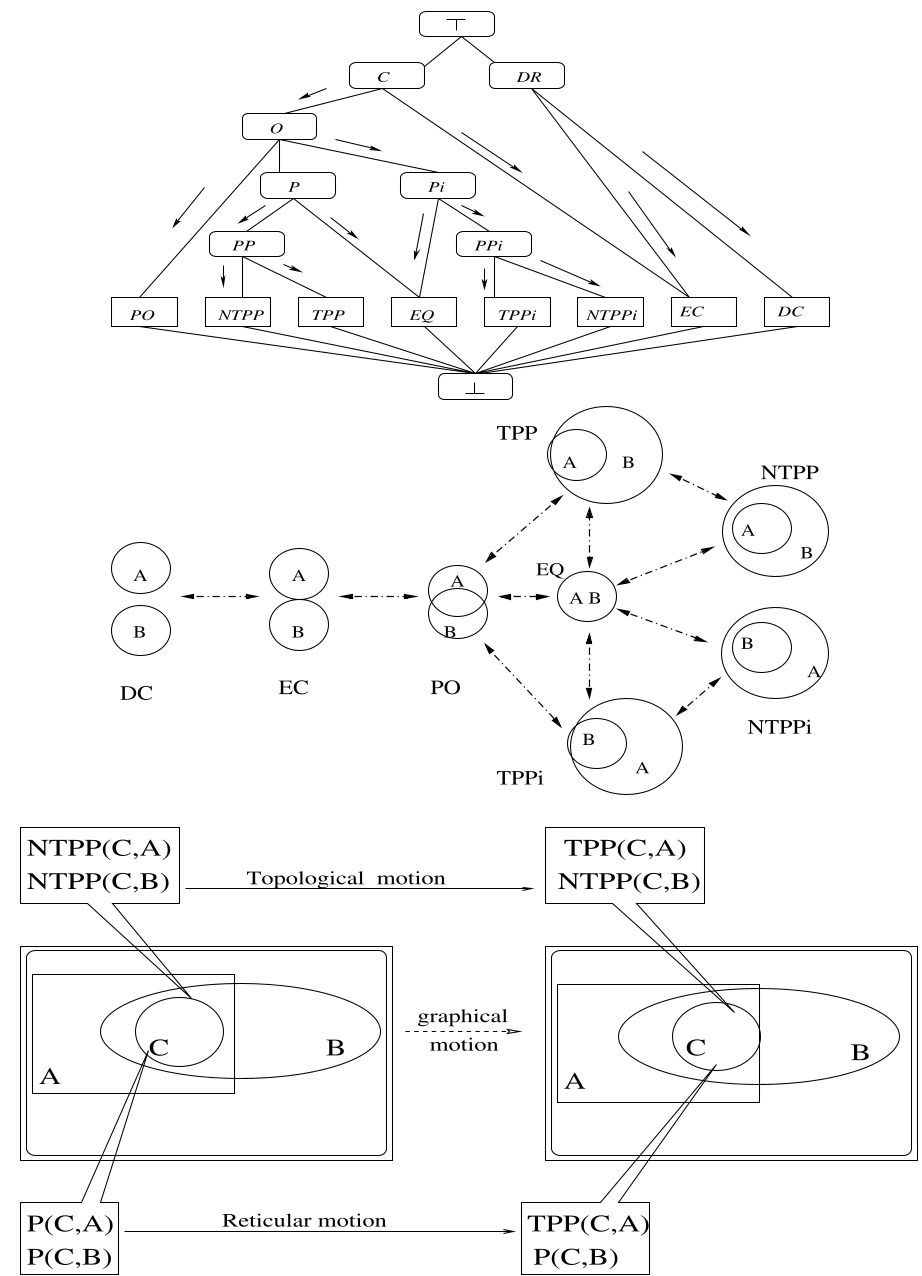
Users interact with a 2D map. If the software suggests two concepts overlap ( - Partial Overlap) but the user knows they should be disjoint, the user simply moves the regions. These are called:
- Reticular Arrangements: Refining a relationship (e.g., changing "connected" to "part-of").
- Topological Arrangements: Swapping one relationship for a disjoint but "cognitively near" one.
3. Back to Logic
Once the map looks right, the system applies a recursive translation back to DL. This is where the magic happens: the system may induce new concepts. If the user drew a region where "Parent" and "Woman" intersect, the system notices this "notion" and asks the user to name it (e.g., "Mother").
Experimental Results: Cleaning the Family Tree
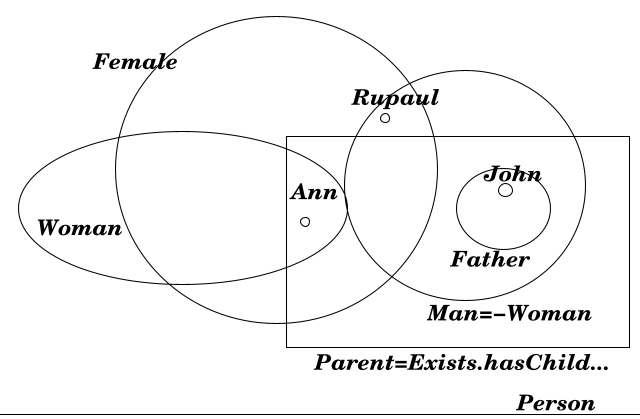
The authors validated this using a family ontology. A notable case involved the concept of "RuPaul" (a famous drag queen), which triggered an anomaly because the ontology had RuPaul as both "Man" and "Female."
By visualizing these as regions, the user could refine the boundaries, leading to the induction of a "Crossdresser" concept. The resulting Knowledge Base was not only consistent but more expressive than the original.
Critical Insight: Why Space Matters
The fundamental principle here is that human spatial reasoning is highly robust. We find it easier to see that two circles are overlapping than to parse a list of disjointness axioms. By using RCC as a "meta-ontology," the authors provide a formal ground for "Geomancy for Knowledge Bases"—turning the visual act of cleaning a map into the logical act of cleaning a schema.
Conclusion and Future Work
This work demonstrates that mereotopology is a powerful tool for knowledge acquisition. While currently applied to small-to-medium concept sets, future work aims to incorporate roles (relationships between individuals) and automate more of the spatial-to-logical translation. As we move toward more complex AI systems, bridging the gap between human intuition (space) and machine verification (logic) will be vital for building trustworthy knowledge foundations.