
Bridging the Semantic Gap: Task-Based Ontologies for Dynamic Business Networks
Ontology Development for Designing and Managing Dynamic Business Process Networks
The paper introduces a task-based ontological framework for designing and managing dynamic Business Process Networks. It synthesizes AI planning and software engineering principles to bridge the gap between declarative process representations and procedural implementations, specifically targeting large-scale Information Integration tasks.
Executive Summary
TL;DR: This paper addresses the fragmentation in business process management by proposing a task-based ontological framework. By decoupling domain logic (declarative) from software execution (procedural), the author enables AI-driven planning and dynamic integration of heterogeneous information sources like ERP and CRM systems.
In the academic landscape, this work acts as a bridge between AI Planning and Software Engineering, moving beyond static modeling (like UML) toward a more flexible, "knowledge-level" architecture for autonomous systems.
The Problem: The "Babel" of Process Languages
Modern organizations operate in dynamic environments where processes are spatially and temporally distributed. Current manual approaches suffer from three fatal flaws:
- Semantic Mismatch: Different systems (ERP vs. PDM) use different terminologies for the same entities.
- Coupling: Domain logic is often "hard-coded" into the software, making changes resource-intensive.
- Model Multiplicity: Disconnects between high-level requirements (Activity Diagrams) and low-level code lead to propagation errors and system brittleness.
Methodology: The Task-State Synergy
The core innovation is the Domain Semantics Layer. Instead of mapping the real world directly to code, the author introduces an intermediary layer based on Tasks, States, and Agents.
1. The Architecture
The framework separates the "Knowledge Level" (what the system knows) from the "Symbol Level" (how it is implemented).
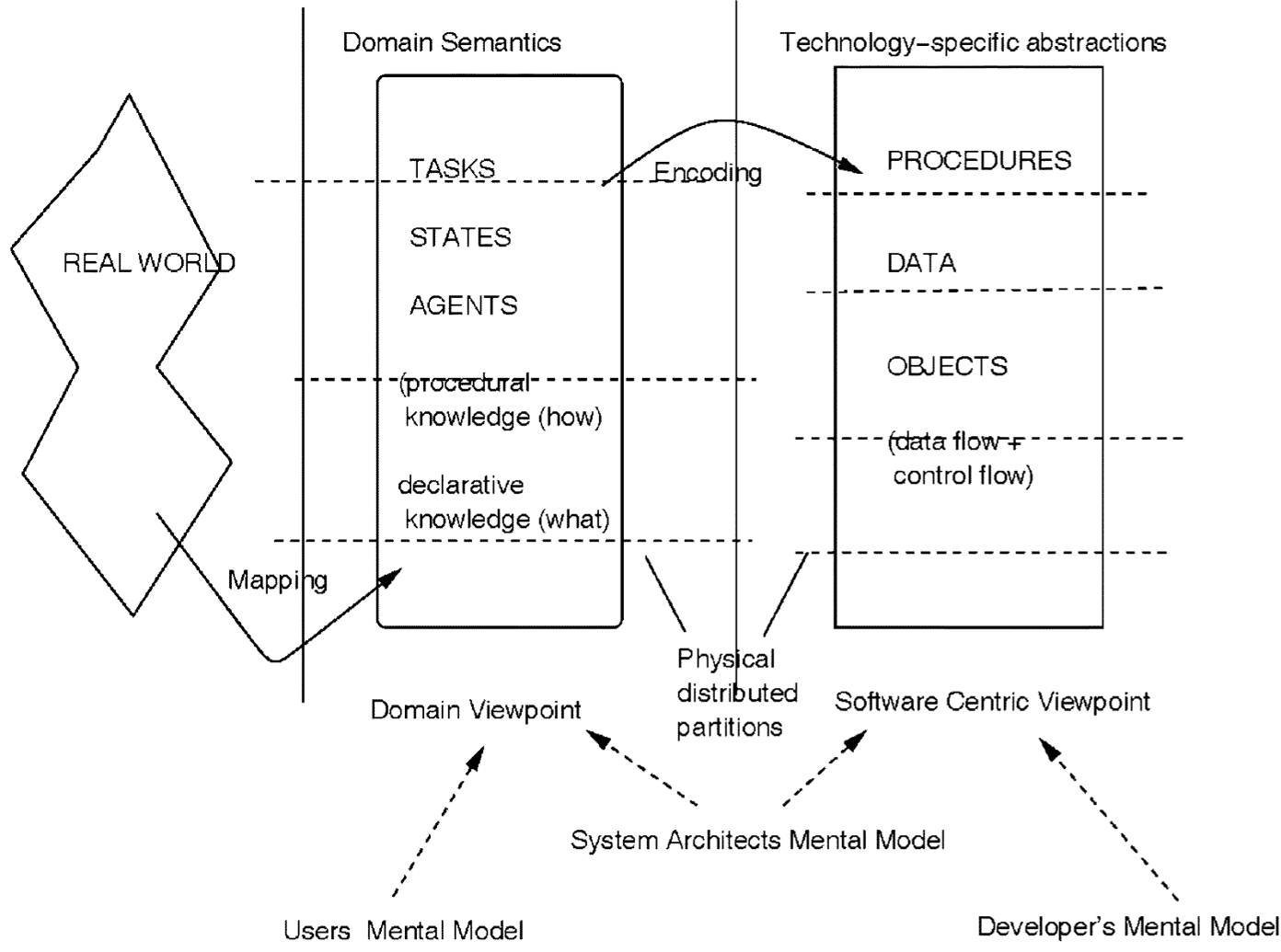 Figure: The three-layered ontological framework showing the decoupling of domain semantics from technology abstractions.
2. The Task Primitive
Each task is defined by:
- Declarative Logic: Pre-conditions and Post-conditions (using First-Order Logic).
- Procedural Implementation: The actual API call or script.
This dual nature allows an AI planner to look at the conditions to build a sequence (a plan) and then hand it to an executor to run the implementation.
Implementation & Results: Intelligent Information Integration
The author instantiated this framework in a "Design Mediator" for New Product Development (NPD). The mediator acts as a single agent that receives design queries and dynamically generates a workflow to fetch data from disparate back-ends.
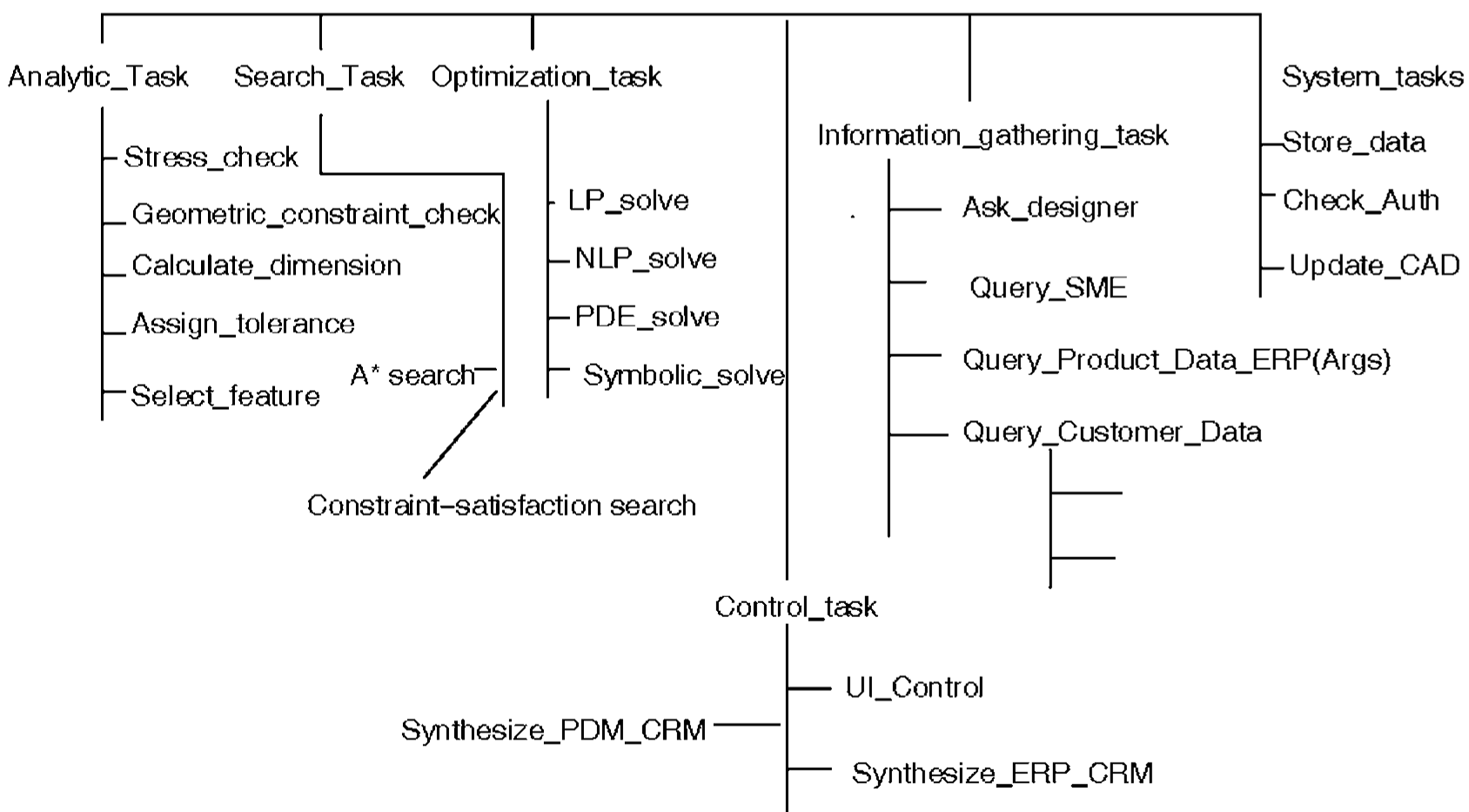 Figure: The Intelligent Information Integration (I3) architecture using task ontologies for engineering design.
Key Findings:
- Dynamic Composition: Unlike static workflows, the system can use AI planning to re-route tasks if an information source (e.g., a specific ERP database) is down.
- Scalability: By using a library of reusable task abstractions, the system mimics the success of tools like Apache ANT, where complex software builds are managed via simple, composable task units.
Critical Analysis & Takeaways
The Power of Inductive Bias
The paper rightly identifies that the complexity of modern systems arises from interactions rather than individual components. By forcing a "Task-State" ontology, the author provides an inductive bias that rewards modularity and reuse.
Limitations
- Knowledge Engineering Bottleneck: Defining these ontologies is extremely labor-intensive and requires subject matter experts who understand both the business and formal logic.
- Performance Overhead: Interleaving AI planning with execution adds latency compared to hard-coded scripts.
Future Outlook
As we move toward Autonomic Computing, this framework serves as a blueprint. The future lies in maturing the "Mapping" between visual languages (UML) and these formal task representations to allow for Model-Driven Development that is truly automated.
Author Note: This paper is a significant milestone for practitioners looking to move beyond "spaghetti code" integration toward high-assurance, semantic process networks.