
Beyond Correlation: Enhancing Gene Analysis through Ontology-Driven Clustering
An Ontology-Driven Clustering Method for Supporting Gene Expression Analysis
This paper introduces an ontology-driven clustering method for gene expression analysis, integrating Gene Ontology (GO) semantic similarity into hierarchical clustering. Tested on S. cerevisiae (yeast) data, the method successfully identifies functional relationships that traditional expression-based correlation methods overlook.
TL;DR
Gene expression analysis has long relied on the "guilt by association" principle—if two genes behave similarly, they must do the same thing. This paper challenges the sufficiency of this data-driven approach by introducing a GO-driven clustering framework. By integrating semantic similarity from the Gene Ontology (GO), the authors provide a method that doesn't just see numbers, but understands the biological "meaning" of gene clusters.
The "Meaning" Gap in Bioinformatics
Standard clustering techniques (like K-means or Hierarchical Clustering) use Pearson's correlation to group genes. While effective for finding co-regulated genes, these methods suffer from two main flaws:
- Lack of Context: They cannot explain the biological pathway or function shared by the cluster without manual post-hoc analysis.
- False Positives/Negatives: Genes might fluctuate together by chance or due to broad experimental perturbations, while performing completely different functions (Functional Heterogeneity).
The authors argue that we must treat biological knowledge (GO) as a primary input rather than a secondary validation tool.
Methodology: The Semantic Bridge
The core of this work lies in transforming a hierarchical vocabulary (GO) into a mathematical distance matrix.
1. Lin's Semantic Similarity
The authors utilize Lin's metric, which leverages the Information Content (IC) of GO terms. The logic is elegant: the similarity between two terms is the ratio between the information shared (their Most Informative Common Ancestor) and the information content of the terms themselves.
2. The Integrated Framework
The researchers built a pipeline that processes both the SGD (Saccharomyces Genome Database) annotations and the classic Eisen et al. yeast expression dataset.
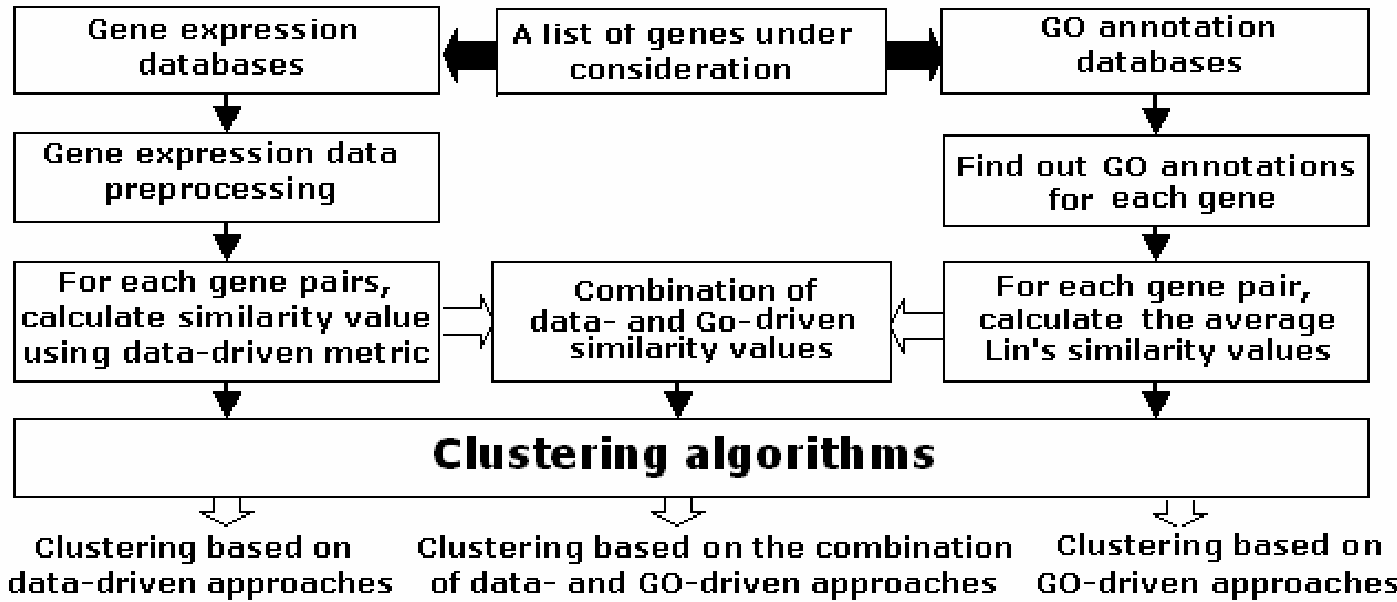 Figure: The proposed framework integrating data-driven similarity and GO-driven knowledge.
Experimental Insights: When Data and Knowledge Diverge
The authors benchmarked their method against 10 well-known yeast gene clusters.
The Histone Success
In Cluster H (Histone genes), the data-driven correlation and the GO-driven similarity both exceeded 0.90. This confirms that for tightly co-regulated, single-function complexes, traditional methods work perfectly.
The "Cluster B" Revelation
The real value of this method appeared in Cluster B. While these genes showed a high expression correlation (0.83), their semantic similarity was surprisingly low (0.16 in Molecular Function).
- The Problem: Data-driven clustering forced them together.
- The GO Solution: The ontology-driven approach split them. It correctly identified that half the genes were involved in cytoskeletal organization, while the other half were involved in cell proliferation.
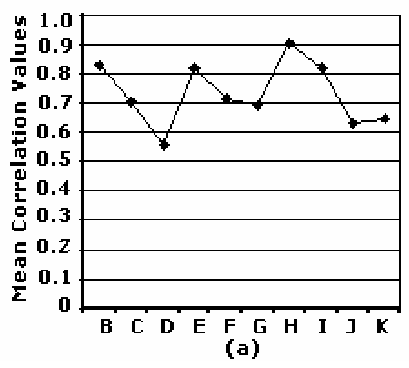 Figure: Comparison of Pearson Correlation vs. Lin's Similarity across different GO hierarchies (MF, BP, CC).
Critical Analysis & Conclusion
Takeaway
This paper serves as a seminal reminder that bioinformatics is not just a data science problem, but a knowledge integration problem. By using GO not just to "tag" clusters but to "build" them, we can achieve a higher level of biological fidelity.
Limitations & Future Work
The study relies on the quality of existing annotations. As the authors note, they excluded IEA (Inferred from Electronic Annotation) due to reliability concerns. Furthermore, as GO expands and changes its topology, the similarity values will shift.
Future research should look into Memetic Algorithms and multi-organism validation. However, the fundamental shift from "What the data says" to "What the biology knows" remains the paper's most significant contribution to the field of functional genomics.