
Beyond Vectors: Mastering Aspect Sentiment with Ontology-Driven Reasoning
Ontology-Driven Sentiment Analysis of Product and Service Aspects
The paper introduces a hybrid approach for Aspect-Based Sentiment Analysis (ABSA) that combines a domain-specific ontology with a Support Vector Machine (SVM) classifier. By leveraging structured knowledge to disambiguate sentiment and link it to specific product aspects, the method achieves over 80% accuracy on SemEval-2015 and SemEval-2016 benchmarks.
TL;DR
Determining whether "small" is a compliment or a complaint is a classic challenge in Sentiment Analysis. This paper presents a hybrid framework that bridges the gap between Statistical Machine Learning and Symbolic Reasoning. By using a restaurant domain ontology to catch context-specific nuances and a Support Vector Machine (SVM) as a fallback, the authors achieved top-tier results on SemEval datasets, proving that domain knowledge is the ultimate "cheat code" for small-data scenarios.
The Context-Dependency Trap
Most sentiment analysis models treat words as isolated units or fixed vectors. However, in the real world, sentiment is highly context-dependent. Consider these two sentences:
- "The price was small." (Positive)
- "The portion was small." (Negative)
For a standard Bag-of-Words (BoW) model, "small" is ambiguous. To solve this, the authors argue that we need a structured understanding of the domain — an Ontology.
Methodology: The Hybrid "Heracles" Framework
The core innovation lies in the three-tier classification of Sentiment Mentions within the ontology:
- Type-1 (Generic): Words like "good" or "bad" that carry the same weight regardless of the aspect.
- Type-2 (Aspect-Specific): Words like "delicious" which inherently imply a specific category (Food/Sustenance).
- Type-3 (Context-Dependent): Ambiguous words like "small" where a reasoning engine must link the property to the aspect to determine polarity.
Architecture of Reasoning
The system follows a "Rule-First, Model-Second" logic. It first attempts to resolve sentiment via semantic axioms in the ontology. If the ontology finds only positive or only negative signals, it commits to that choice. If signals are mixed or absent, the SVM backup takes over.
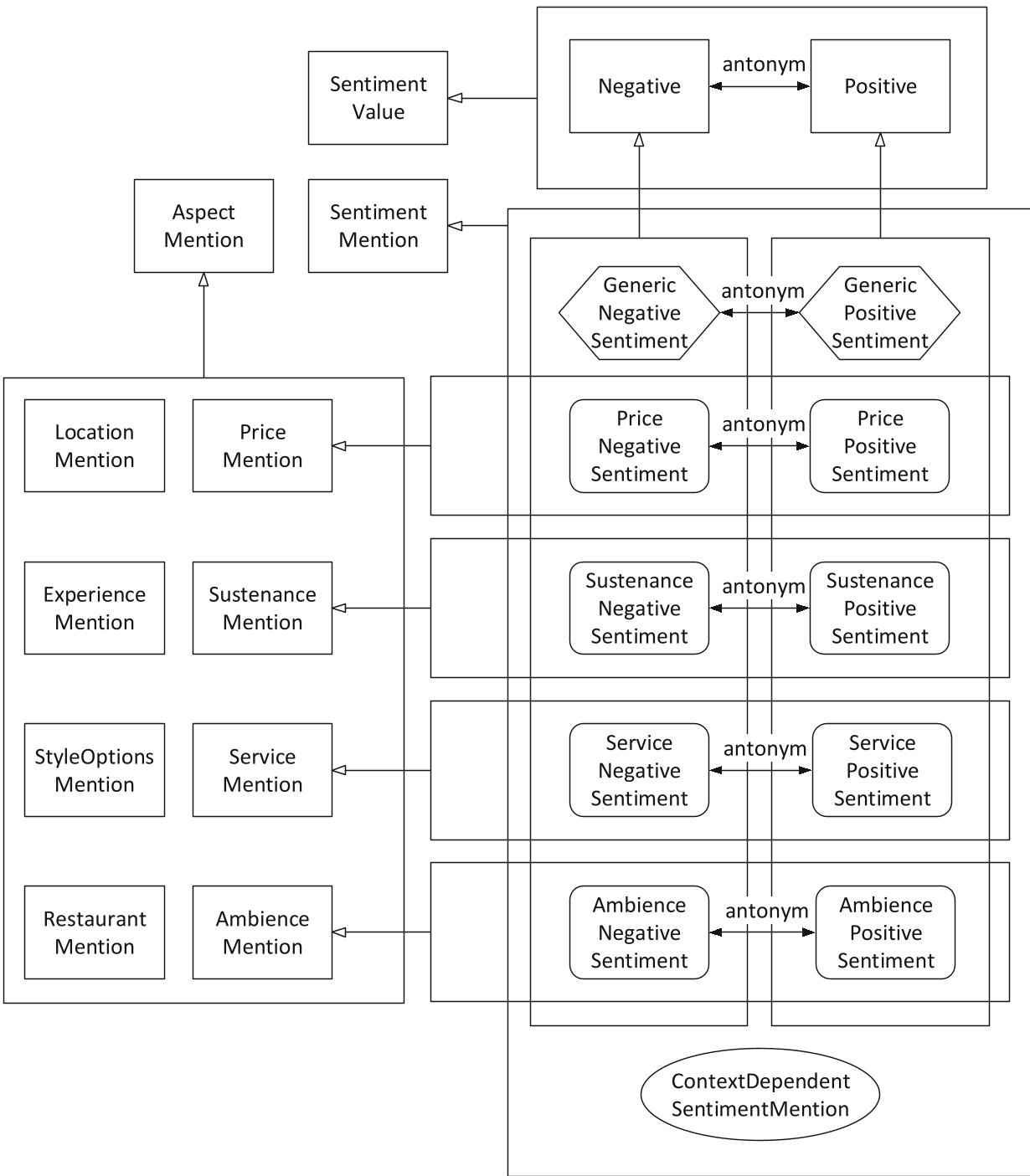 Figure 1: Schematic overview of the ontology classes including AspectMention and SentimentValue.
Experimental Results: Knowledge as a Data Multiplier
The experiments on SemEval-2015 and 2016 Restaurant datasets yielded impressive conclusions:
- Data Efficiency: The "Ont+BoW" hybrid outperformed the pure statistical baseline (BoW) most significantly when training data was scarce. This suggests that the ontology acts as an "inductive bias" that guides the model when data-driven evidence is weak.
- High Precision: When the ontology was able to make a decision, it was significantly more accurate than the SVM.
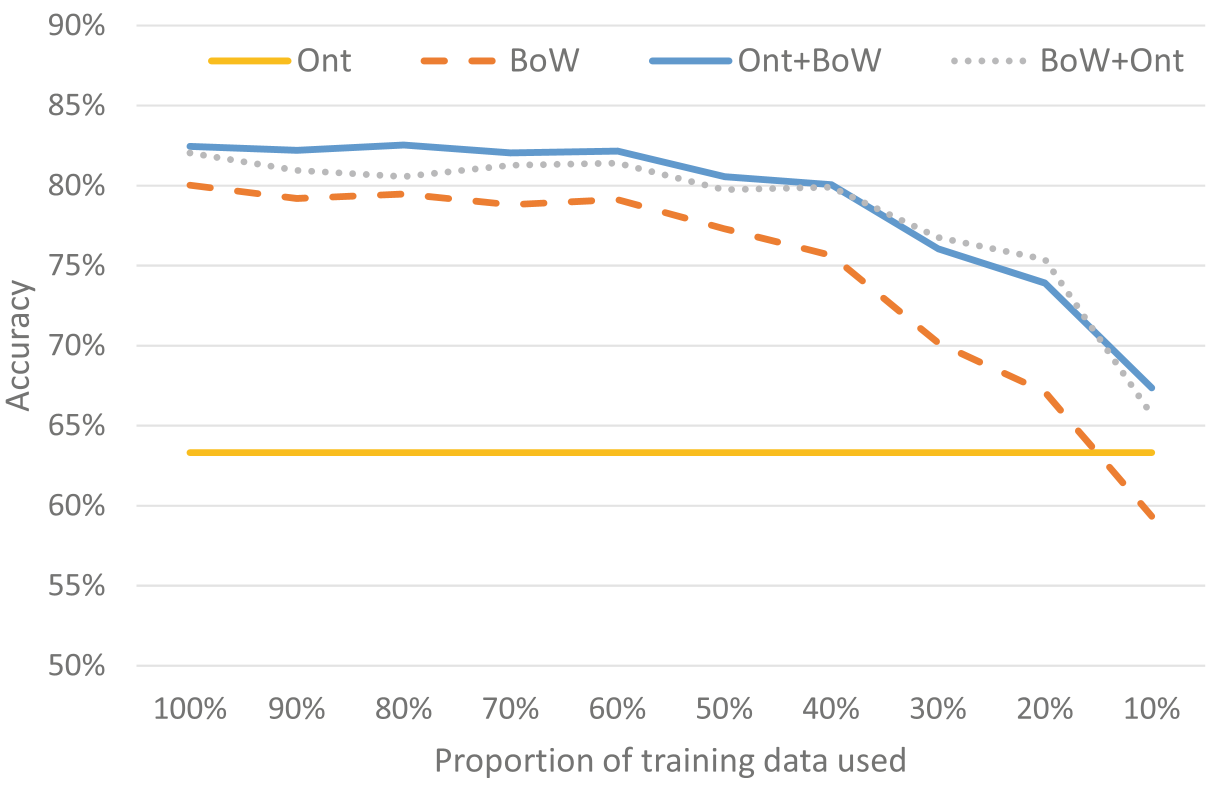 Figure 2: Performance gains of hybrid methods across different training data volumes.
Competitive Edge
While the system didn't participate in the original SemEval competition, its post-hoc results (82.5% and 86.0%) place it among the top 3 performing systems of that era, challenging even complex neural network submissions of the time.
Critical Insight & Future Outlook
The beauty of this approach is its interpretability. Unlike black-box neural networks, when the ontology labels a review as "negative," we can trace the exact logic: SmallPortion is-a NegativeSentiment.
Limitations: The manual construction of ontologies is labor-intensive. The authors acknowledge this and suggest future work should focus on automated ontology learning — using web-scraping and large-scale reviews to find aspect-sentiment pairs automatically.
As we move deeper into the era of Large Language Models (LLMs), this research serves as a reminder: structured domain knowledge remains a powerful tool for grounding models and handling the subtle "physics" of human language that patterns alone might miss.
Conclusion
This work demonstrates that the future of NLP isn't just about "more data," but about "smarter data structures." By combining the flexibility of SVMs with the precision of ontologies, Schouten and Frasincar have provided a blueprint for robust, domain-aware AI.