
High-Fidelity Ontology Embedding: Bridging Symbolic Logic and Neural Latent Spaces
An Ontology Embedding Approach Based on Multiple Neural Networks
This paper introduces a novel ontology embedding framework that utilizes multiple "expert" neural networks combined with an autoencoder to represent ontological concepts and instances as low-dimensional, continuous vectors. By modeling specific semantic relations and training via Noise Contrastive Estimation (NCE), the method achieves near-perfect semantic capturing across various biomedical ontologies.
TL;DR
Ontologies are the backbone of structured knowledge, yet they remain "undigestable" for most deep learning architectures. This paper presents a specialized pipeline that transforms these symbolic structures into dense, low-dimensional vectors using a hierarchy of expert neural networks and autoencoders. The result? A representation that retains 99%+ of the original semantic accuracy while being computationally efficient.
The Gap Between Logic and Vectors
In the world of Knowledge Engineering, ontologies provide a rigorous vocabulary of a domain. However, Deep Learning thrives on continuous vector spaces, not discrete "subject-predicate-object" triples. The challenge is two-fold:
- Structural Complexity: How do we preserve the rigid hierarchy (is-a, part-of) in a flexible vector space?
- Dimensionality Explosion: Large ontologies lead to sparse, high-dimensional matrices that are difficult to train and store.
Methodology: The "Expert Network" Approach
The authors propose a modular architecture that treats each semantic relation as a unique learning task.
1. Relation-Specific Experts
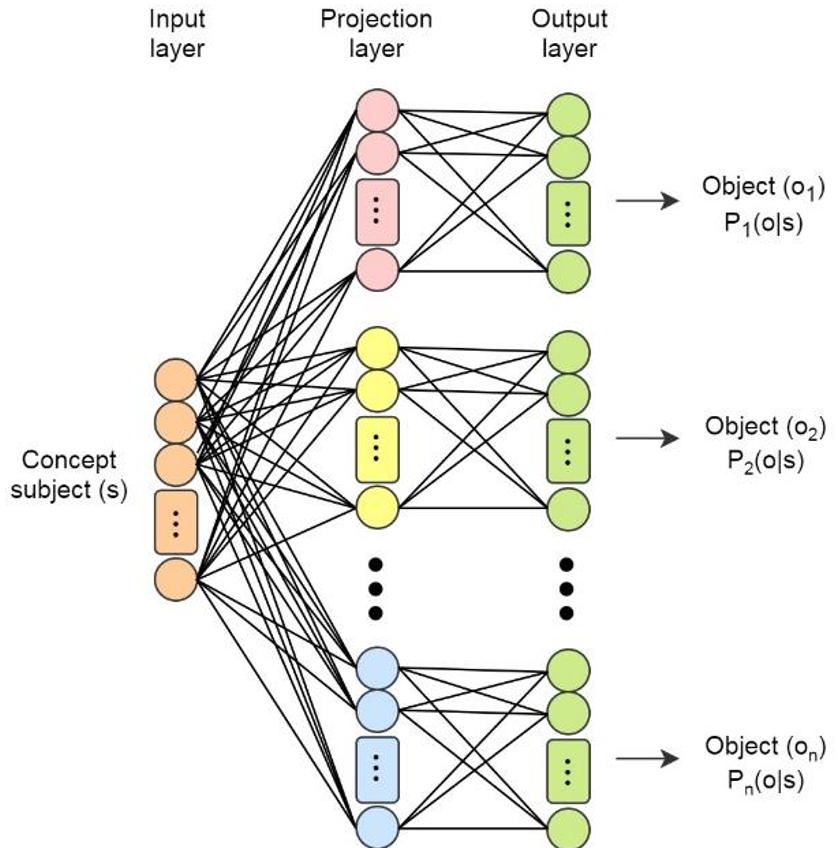
Instead of training one giant model for the whole ontology, the authors implement Multiple Neural Networks. Each network is an "expert" on a specific relation . If a triple exists, the expert learns the conditional probability .
To avoid the "softmax bottleneck" (the cost of normalizing over thousands of entities), they use Noise Contrastive Estimation (NCE). This converts a complex density estimation problem into a binary classification task: "Is this object a real relation or just random noise?"
2. Weighted Concatenation and Compression
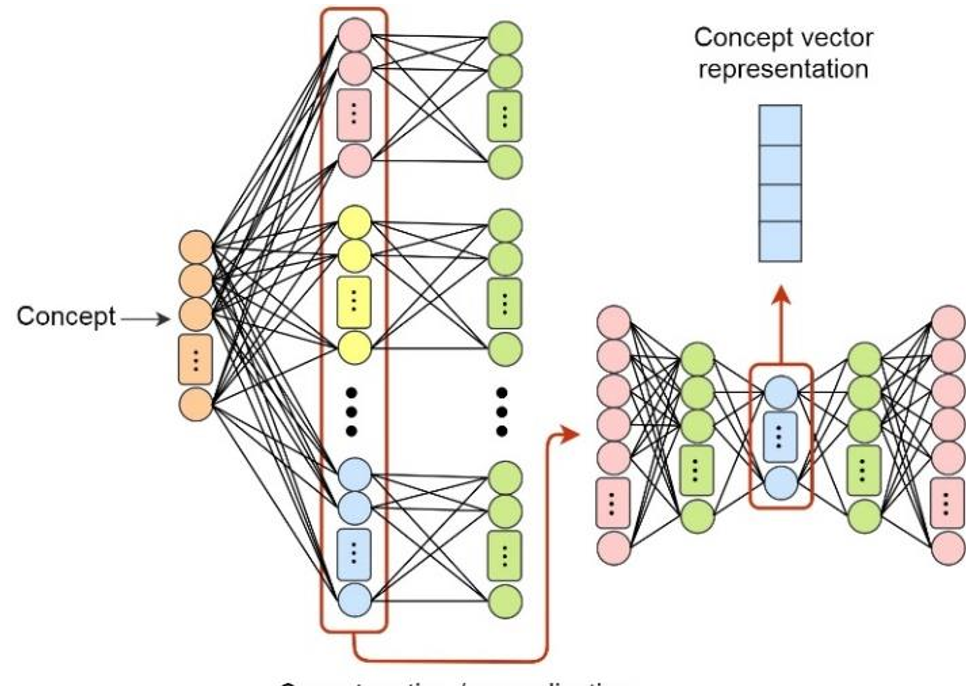
Once each expert network generates a feature vector , they are concatenated. To ensure that frequent, high-impact relations carry more weight, the authors allocate more dimensions to them. Finally, an Autoencoder is used to compress this potentially sparse concatenated vector into a dense representation.
Experimental Results: Precision Medicine and Beyond
The model was stress-tested using 20 different biomedical ontologies from the BioPortal repository.
Visualizing Semantics
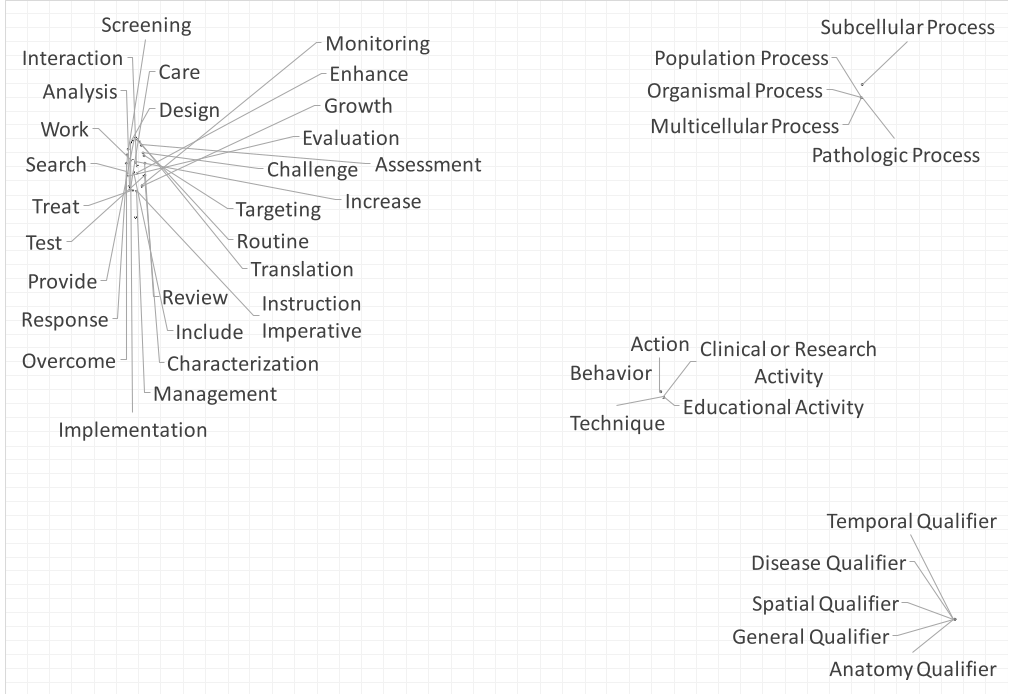
Using t-SNE projections on the PREMEDONTO (Precision Medicine) ontology, the authors demonstrated that the model naturally clusters concepts like "Activities," "Actions," and "Biological Processes" without being explicitly told to do so.
Quantitative SOTA
The performance was measured using Jaccard similarity between the "ideal" semantic neighbors in the ontology and the "predicted" neighbors in the vector space (via Cosine and Euclidean distance).
- Average Accuracy: 0.993 (Cosine) / 0.994 (Euclidian).
- Dimensionality Reduction: Ontologies with thousands of concepts were successfully compressed into vectors as small as 2 to 20 dimensions.
Critical Insight: Why This Matters
The core achievement of this paper is the preservation of inductive bias. By structuring the neural networks to mirror the relational logic of the ontology, the authors ensure that the resulting vector space is not just a statistical "hallucination" but a mathematically sound reflection of the source knowledge.
Limitations & Future Work
While the accuracy is impressive, the paper primarily focuses on static ontologies. Modern knowledge graphs are dynamic and evolve over time. Furthermore, while the vectors are dense and efficient, the paper does not explore how these embeddings perform in downstream "black box" tasks like link prediction or clinical decision support.
Conclusion
This work provides a robust blueprint for anyone looking to integrate expert knowledge systems with neural frameworks. By leveraging expert networks and NCE, we can finally treat ontologies not as rigid files, but as fluid, computable dimensions in a latent space.