
SemML: Bridging the Semantic Gap in Bosch’s Industrial Machine Learning
Ontology-Enhanced Machine Learning: A Bosch Use Case of Welding Quality Monitoring
The paper introduces SemML, a semantically-enhanced system for Machine Learning (ML) pipeline development within industrial manufacturing, specifically for Bosch's electric resistance welding quality monitoring. It leverages ontologies and Reasoned Ontology Templates (OTTR) to address communication barriers between diverse experts and automate data integration and feature engineering.
TL;DR
At Bosch, developing Machine Learning (ML) for welding quality monitoring isn't just a data problem—it's a communication and integration nightmare. This paper presents SemML, a framework that uses ontologies and ontology templates to turn industrial domain knowledge into machine-readable metadata. By treating ontologies as a "lingua franca," Bosch reduced the friction between engineers and data scientists, achieving nearly 93% modeling accuracy even among users with zero semantic technology background.
The Problem: The 80% "Janitor Work" in Industry 4.0
In modern automotive manufacturing, a single car body can have up to 6,000 welding spots. Predicting the quality of these welds is vital, but Bosch identified that 80% of development time is wasted on:
- Communication (C1): Managers, engineers, and data scientists speak different "languages."
- Data Integration (C2): Heterogeneous sensor data names (e.g., "Current" vs "Amp_Val") require manual mapping for every new factory.
- Generalizability (C3): A model built for Resistance Spot Welding (RSW) rarely works for Hot-Staking (HS) without massive re-engineering.
Methodology: Semantics as the "Auto-Pilot" for ML
SemML introduces a multi-layered architecture that injects semantic intelligence into every stage of the CRISP-DM-like workflow.
1. The Core Ontology & OTTR Templates
Instead of asking engineers to write complex OWL logic, SemML uses Reasoned Ontology Templates (OTTR). Experts fill out simple forms (e.g., defining a "Welding Gun"), and the system generates the underlying formal axioms. This acts as the Uniform Communication Model (Requirement R1).
2. Automated Feature Reasoning
This is where the magic happens. The ML Annotator uses an ontology reasoner to infer how a raw data column should be treated.
- Input: A data column mapped to
operationCurveCurrentValue. - Inference: The system recognizes this belongs to the
TimeSeriesclass in the QMM-ML Ontology. - Action: It automatically triggers time-series feature engineering (e.g., calculating Max, Min, or Segmentation) without the data scientist writing custom code for that specific dataset.
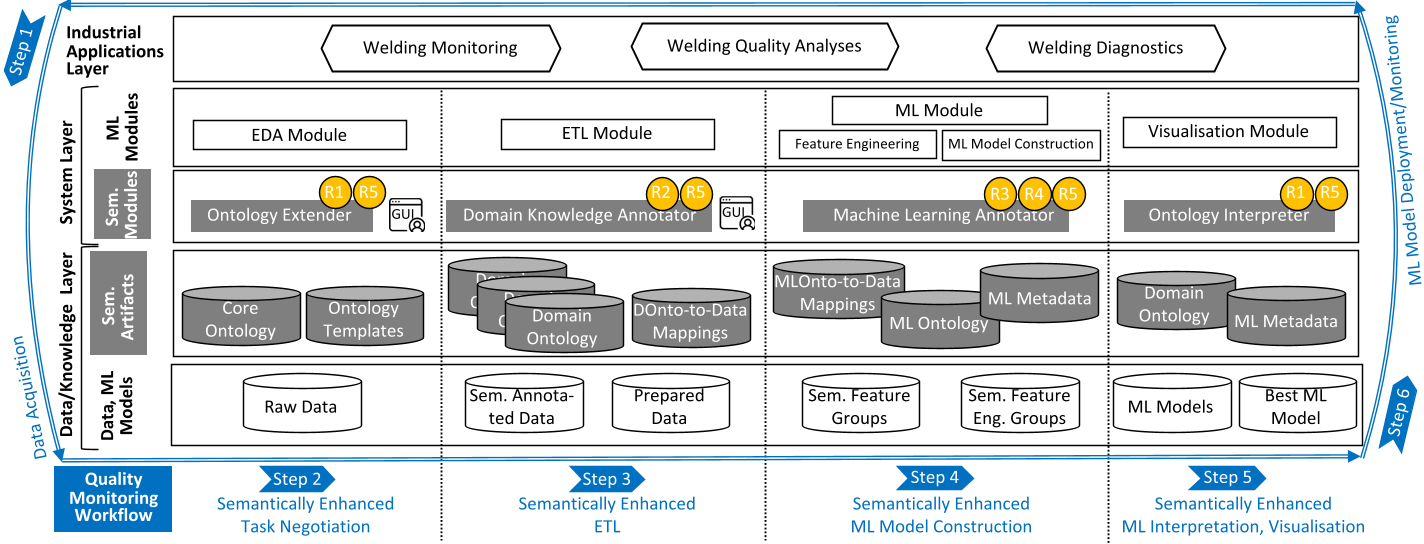 Figure 1: The SemML architecture showing the flow from raw industry applications to semantic and ML layers.
Experiments: Performance at the Bosch Factory
The authors validated SemML through two core experiments involving 14 experts across two different welding processes (RSW and HS).
- Effectiveness: Domain experts achieved 90% Final Correctness in creating ontologies and 100% Correctness in mapping data.
- Efficiency: The average time to define a new process term was only 50 seconds, with a clear "learning curve" where users got faster as they reused templates.
- Low Barrier to Entry: Critically, there was no significant correlation between knowledge of semantic technologies and performance. Only domain expertise mattered, proving the tool is accessible to factory-floor engineers.
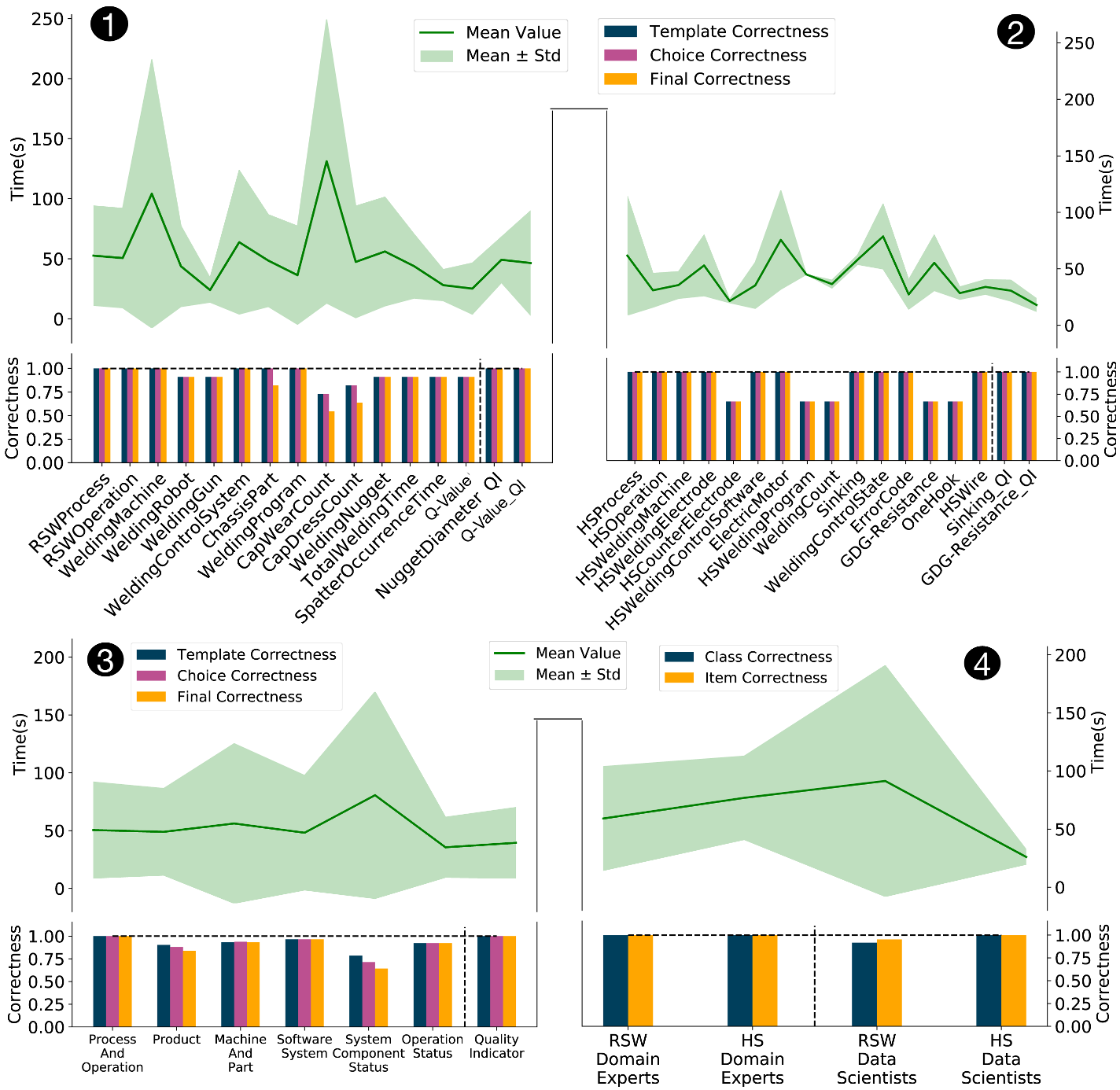 Figure 2: User study results showing that as users become familiar with templates, time-per-task decreases while accuracy remains high.
Critical Insight: Why This Matters
The standard approach to ML is h: X -> Y (mapping features directly to labels). This is brittle. SemML proposes X -> Domain Ontology -> ML Ontology -> Y.
By introducing these middle layers, Bosch has successfully decoupled the physics of the process from the math of the model. If a new sensor is added, the engineer updates the domain ontology, and the system automatically knows how to update the ML features.
Conclusion & Outlook
SemML represents a shift from "Ad-hoc AI" to "Systematic AI" in manufacturing. While the current study focused on communication and integration (C1 & C2), the ongoing work aims to prove that these semantic mappings significantly improve the transferability of models between different manufacturing plants—the holy grail of industrial AI.
Key Limitation: The setup of the initial Core Ontology is still "onerous and time-consuming." However, once the foundation is laid, the marginal cost of adding new machines or processes drops significantly.