
Ontology Enhancement: Bridging the Gap Between Logic and Empirical Data
Ontology Enhancement through Inductive Decision Trees
The paper introduces an algorithm for "Ontology Enhancement through Inductive Decision Trees," a technique to enrich manually created ontologies with probabilistic rules derived from empirical data. By using the NBTree algorithm, it transforms external datasets into decision tree branches represented as OWL2 rules, effectively grounding abstract semantic concepts in real-world observations.
TL;DR
Ontologies are the backbone of the Semantic Web, but they are often too rigid or biased when manually constructed. This paper presents a methodology to inductively enhance ontologies by mining external datasets using Decision Trees. By converting data patterns into probabilistic OWL rules, the authors provide a way to ground abstract concepts (like "Small Cat") in empirical measurements (height, weight), significantly improving the accuracy of ontology matching.
The Problem: The "Ivory Tower" of Manual Ontologies
Traditional ontologists define domains based on theoretical knowledge. While rigorous, this approach suffers from:
- Lexical Ambiguity: Differentiating a "Tiger" from a "Panther" requires more than just a label; it requires physical thresholds that are rarely captured in basic hierarchies.
- Subjective Bias: Different experts might classify the same specimen differently based on their specific research focus.
- Lack of Uncertainty: Standard Description Logic (DL) is often "crisp"—an object either belongs to a class or it doesn't. Real-world data is messy and overlapping.
The authors argue that for ontologies to be truly useful in fields like geology or commerce, they must be "grounded" in data.
Methodology: From Data Clusters to Semantic Regions
The core innovation is the Ontology Extension Algorithm. It works by treating the ontology hierarchy as a roadmap for a supervised learning task.
1. Database Preparation
The process begins by "flattening" the ontology hierarchy into a denormalized database. Every record in the dataset is labeled not just with its leaf-level class (e.g., Siamese), but with every parent class in the chain (e.g., HouseCat -> Felinae -> Mammal).
2. Inductive Tree Learning (NBTree)
The algorithm utilizes NBTree, a hybrid between decision trees and Naive Bayes. Unlike a standard tree that gives a "Yes/No" result, NBTree provides a Bayesian probability () for each branch.
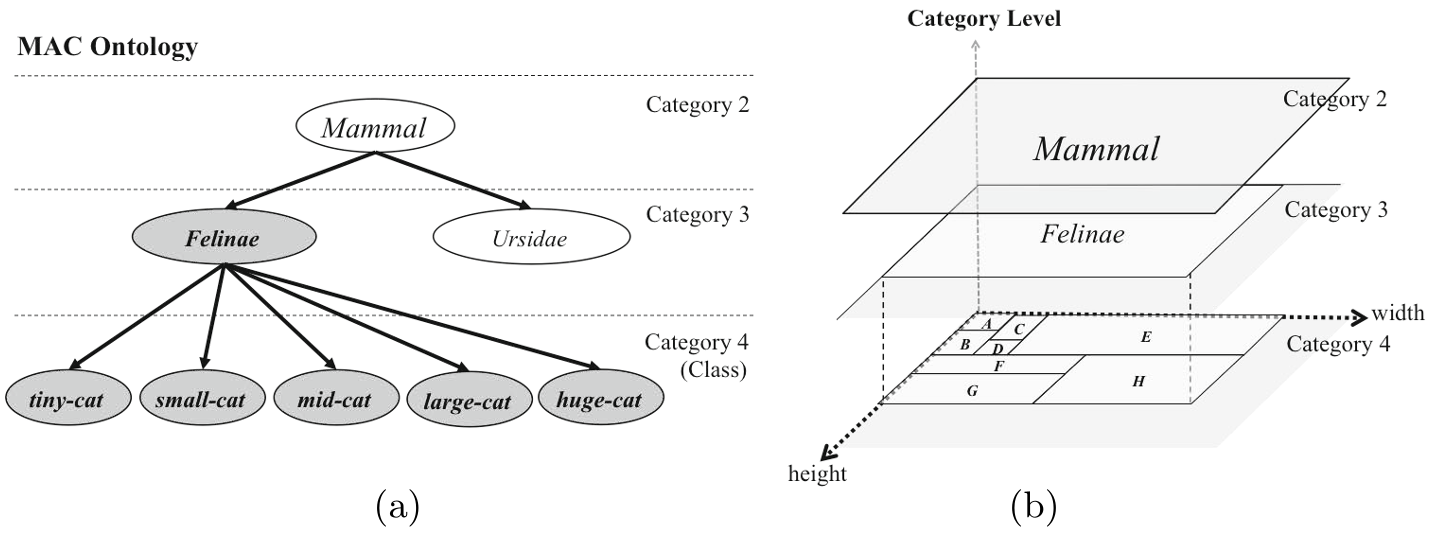 Figure 1: Visual representation of how sub-classes (C4) are subsumed by super-classes (C3) within a 2-dimensional attribute space.
3. Defining "Regions" and "Characteristics"
A Region (Reg) is defined as a specific branch of the tree (e.g., Height > 10.5 AND Width <= 2.5). The sum of these regions creates a Concept Characteristic, a multi-dimensional "footprint" of a semantic concept in the physical data space.
Experimental Insight: The Feline Commerce Use Case
The authors tested this on two simulated feline ontologies: MAC (Mats for Cats) and CAP (Cats as Pets). While the ontologies used different terminologies, the underlying data for "Tiny-cat" or "Mid-cat" showed significant cluster overlap when mapped into 2D regions.
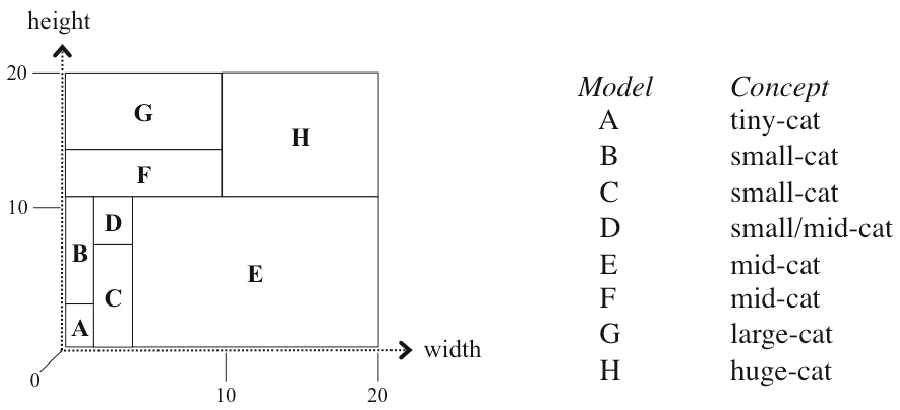 Figure 2: The generated NBTree for the MAC ontology, utilizing Height and Width to differentiate feline sub-classes.
Key Results:
- Accuracy: The Bayesian models achieved a probability () of up to 0.96 for distinct concepts.
- Matching: By comparing the "Regions" of the MAC ontology with those of the CAP ontology, the system could automatically identify that "Model A" in MAC was equivalent to "Small-cat" in CAP based on empirical attribute distribution, even if the naming conventions differed.
Critical Analysis: Strengths and Limitations
Strengths:
- Grounding: It moves ontology matching from a linguistic problem to a statistical one.
- Flexibility: The use of the OWL2 RL profile allows these rules to be integrated into standard reasoners.
Limitations:
- Data Distribution Bias: As noted in Definition 5, the NBTree is sensitive to class imbalance. If 95% of your data is "House Cats," the tree may ignore "Lions" entirely.
- Dimensionality: The "Region" concept is primarily illustrated in 2D; scaling this to hundreds of attributes (as seen in complex biological ontologies) may lead to the "curse of dimensionality."
Conclusion
This paper provides a robust framework for data-driven ontology evolution. Instead of manually debating whether a river is a "stream" or a "creek," we can let the data define the boundary. By embedding decision trees into OWL rules, the authors have successfully bridged the gap between the messy world of empirical data and the structured world of formal logic.