
CompFlow: Bridging the Semantic Gap in Human-Machine Computation Workflows
An Ontology for Human-Machine Computation Workflow Specification
This paper introduces CompFlow, an ontology-based framework and process for specifying, instantiating, and executing human-machine computation workflows. By leveraging Description Logics (OWL), it enables the creation of semantically enriched, re-usable, and flexible task structures suitable for complex domains like Crowdsourcing and Ambient Assisted Living (AAL).
TL;DR
CompFlow is a novel ontological framework that brings the power of Description Logics to workflow management. Unlike traditional "black-box" workflow engines, CompFlow embeds domain knowledge and task semantics directly into the process definition, allowing humans and machines to collaborate seamlessly in complex environments like smart homes and micro-tasking platforms.
Academic Positioning: This work bridges the gap between Semantic Web technologies (OWL-S) and Business Process Management (BPM), moving from rigid procedural code to flexible, knowledge-aware execution.
The Problem: Workflows Without "Meaning"
Historically, workflow languages like BPEL or YAWL have been the backbone of industrial automation. However, they suffer from a "semantic void." They can tell a system when to execute a task, but they cannot describe what the task actually represents in the real world.
When we introduce human workers into the mix—as seen in Crowdsourcing or Ambient Assisted Living (AAL)—this lack of semantics becomes a bottleneck. How do we ensure a machine understands the context of a human response? How can we reuse a specific task logic across different applications? The author's insight is that ontologies are the missing link: by treating a workflow as a conceptual model rather than just a sequence of code, we gain the benefits of automated reasoning and high re-usability.
Methodology: The Anatomy of CompFlow
The CompFlow process is divided into three distinct phases: Definition, Instantiation, and Execution.
1. The Meta-Model (Upper Ontology)
The architecture relies on a fixed "Upper Ontology" that defines the universal vocabulary of a workflow:
- Activity-Definitions: The building blocks (Tasks, Events, Gateways).
- Worker-Definitions: Identifying whether the actor is a Human or a Machine.
- Interface-Definitions: Specifically modeling how information is presented (e.g., Voice vs. GUI).
2. Architecture and Logic
By using Description Logics, the framework allows for Abstract Workflow Definitions. These capture pure domain knowledge without being tied to a specific run-time instance. When a real-world event occurs (like a fall detected in an elderly care home), the engine instantiates a Concrete Workflow based on these semantic rules.
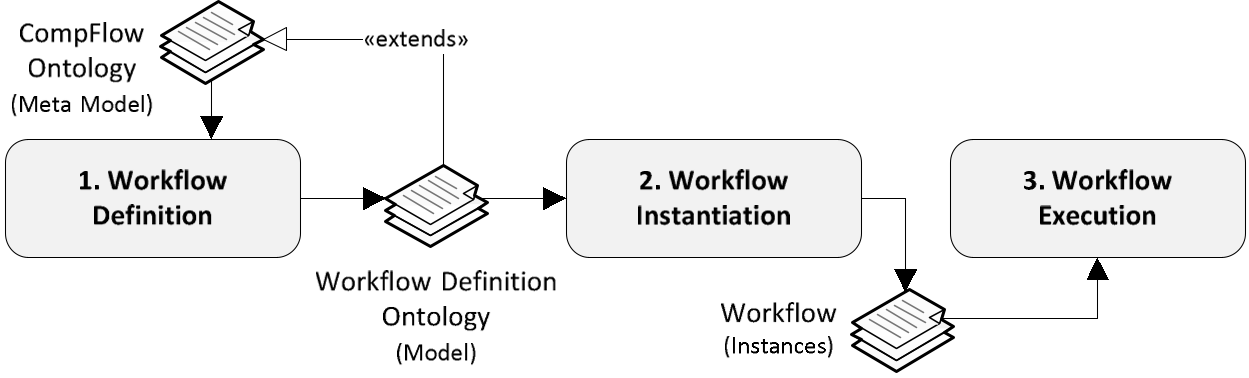 Figure 1: The three-phase process of CompFlow: Definition, Instantiation, and Execution.
Real-World Application: Ambient Assisted Living (AAL)
To prove the framework's utility, the authors implemented a scenario for researchers monitoring user interactions in a smart environment.
- The Trigger: A user interacts with a "Help" option (Event).
- The Task: The system must ask a feedback question.
- The Flexibility: Because the interface is modeled as an ontological entity, the system can dynamically choose to deliver the question via Speech if the user is moving, or via a Smartphone GUI if they are stationary.
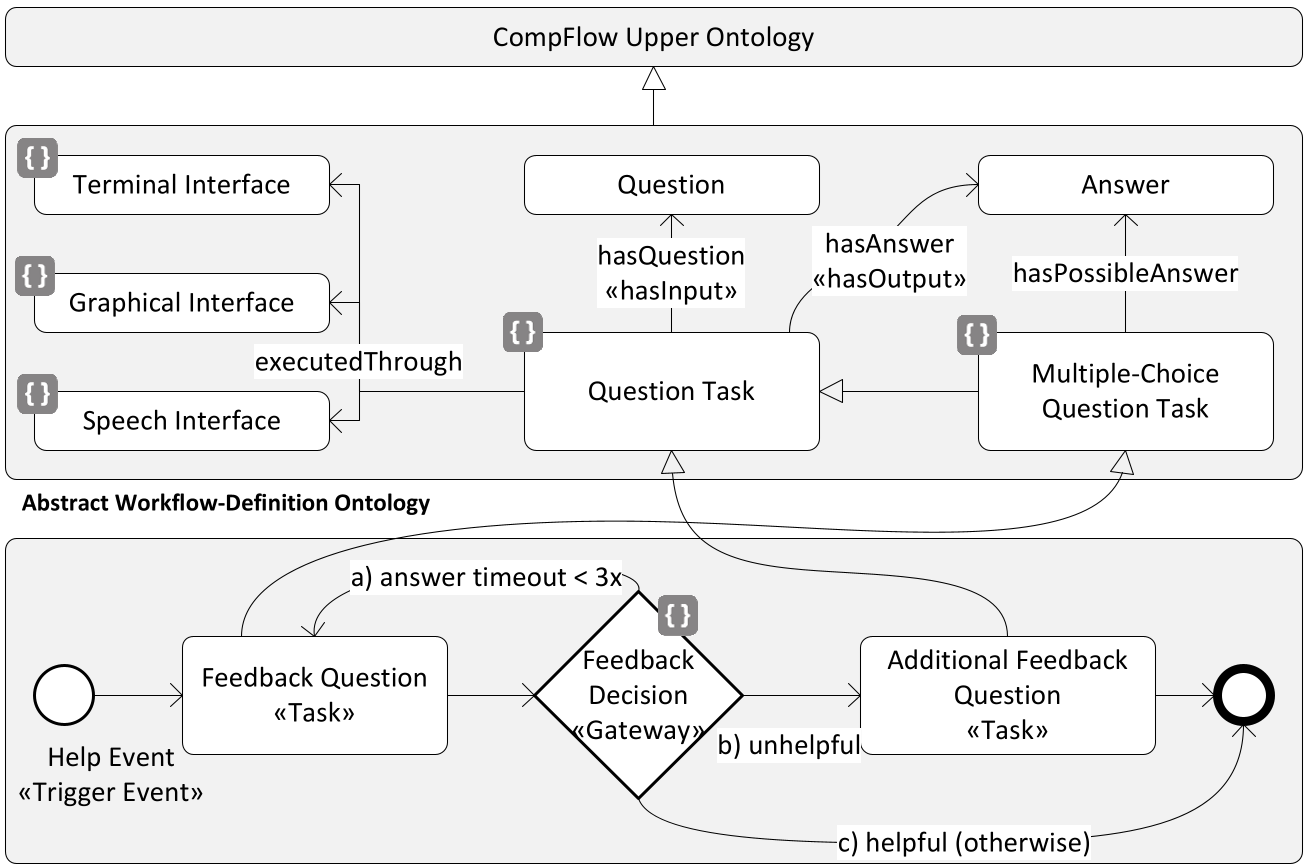 Figure 2: Implementation of the "Help Option" scenario using the CompFlow ontology.
Critical Insight: Why This Matters
The true innovation of CompFlow isn't just "using an ontology"—it's the formalization of interfaces and worker roles as first-class citizens in the logic.
- Decoupling Logic from UI: By making "Interfaces" part of the ontology, developers can change how a human interacts with the system without rewriting the underlying business logic.
- Reasoning-Ready: Using TBox (concepts) and ABox (instances) allows for future integration of automated reasoners that could potentially "check" if a workflow is logically sound before it even runs.
Limitations and Future Work
While CompFlow provides a robust structural foundation, it currently relies on "code blocks" for complex gateway logic (e.g., evaluating a specific condition). The authors aim to move toward a more declarative approach where the gateway logic itself is derived from the ontology, further reducing the need for traditional programming.
Conclusion
CompFlow represents a significant step toward Intelligent Workflow Management. By treating tasks as semantically enriched entities, it paves the way for more sophisticated human-AI collaboration systems that are not just "programmed" but "instructed" through domain knowledge.