
Structuring the AI Mind: An Ontology Framework for Machine Learning
Ontology knowledge-based framework for machine learning concept
This paper presents an ontology-based knowledge framework designed to standardize and organize machine learning (ML) concepts. The researchers developed a structured database covering four domains: learning types, techniques, evaluation metrics, and applications, achieving a precision of 99.65% in information retrieval.
TL;DR
As machine learning (ML) evolves at a breakneck pace, the information describing it remains fragmented across thousands of disparate sources. This paper introduces a formal Ontology Knowledge-Based Framework that transforms ML concepts from raw text into a structured, machine-readable hierarchy. By mapping the DNA of ML—from learning paradigms to specific evaluation metrics—the authors achieved near-perfect retrieval precision (99.65%).
The Motivation: Escape the "Information Silo"
Despite the popularity of AI, learning human-comparable concepts remains a challenge for machines because knowledge is stored in "silos"—textbooks, websites, and papers that use different terminologies. The authors identified a critical gap: there was no unified semantic structure to answer complex queries like "Which evaluation metrics are specific to unsupervised clustering in medical image processing?"
The goal was to move beyond keyword search toward Semantic Understanding, allowing academic institutions to set up skill-based education tracks and researchers to identify current trends in application domains.
Methodology: The Semantic Architecture
The researchers adopted a Top-Down ontology design to ensure logical consistency. The framework is divided into two phases:
1. The Building Phase
The ontology was structured into four primary application domains:
- Learning Type: Supervised, Unsupervised, Semi-supervised, and Reinforcement Learning.
- Learning Techniques: Categorizing algorithms like SVM, Neural Networks, and Decision Trees.
- Learning Evaluation: Metrics such as Precision, Recall, F-measure, and MAPE.
- Applications: Domain-specific use cases like Face Recognition and Medical Diagnosis.
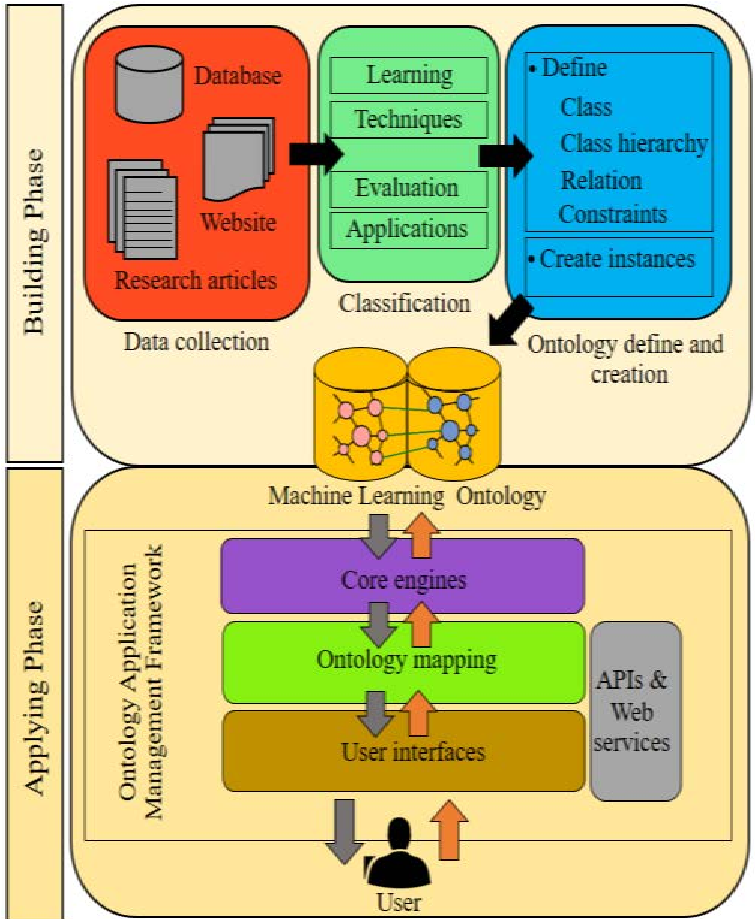 Figure 1: The Machine Learning Ontology Knowledge-Based Framework showing the flow from data collection to user interface.
2. The Applying Phase
To make this data searchable, the authors used:
- Apache Jena: A Java framework for building Semantic Web and Linked Data applications.
- RDF Graphs: To represent the complex, interconnected relationships between algorithms and their results.
- OAM Framework: Providing the user interface for complex querying.
Experiments: Testing Semantic Intelligence
The framework's performance was measured by its ability to correctly retrieve information based on 20 distinct question sets.
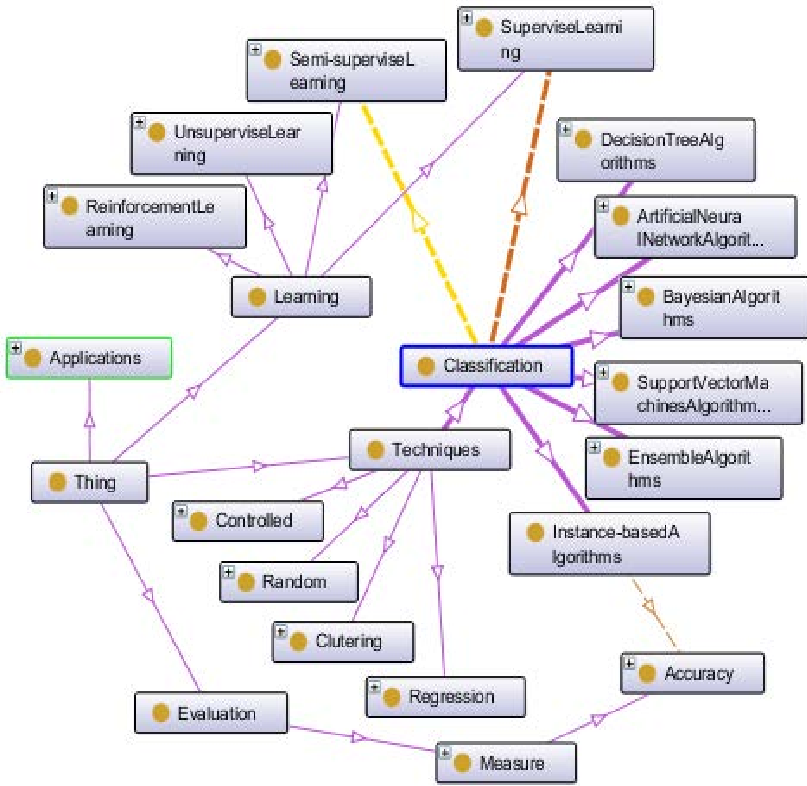 Figure 2: Visualizing the "Techniques" class within the ontology, showing how specific algorithms are nested.
Key Results:
- Precision (99.65%): Nearly every result returned by the system was relevant to the query.
- Recall (95.90%): The system successfully found almost all relevant information within the database.
The precision remained high across various categories (Classification, Regression, Clustering), proving that the "Rules" and "Constraints" defined in the building phase were robust enough to handle multifaceted queries.
Critical Analysis & Future Outlook
This work is a significant step toward Open Science. By formalizing the ML domain, it allows for the creation of "Expert Systems" that can advise students or engineers on which model to pick for a specific dataset.
Limitations: As of its publication, the framework is largely dependent on the manual curation of knowledge from books and articles. In the age of Large Language Models (LLMs), the next logical step would be Automated Ontology Population, where an AI reads new arXiv papers daily to update the hierarchy in real-time.
Conclusion: By treating Machine Learning not just as a set of tools, but as a structured field of knowledge, this paper provides the blueprint for more intelligent, context-aware AI research platforms.