
Bridging the Semantic Gap: Leveraging Traceability for Automated Ontology Learning
Ontology learning and its application in software-intensive projects
This paper presents a semi-automated ontology learning framework designed specifically for software-intensive projects. By leveraging existing user-defined trace links combined with web-mining and NLP, the method achieves SOTA performance in trace retrieval, reaching over 90% recall and 80% precision.
TL;DR
In software-intensive systems, the "term mismatch" problem—where a requirement says "access rights" but code says "privileges"—strangles the accuracy of automated tools. This paper proposes a semi-automated pipeline that turns existing trace links into a goldmine for Ontology Learning. By combining NLP, web-mining, and machine learning, the author achieves over 90% recall in trace retrieval tasks, effectively teaching machines the "hidden language" of domain experts.
Context: The Problem of Term Mismatch
Most automated software engineering tools rely on syntax—the literal words used in a document. However, human experts understand the semantics. In a medical device project, an expert knows that a "User ID" is a type of "Credential," even if the words share no common letters.
Current SOTA methods for trace retrieval often fail to reach 90% recall because they lack this domain-specific intelligence. While general ontologies like WordNet exist, they are useless for technical domains (e.g., they won't tell you that an "OBM" is located on an "Automobile segment").
Methodology: Turning Trace Links into Knowledge
The core insight of this research is a clever reversal of the standard workflow: instead of using an ontology to find trace links, the author uses existing trace links to learn the ontology.
1. Candidate Fact Extraction
The system identifies noun and verb phrases from source and target artifacts connected by a trace link. These pairs are considered "candidate facts" (e.g., "access right" is-a "privilege").
2. The Evidence Gathering Engine
To filter the thousands of potential pairs, the system uses a Random Forest classifier fed by four distinct knowledge sources:
- LSP Matching: Searching for patterns like "X such as Y" in domain documents.
- Association Rule Mining: Statistically checking how often terms co-occur across the project.
- Topic Modeling: Determining if terms belong to the same conceptual cluster.
- Semantic Relatedness: Checking existing (though limited) lexical databases.
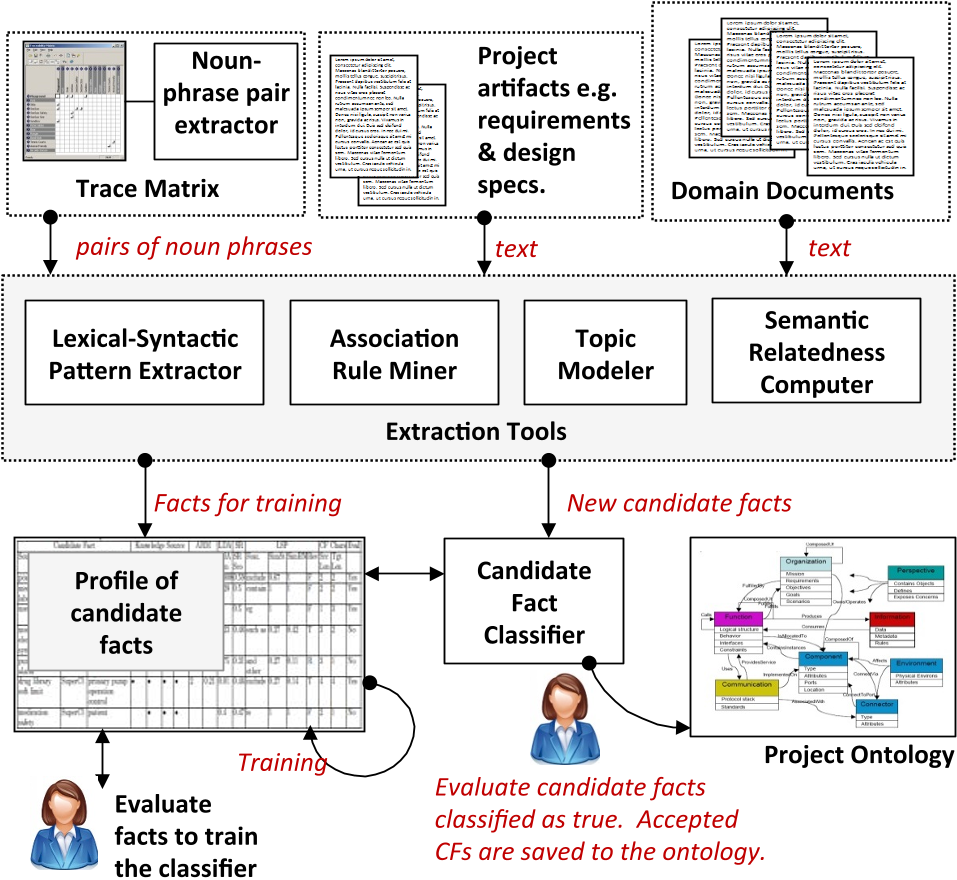 Figure 1: The system architecture for Ontology Learning.
From Knowledge to Action: The DoCIT Solution
The learned ontology isn't just a static list; it's operationalized via DoCIT (Domain-Specific Intelligent Traceability). DoCIT uses the ontology to build Action Frames—structured representations of what a requirement actually does.
| Requirement Artifact | Action | Recipient | Theme |
|---|---|---|---|
| "The OBM shall support reception of WSM" | reception | OBM | WSM |
By matching these frames using the ontology's hierarchical relationships (e.g., "OBM is part of Segment"), the system can prove a link exists even when the vocabulary differs.
Experimental Results
The approach was validated across transportation and healthcare domains.
- Traceability Performance: Achieved >90% recall and >80% precision, crushing traditional term-based models.
- Ontology Reuse: In a "cold-start" scenario, an ontology learned from one healthcare project (CCHIT) improved the Mean Average Precision (MAP) of nine other projects by over 30%.
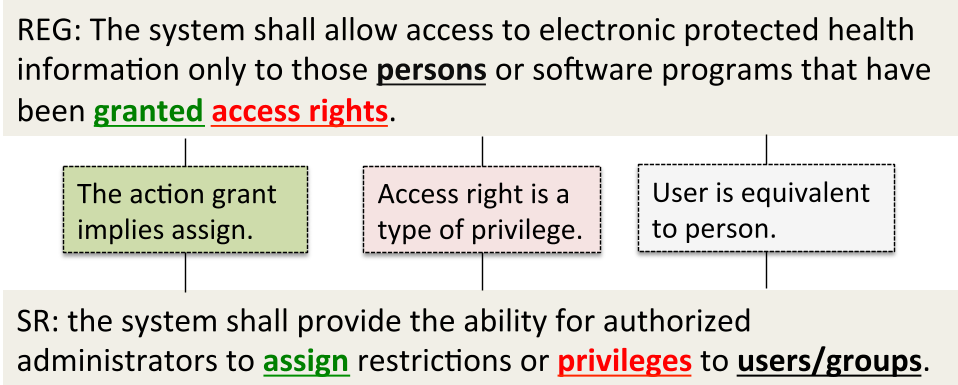 Figure 2: How domain facts bridge the gap between regulations and system requirements.
Critical Insight & Future Outlook
The primary strength of this work is its Inductive Bias—it assumes that the answers to domain complexity are already hidden in the historical data of the project itself.
Limitations: The "semantic drift" in automated bootstrapping remains a risk, and the system still requires a "human-in-the-loop" to validate candidate facts.
Future Work: The transition toward Search-Based Software Engineering (SBSE) to automatically learn link heuristics represents the next frontier. As we move into 2026, integrating these ontologies with Large Language Models could solve the "cold start" problem entirely by providing the structured reasoning LLMs often lack in niche technical fields.
Takeaway for Practitioners: Don't just archive your trace links; use them as training data to build a corporate memory that makes your next project 30% more efficient.