
Ontology Learning: Breaking the Knowledge Acquisition Bottleneck for the Semantic Web
Ontology Learning for the Semantic Web
The paper introduces a comprehensive semi-automatic framework for "Ontology Learning" designed to facilitate the construction of the Semantic Web. It presents the Text-To-Onto system, which integrates multi-strategy machine learning and natural language processing (NLP) to extract concepts and relations from unstructured and semi-structured Web data.
TL;DR
The Semantic Web's biggest hurdle isn't the technology of data exchange, but the sheer volume of manual labor required to define formal ontologies. Alexander Maedche and Steffen Staab propose a semi-automatic Framework for Ontology Learning that transforms unstructured text and legacy data into structured knowledge using a cooperative human-AI cycle.
The Core Challenge: The Acquisition Bottleneck
For the Semantic Web to function, machines need a shared vocabulary (ontologies). Traditionally, these were built manually—a process that is "tedious and cumbersome." The authors identify three critical questions often asked by engineers:
- Can we develop it quickly?
- Is it too difficult?
- How can we be confident it's "right"?
Existing tools were designed for structured databases, but the Web is a "messy" frontier of HTML, XML, and free text. To solve this, the authors moved from manual modeling to Ontology Learning, a discipline that mines semantic gold from the "syntactic Web."
Methodology: The Ontology Learning Cycle
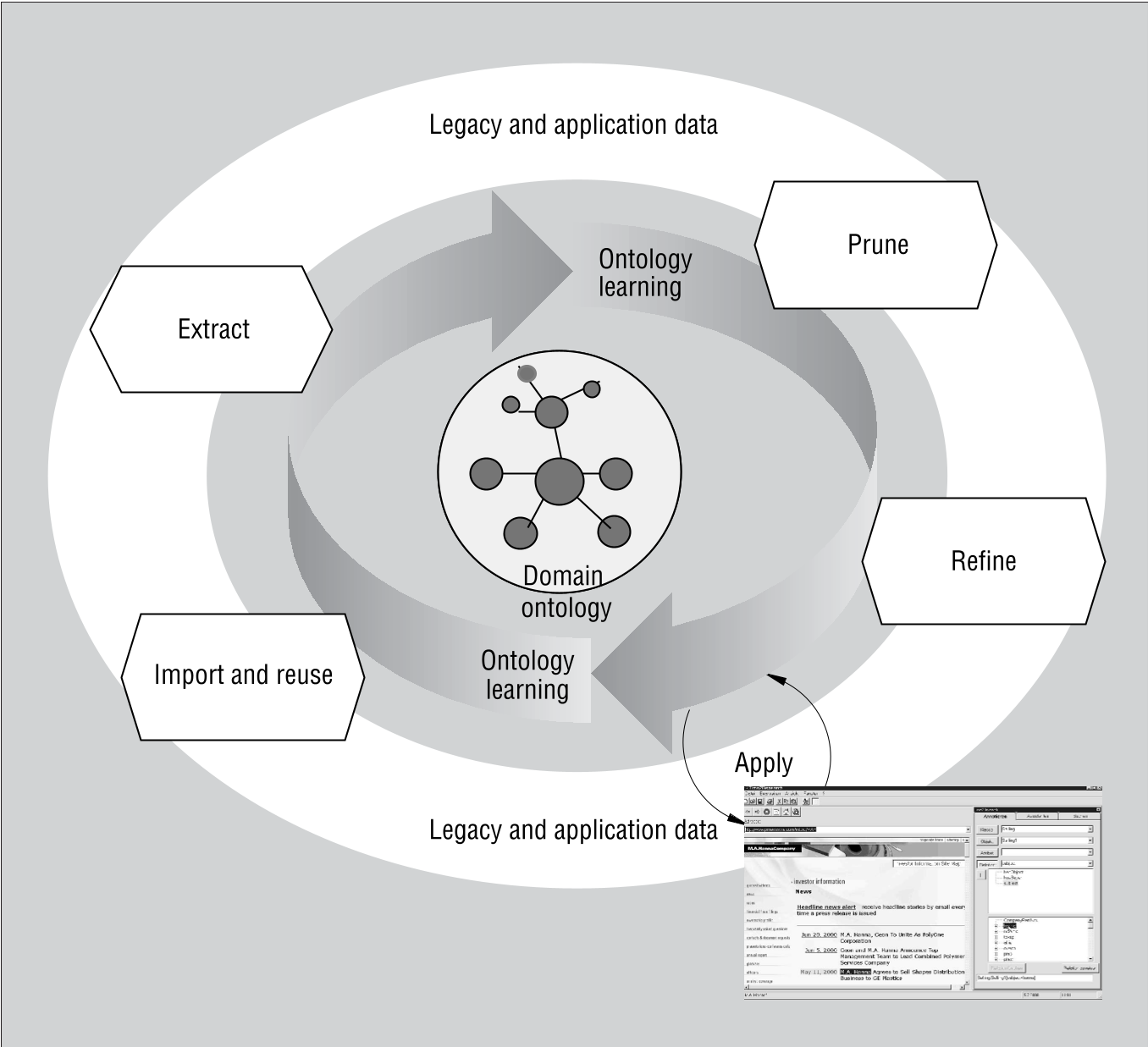
The researchers argue that knowledge acquisition shouldn't be fully automatic (which is intractable) but "cooperative." They define a five-stage lifecycle:
- Import/Reuse: Merging existing RDF schemas or legacy structures.
- Extraction: The heavy lifting—using NLP and machine learning to find concepts and relations.
- Pruning: Removing "out-of-focus" elements to keep the model lean and relevant.
- Refinement: Fine-tuning the ontology based on application-specific data.
- Evaluation: Validating the model against the target application.
The Architecture: Text-To-Onto
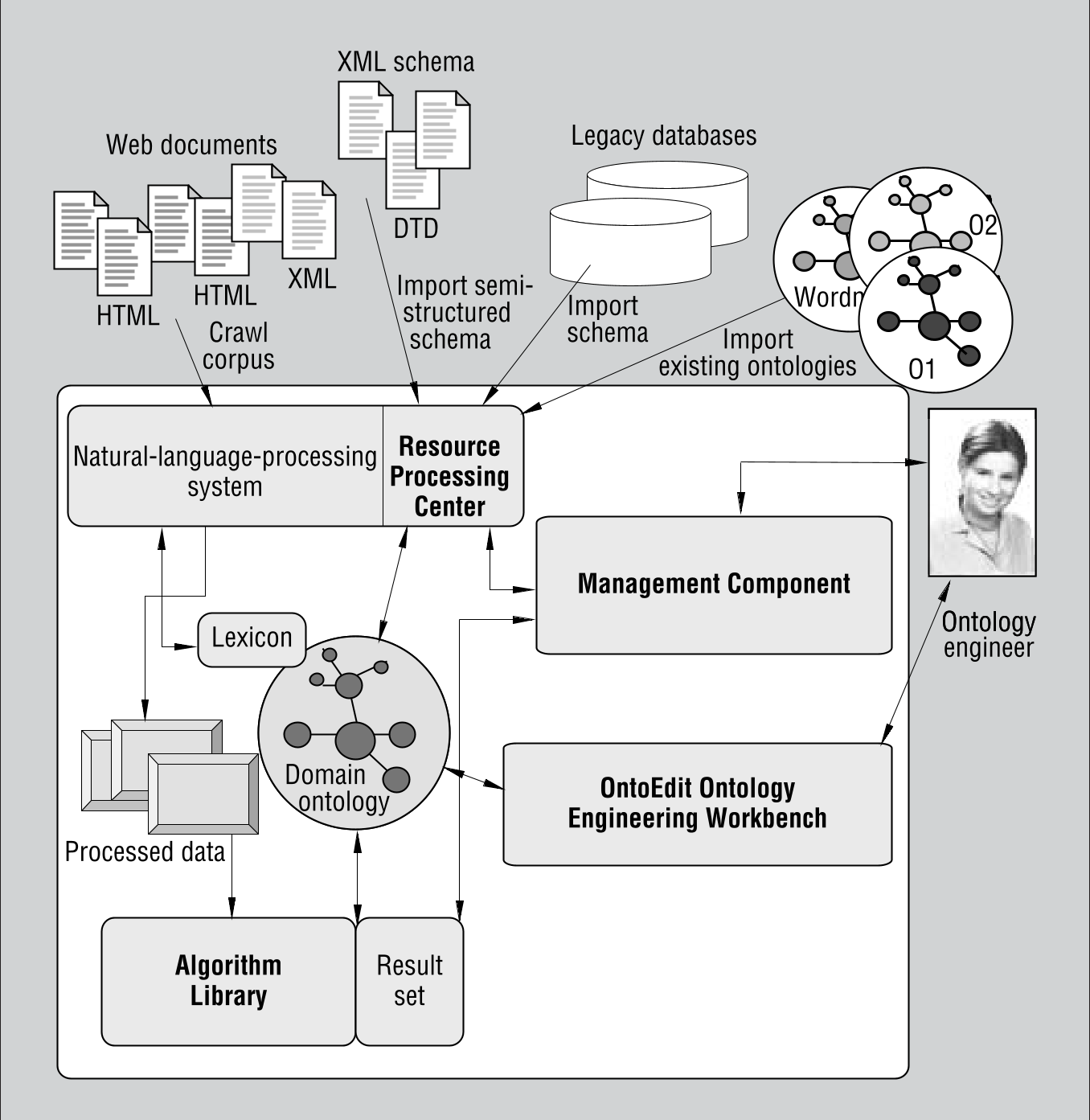
The implemented workbench, Text-To-Onto, sits between raw data and formal representation. It uses a tiered architecture:
- Resource Processing: Uses the SMES system for German text processing (tokenization, POS tagging, chunk parsing).
- Algorithm Library: Contains a diverse set of tools including association rule mining, clustering, and dictionary parsing.
Technical Deep Dive: Association Rules and Lexical Separation
Two technical insights set this work apart:
- Lexical vs. Conceptual: The framework separates "Lexical Entries" (strings like 'school') from "Concepts" (the abstract idea). This allows the system to merge ontologies where the same word means different things in different contexts—a vital feature for the decentralized Web.
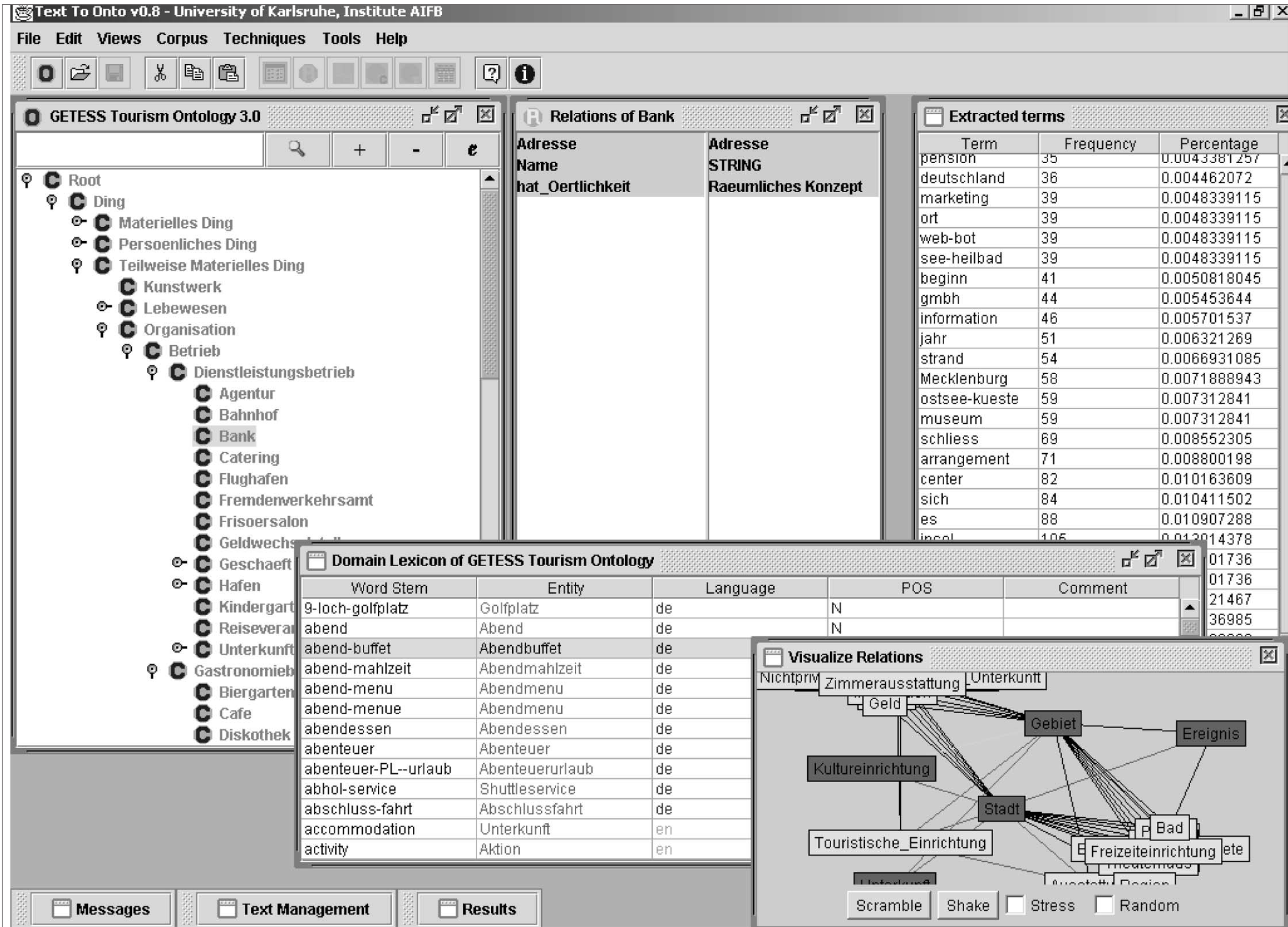
- Discovery of Relations: Most tools only find "is-a" hierarchies. This framework uses Generalized Association Rules to find non-taxonomic relations. For example, by analyzing patterns in text, it can suggest that a "Festival" is usually "located in" an "Area," prompting the engineer to create a new predicate.
Experimental Evidence
The authors demonstrated the framework's versatility across multiple domains:
- Dictionary Parsing: Automatically generated concept hierarchies from an insurance company's machine-readable dictionary by identifying head-modifier relationships in definitions.
- Text Clustering: Integrated systems like Asium to cluster nouns based on their syntactic relationship to verbs, effectively learning subcategorization frames.
Strategic Insights & Conclusion
The paper concludes that completeness is the enemy of progress. We don't need "perfect" ontologies; we need "cheap and good enough" models that can evolve.
Key Takeaways for Future Research:
- Amoeba-like Ontologies: As the Web grows, ontologies will no longer have clear boundaries; they will import and refer to each other dynamically.
- Beyond RDF(S): Future systems must move beyond simple conceptual structures to learn complex Axioms (logical constraints), which remains one of the hardest challenges in the field.
While written in the early days of the Semantic Web, this paper’s focus on the "acquisition bottleneck" remains startlingly relevant in the era of Knowledge Graphs and Large Language Models.