
Beyond the Bug: Modeling the "How" of Learning via Strategy Ontologies
Development of an Ontology of Learning Strategies and its Application to Generate Open Learner Models
The paper introduces a Multi-Strategy Machine Learning System (MSMLS) that utilizes a formal ontology of 30+ learning strategies to diagnose student errors. By generating "Plausible Justification Trees," it identifies whether a student's mistake stems from domain knowledge gaps or the mis-selection of a learning strategy (e.g., misapplying Analogy instead of Induction), ultimately creating an Open Learner Model (OLM) for metacognitive reflection.
TL;DR
Existing Intelligent Tutoring Systems (ITS) are great at telling a student what they got wrong, but they rarely explain how the student learned it incorrectly. This paper presents a Multi-Strategy Machine Learning System (MSMLS) that uses a comprehensive ontology of learning strategies to detect "learning bugs." By exposing "Plausible Justification Trees" to the student, the system transforms the "black box" of the student's mind into an Open Learner Model for self-improvement.
The "Why": Why Procedural Diagnosis Isn't Enough
In educational technology, "Buggy Models" have long been the gold standard for tracking student errors. However, these models are often static libraries of predefined mistakes. They treat the symptom (the error) rather than the disease (the flawed learning strategy).
The author's core insight is that students are like machine learning agents. If a student misapplies an analogy or over-generalizes from an example (Induction), they will consistently produce errors. If we can model the selection of these strategies using an ontology, we can pinpoint exactly where the student's learning process deviated from the ideal path.
Methodology: The Architecture of Metacognition
The heart of the MSMLS is an Ontology of Machine Learning Strategies. This isn't just a list; it’s a rich data structure containing 26 attributes for each strategy, including Applicability-conditions, Constraints, and Generates.
1. The Strategy Ontology
The system identifies over 30 distinct strategies, such as:
- Induction (Training instances, observation, discovery)
- Analogy
- Abduction
- Chunking
2. Plausible Justification Trees
When a student is presented with a problem (e.g., multi-digit subtraction), the system generates multiple trees. Each tree represents a "path" the student might have taken. One is the "Correct Tree," while others represent "Erroneous Trees" born from mis-selecting a strategy.
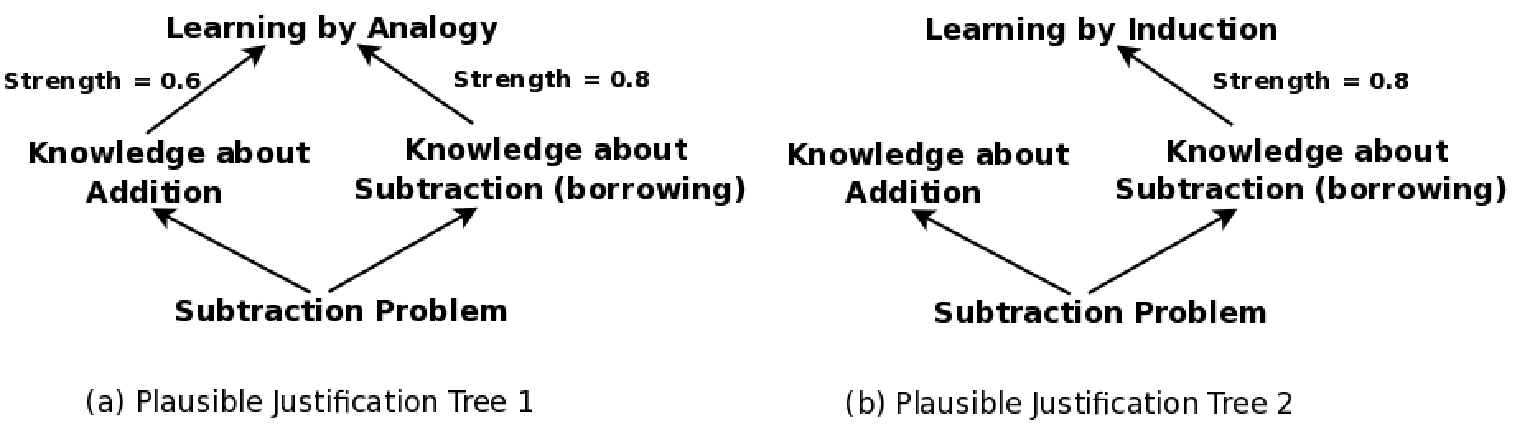 Figure 1: Comparison between a correct justification tree and an erroneous one influenced by an inappropriate analogy with Addition.
Experiential Evidence: The Subtraction Domain
The author tested the system on multi-digit subtraction, a classic benchmark for cognitive diagnosis.
- The Findings: Most student "bugs" are not random. They often stem from "Analogy interference." For instance, a student might incorrectly apply the logic of Addition (where you don't need to "decrement" a column) to Subtraction (where borrowing is required).
- Quantifying the Impact: The system successfully modeled 47 known buggy rules and demonstrated that by "opening" these trees to students, they could engage in metacognitive reflection—seeing their own "learning personality" compared to an expert's.
Critical Insight: The Value of "Opening" the Model
The most significant contribution of this work isn't just the diagnosis; it's the Open Learner Model (OLM). By externalizing the learning process:
- Neutralizing Noise: The system ignores "concept slips" (careless errors) because they don't fit into a coherent strategy tree.
- Formative Assessment: Students can see the "goal" (the ideal model) and their current "path," making the path to mastery explicit.
- Instructional Design: If many students share the same erroneous tree, it highlights ambiguities in the teaching material itself.
Conclusion & Future Outlook
While the current implementation relies on symbolic XLISP and property-lists, the underlying logic is a roadmap for modern AI in education. In an era of LLMs, the concept of Strategy Ontologies could be the key to moving beyond "stochastic parrots" toward AI tutors that truly understand the cognitive scaffolding of their human counterparts.
Takeaway: To teach someone effectively, you don't just correct their answer; you correct their way of learning.