
The e-Participation Ontology: Bridging the Gap Between Government Portals and Social Media
An ontology for next generation e-Participation initiatives
The paper introduces a formal e-Participation Ontology, a semantic framework designed to unify e-Participation initiatives across three perspectives: democratic process, project, and sociotechnical platform. It achieved a standardized, executable model (RDF/OWL) that bridges government-led and citizen-led participation, validated through case studies like the "Puzzled by Policy" EU initiative.
TL;DR
For over a decade, digital democracy has been split between formal government platforms and spontaneous social media debates. This paper presents a formal e-Participation Ontology that unifies these worlds. By providing an executable RDF/OWL framework, the authors bridge the gap between "government-led" initiatives and "citizen-led" spontaneous deliberation, creating a machine-readable foundation for the next generation of e-participation.
The "Duality" Crisis in Digital Democracy
Existing e-participation efforts often suffer from a fatal disconnect. On one side, we have formal, structured projects (e-consultations, voting); on the other, the "wild west" of social media where real political discourse actually happens.
The authors argue that prior models were static and fragmented. They described what e-participation is as a research domain but failed to provide the technical "glue" (interoperable data standards) to help these platforms talk to each other or to automate the monitoring of citizen-led discussions. This lack of a formal schema has hindered comparative analysis and the evolution of the field.
Methodology: The Integrated Model (IMeP)
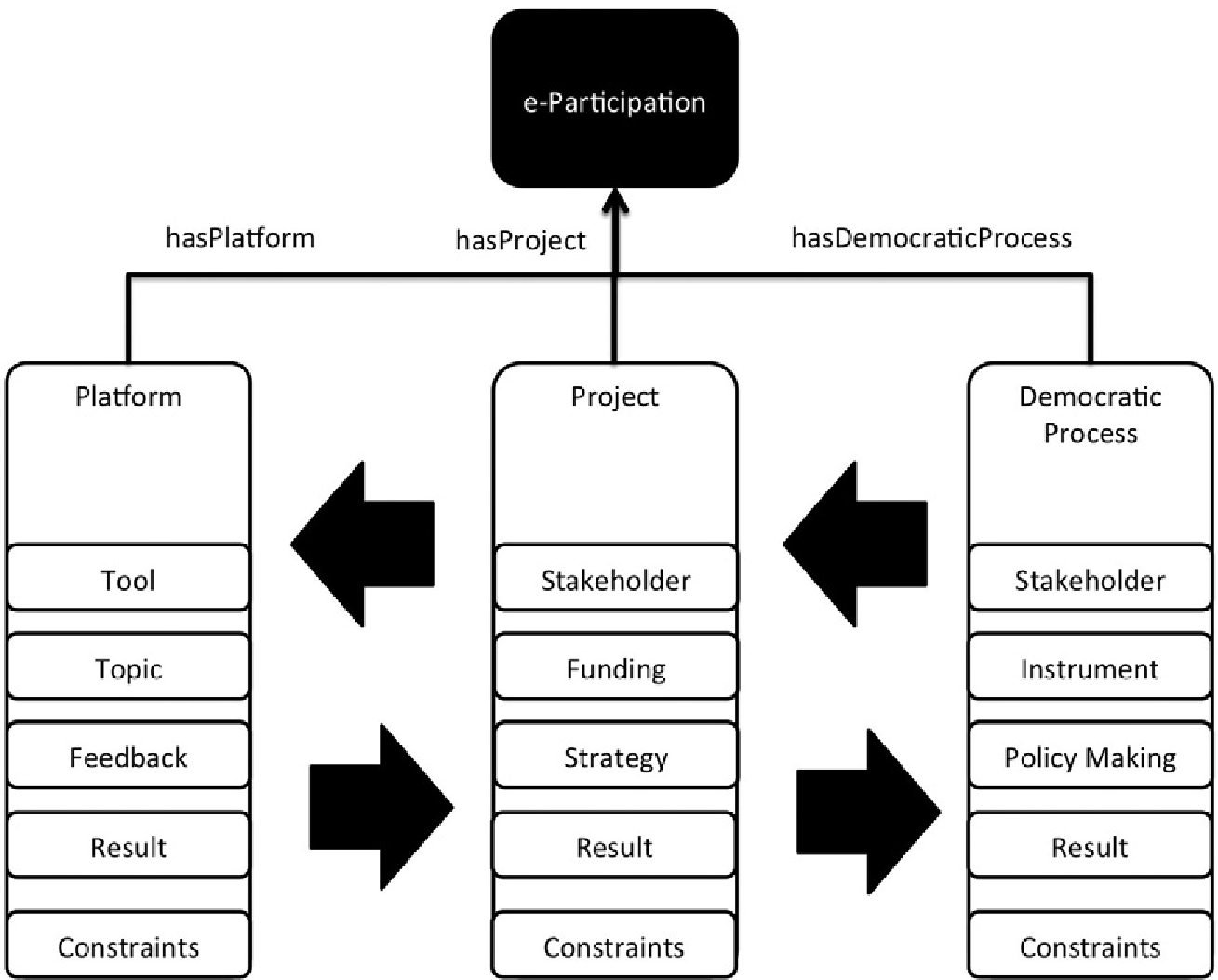
The research moves beyond simple flowcharts to a sophisticated sociotechnical model. Grounded in Giddens' Structuration Theory, the authors propose an "Integrated Model for e-Participation" (IMeP) that treats participation as a dynamic cycle of resource distribution between citizens and decision-makers.
The Three Perspectives
The ontology is built on three pillars:
- Democratic Perspective: The "Why" and "What" (legal triggers, policy domains).
- Project Perspective: The "When" and "How much" (funding, management, timeframe).
- Platform Perspective: The "How" (technical tools, discussion monitoring, automated summarization).
Core Innovation: Handling the "Duality"
Most platforms ignore what happens on Twitter or Facebook. This ontology explicitly includes classes for "Spontaneous citizen-discussion monitoring". By defining standardized relations between a formal deliberation topic and social media "back-links," the system allows governments to acknowledge and absorb bottom-up feedback into the official policy cycle.
Implementation & Validation
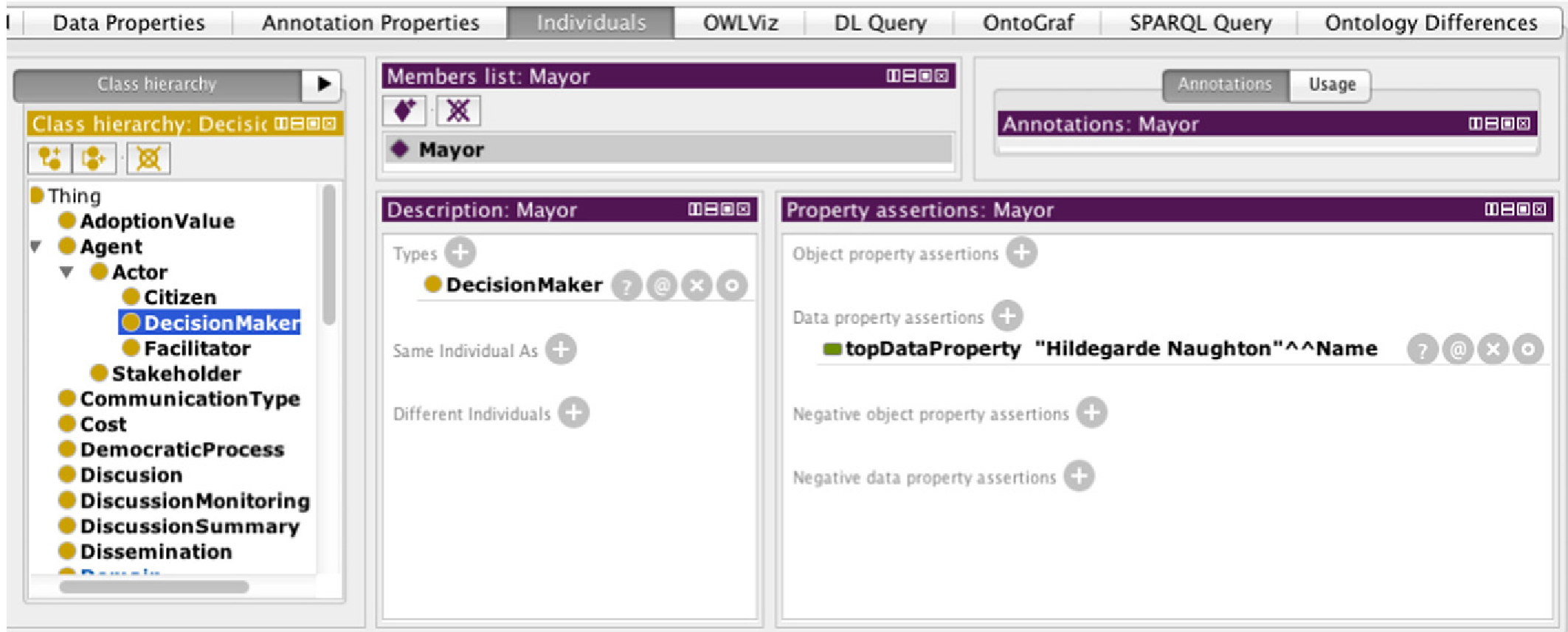
The authors implemented the ontology using RDF/OWL and validated it with the Protégé reasoning engine. They didn't just stop at theory; they applied the model to:
- The Galway Transportation Initiative: Mapping local stakeholders and press dissemination.
- Puzzled by Policy (EU Project): Comparing immigration-related pilots across different European nations.
Experimental Proof: A New Level of Transparency
By populating the ontology with real-world data, the researchers were able to quantify and compare the success of participation pilots. For instance, they discovered that the Spanish pilot of "Puzzled by Policy" outperformed others largely due to its integration with mainstream local newspapers—a fact made visible by the ontology’s detailed "Dissemination" and "Stakeholder" classes.
Critical Insight & Future Outlook
The true value of this work lies in its machine-processability. In an era of "infollution" (information pollution), having an ontology that allows computer agents to summarize, cluster, and link discussions across different platforms is vital.
Limitations: While the ontology is a robust "high-level" framework, it still requires specialized sub-ontologies for the linguistic nuances of political deliberation itself.
The Takeaway: Next-generation e-participation isn't about building a better website; it's about building a better data ecosystem where citizen voices—wherever they are expressed—can be formally ingested into the democratic process.