
OntoDM: Constructing a Heavy-Weight Backbone for Data Mining Investigations
Towards an Ontology of Data Mining Investigations
The paper presents OntoDM, a heavy-weight ontology designed to formalize the domain of data mining investigations. Aligned with the Ontology for Biomedical Investigations (OBI) and the Basic Formal Ontology (BFO), it provides a unified terminological framework for entities such as datasets, tasks, and algorithms to enable automated reasoning and standardized reporting.
Executive Summary
TL;DR: Data mining is rapidly evolving, yet it lacks a unified, formalized framework to describe its own processes and findings. The authors propose OntoDM, a rigorous ontology aligned with top-tier scientific standards (BFO and OBI). It moves beyond simple taxonomies to create a logic-based system capable of describing algorithms, datasets, and complex discovery scenarios in a way that machines can truly "understand" and reason over.
Background Positioning: This work represents a significant leap toward the "Automation of Science" by providing a standardized meta-language for the Knowledge Discovery in Databases (KDD) field, transitioning from ad-hoc task descriptions to a formal scientific ontology.
The Problem: The "Light-Weight" Metadata Trap
The field of data mining faces a paradox: while it excels at finding patterns in data, it struggles to organize its own internal knowledge. Current semantic representations for data mining are mostly light-weight. These are often:
- Task-specific: Built only for a single project or software (e.g., specific to WEKA or GRID services).
- Semantically Weak: They define a "is-a" hierarchy but lack the rigorous relational links (e.g., "realizes," "is-concretization-of") required for complex inference.
- Fragmented: No common language exists to allow an Intelligent Discovery Assistant (IDA) to search across different algorithm implementations effectively.
Methodology: The Architecture of Reasoning
The core innovation of OntoDM is its adherence to OBO Foundry principles, ensuring it is open, orthogonal, and utilizes a common formal language (OWL-DL).
1. The Three-Layer Algorithm Model
One of the most profound insights in OntoDM is the separation of an "algorithm" into three distinct facets to allow for multi-dimensional reasoning:
- Specification: The abstract, declarative logic (e.g., the C4.5 math).
- Implementation: The actual software code (e.g., J48 in WEKA).
- Application (Process): The concrete event where the code runs on a specific dataset with specific parameters.
2. Alignment with BFO and OBI
By aligning with the Basic Formal Ontology (BFO), OntoDM inherits a world-view that distinguishes between:
- Continuants: Objects that exist over time (materials, software, datasets).
- Occurrents: Processes that happen (the act of training a model).
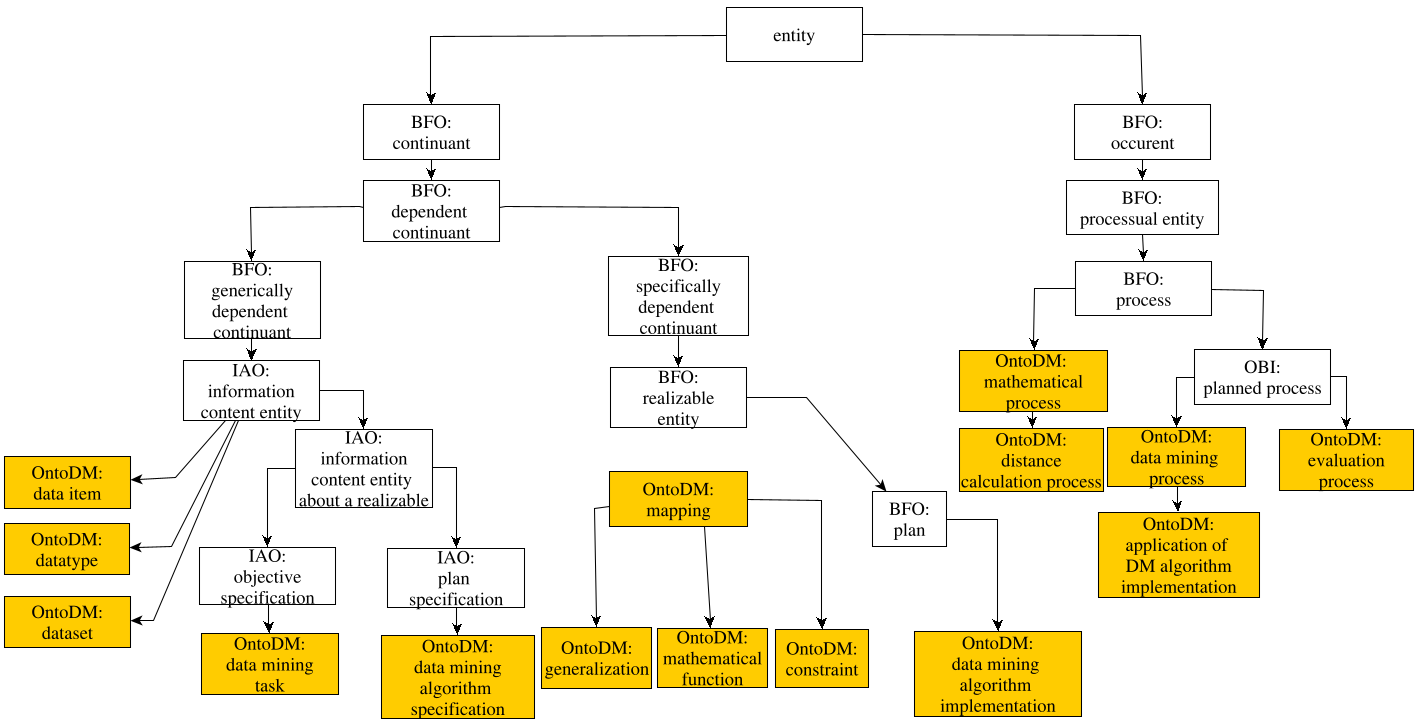 Figure 1: The Part of OntoDM class hierarchy illustrating its grounding in BFO and OBI.
Experiments and Practical Modeling
To prove the utility of OntoDM, the authors modeled the C4.5 Decision Tree algorithm. This modeling isn't just a label; it defines how the implementation weka.J48 realizes the C4.5 algorithm specification and how the application of that algorithm achieves the objective of predictive modeling.
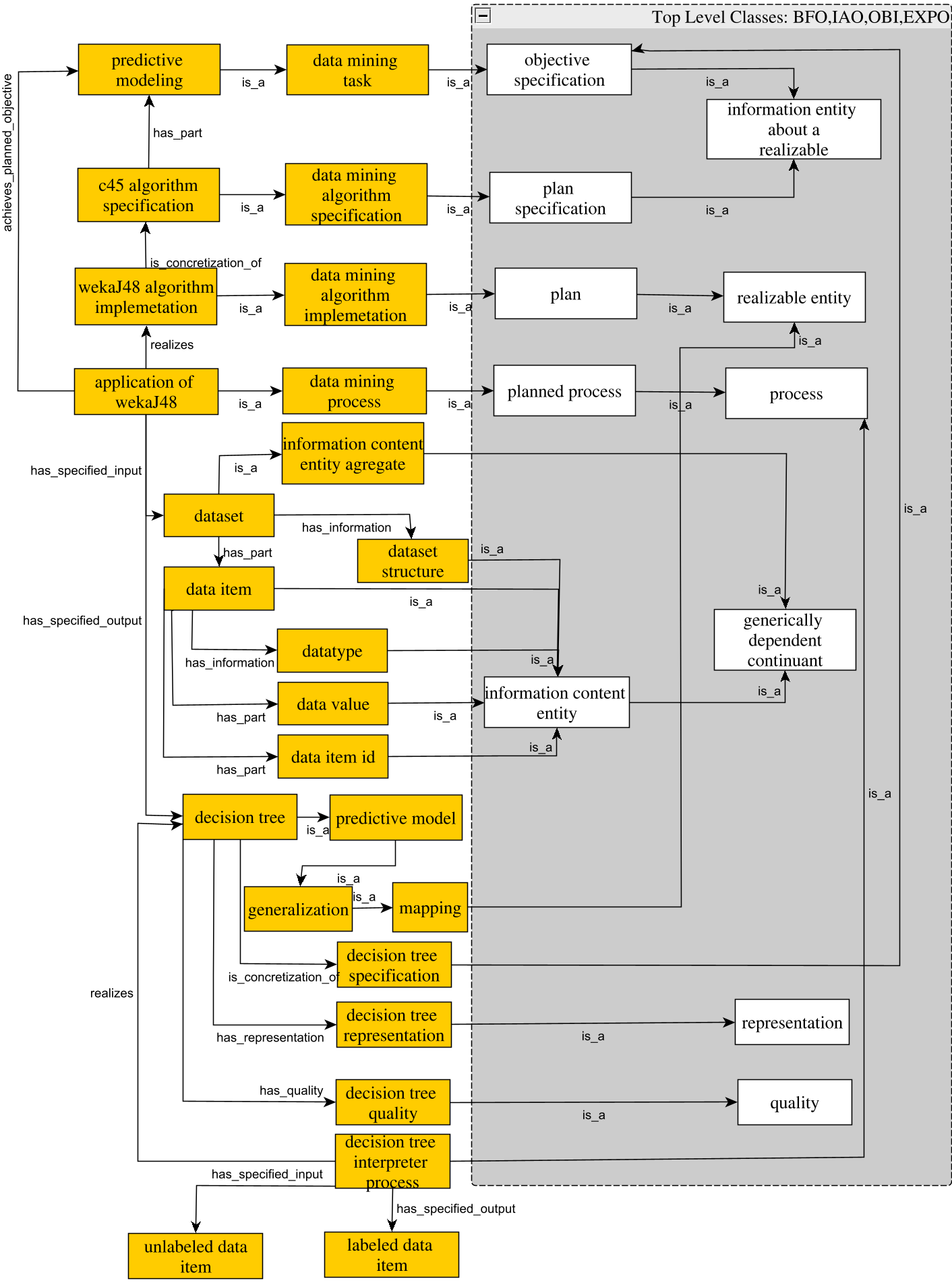 Figure 2: Detailed representation of the WEKA J48 algorithm application within the OntoDM framework.
Key Achievements:
- 292 Classes: Covering everything from primitive datatypes (nominal, numeric) to complex generalizations (predictive models, patterns).
- Interoperability: Because it uses OBI relations like
has-specified-input, it can potentially interoperate with biological ontologies to describe bioinformatics experiments seamlessly.
Critical Insight & Conclusion
Takeaway
OntoDM is not just a vocabulary; it is a foundational infrastructure for the next generation of AI. It provides the "grammar" needed for automated systems to design their own experiments and for researchers to report results in a way that is globally searchable and repeatable—much like the MIAME standards revolutionized microarray experiments in biology.
Limitations & Future Work
- Population: The ontology currently acts as a skeletal structure. The real value will come as the community populates it with thousands of algorithm instances and experiment records.
- Complexity: The heavy-weight nature of OntoDM requires a higher learning curve for practitioners compared to simple XML/JSON logs.
- Future: The authors envision a future where "Inductive Databases" use OntoDM to automatically manage queries and generalizations, effectively creating a self-organizing knowledge discovery system.
In summary, OntoDM moves data mining from an "art of workflow design" to a "formalized science of investigation."