
EPAM: Bridging Unsupervised Clustering and Ontology for Robust Activity Recognition
An Ontology and Pattern Clustering Approach for Activity Recognition in Smart Environments
The paper introduces the Event Pattern Activity Modeling (EPAM) framework, a hybrid unsupervised learning and knowledge-driven approach for Activity of Daily Living (ADL) recognition. By combining location-based segmentation, Jaro-Winkler similarity clustering, and Ontological modeling, it achieves high-precision activity tracking without the need for error-prone manual data labeling.
TL;DR
The Event Pattern Activity Modeling (EPAM) framework addresses the "annotation bottleneck" in smart home systems. By utilizing unsupervised clustering (via Jaro-Winkler similarity) and Ontological reasoning, it transforms raw, unlabeled sensor streams into structured activity hierarchies. The result? A system that understands what an occupant is doing and how they do it, without requiring humans to label thousands of data points.
Context & Motivation: The Failure of Fixed Intervals
In the realm of Ambient Intelligence (AmI), most systems act like rigid observers. They often use Fixed Time Interval segmentation, which slices sensor data into 1-minute or 5-minute blocks. The problem? Human behavior isn't a clockwork. An activity like "cooking" might last 20 minutes or be interrupted by a phone call.
The authors identify three primary pain points:
- The Labeling Trap: Supervised learning is expensive and error-prone.
- Interleaved Activities: Humans often multitask, leading to discontinuous sensor events.
- Lack of Semantics: Pure data-driven models lack the "common sense" reasoning that Ontologies provide.
Methodology: The EPAM Framework
EPAM operates in three distinct phases: Segmentation, Clustering, and Modeling.
1. Spatial-Location Segmentation
Instead of time-based slicing, EPAM uses Location-based segmentation. It assumes that most ADLs are spatially anchored (e.g., sleeping in the bedroom, cooking in the kitchen). This allows the system to instinctively group relevant sensor triggers.
2. Hierarchical Clustering with Jaro-Winkler
This is the core technical "unlock." Standard measures like Euclidean distance require sequences of the same length. EPAM adopts the Jaro-Winkler similarity measure, which is historically used for record linkage and duplicate detection. Why? Because it accounts for transpositions and common prefixes. If an occupant performs "A-B-C" but occasionally does "A-C-B," Jaro-Winkler recognizes the similarity where others see a total mismatch.
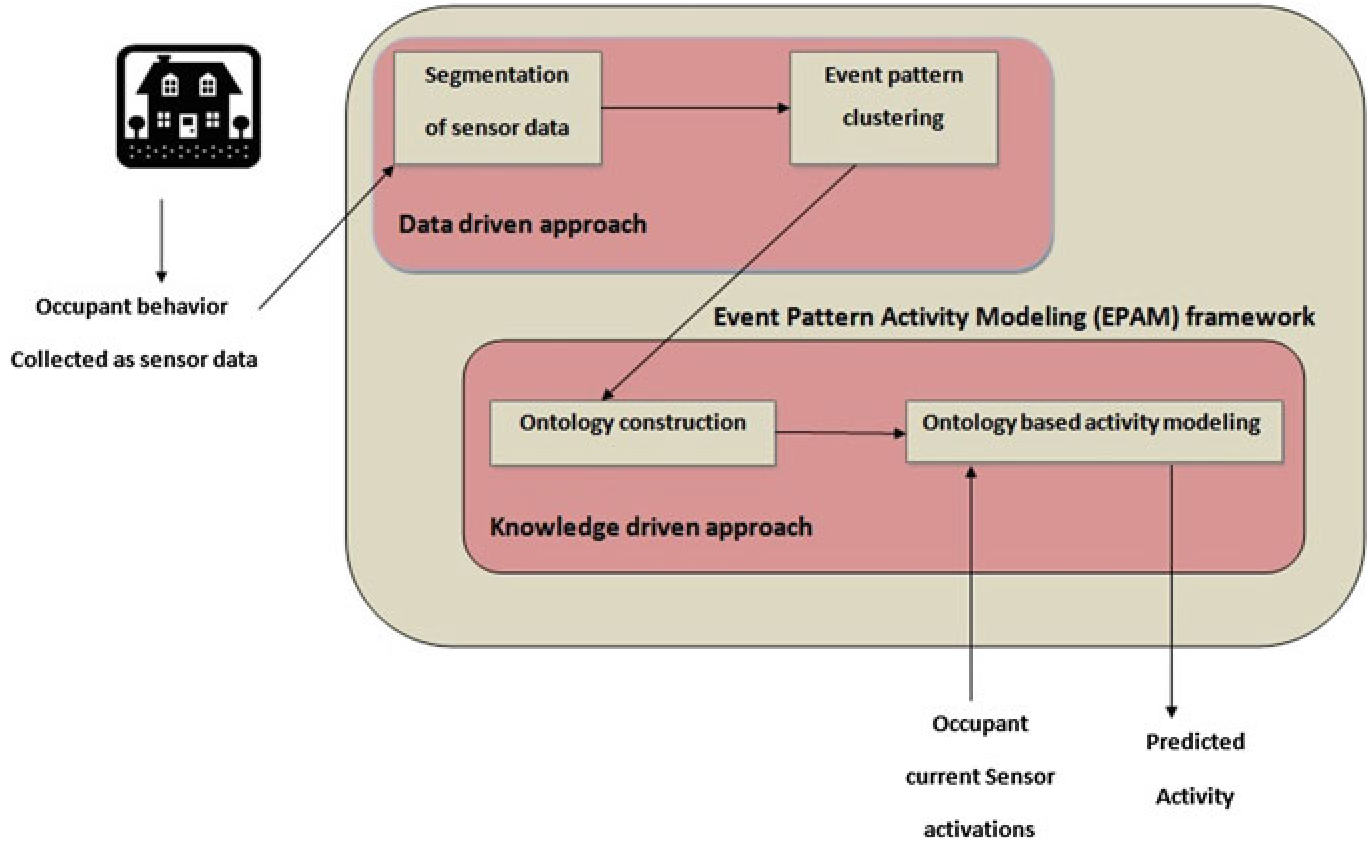 In the figure above, the framework shows the transition from raw sensor data to a structured event pattern through hierarchical clustering.
3. Ontological Modeling
Once clusters are formed, they are fed into a dual-layer Ontology:
- ADL Ontology: Defines the "classes" of activities.
- User Profile Ontology: Stores individual timing and duration habits. By using Fact++ reasoners, the system can perform semantic subsumption—understanding that "making toast" is a sub-activity of "preparing breakfast."
Experimental Insights
Using the WSU CASAS dataset (a gold standard in smart home research), the authors compared their location-based approach against fixed-interval baselines.
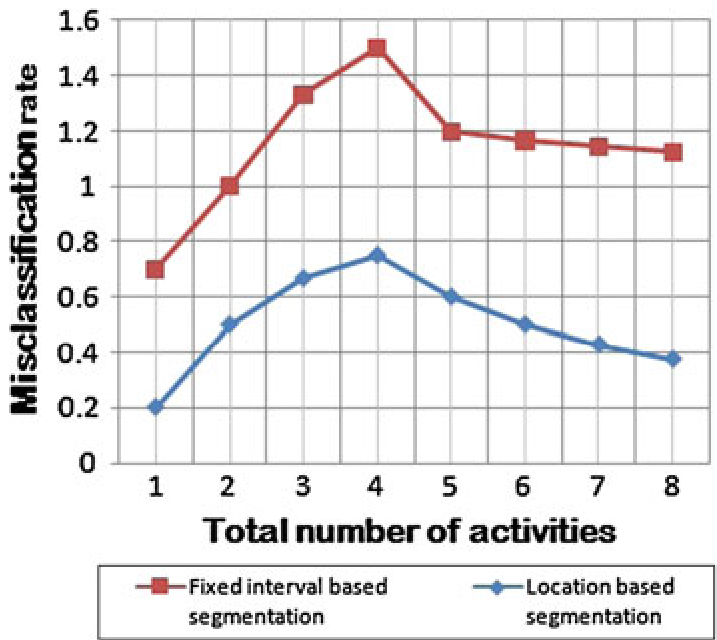 Figure: The misclassification rate for Location-based segmentation is significantly lower than Fixed-interval methods.
The results confirm that spatial context is a much stronger predictor of activity boundaries than arbitrary time slices. Furthermore, the Protege-based ontology development ensures that the model can be reused across different smart homes with minimal re-engineering—a major win for scalability.
Critical Analysis & Takeaways
The EPAM framework is a sophisticated middle ground between "black box" machine learning and "hard-coded" expert systems. Its strengths lie in:
- Robustness to Interleaving: The Jaro-Winkler window limit () effectively handles the messy reality of human behavior.
- Explainability: Because it results in an Ontology, developers can query why the system thinks a user is "sleeping" (e.g., bed sensor is ON in the bedroom).
Limitations: The system still relies on pre-defined spatial zones. In open-plan living spaces where "kitchen" and "living room" overlap, the segmentation might struggle. Future work involving multi-modal sensors (e.g., BLE proximity) could further refine these spatial boundaries.
Final Verdict: EPAM proves that you don't need a labeled dataset to build a smart home that truly understands its occupants. By looking at where events happen and how patterns repeat, we can build more intuitive, privacy-respecting environments.