
Logic Over Statistics: Revolutionizing Ontology Population with ILP
Ontology Population from the Web: An Inductive Logic Programming-Based Approach
This paper introduces a supervised Ontology Population (OP) method that utilizes Inductive Logic Programming (ILP) to automatically generate symbolic extraction rules from Web content. By combining domain-independent lexico-syntactic patterns with WordNet-based semantic similarity, the system successfully populates domain ontologies with new concept instances, outperforming baseline models in complex classification tasks.
TL;DR
Ontology Population (OP) — the task of filling knowledge bases with real-world instances — is traditionally a bottleneck in Semantic Web development. This paper presents a method that uses Inductive Logic Programming (ILP) to bridge the gap between raw web text and structured ontologies. By inducing symbolic rules instead of just training statistical weights, the authors provide a framework that is both highly accurate and fully interpretable by human engineers.
The Interpretability Gap in Information Extraction
Most modern Information Extraction (IE) systems are statistical. While effective, they often act as "black boxes." If a system incorrectly classifies "Apple" as a Fruit instead of a Company in a specific context, it is difficult to "debug" the underlying statistical model.
The authors argue that for Knowledge Engineering, interpretability is non-negotiable. They identify three major pain points in current research:
- Representation Limits: Traditional attribute-value learners struggle with the relational nature of language (e.g., token A follows token B).
- Knowledge Integration: It is difficult to inject "prior knowledge" (like WordNet hierarchies) into standard neural or statistical classifiers.
- Expert Bottlenecks: Hand-crafting extraction rules is too slow to keep up with the growth of the Web.
Methodology: The ILP Advantage
The core innovation lies in the use of Inductive Logic Programming (ILP). Unlike traditional machine learning that outputs a probability, ILP outputs a Logic Program (Horn clauses).
The Architecture
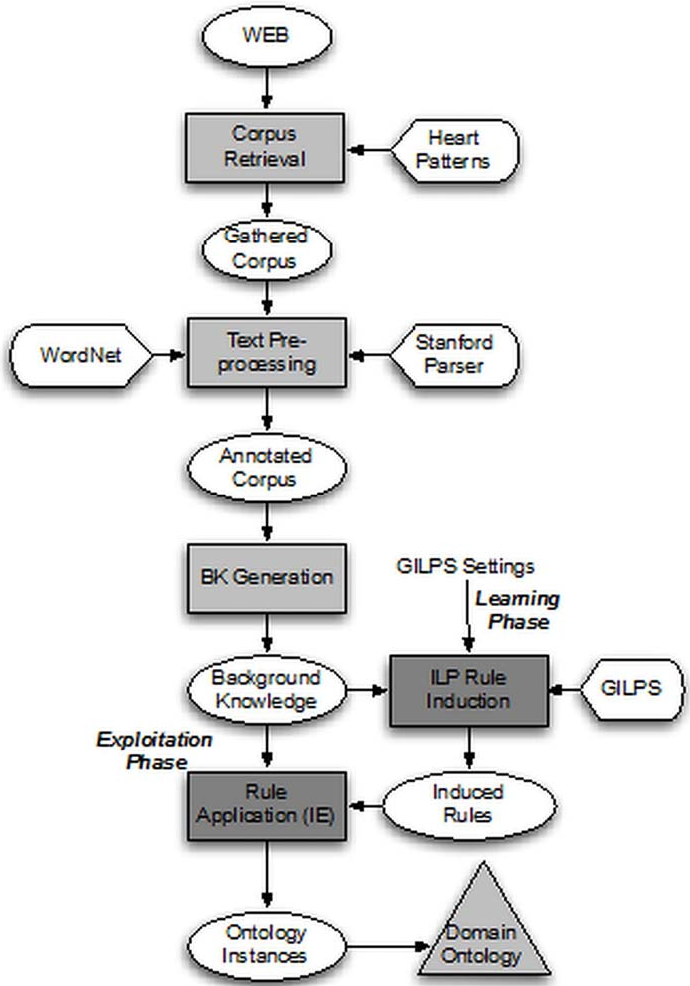
The workflow is divided into two phases: Learning and Exploitation.
- Corpus Retrieval: Uses Hearst patterns (e.g., "Groups such as A, B, and C") to find candidate sentences on the Web.
- Background Knowledge (BK) Generation: This is where the magic happens. The system transforms text into a set of logical predicates:
t_pos(t1, nnp)(Token 1 is a proper noun)t_next(t1, t2)(Token 1 is followed by Token 2)t_wnsim(t1, mammal, '09-10')(Token 1 has a 0.9-1.0 similarity to "Mammal" in WordNet)
Induction of Symbolic Rules
Using the GILPS engine, the system performs a top-down search to find the simplest logical rules that cover positive examples while excluding negative ones. A resulting rule might look like this:
isa_mammal(A) :- t_ner(A, misc), t_orth(A, upperinitial), t_pos(A, nn).
Translation: "A is a mammal if it's a miscellaneous entity, starts with an uppercase letter, and is a singular noun."
Experimental Insights
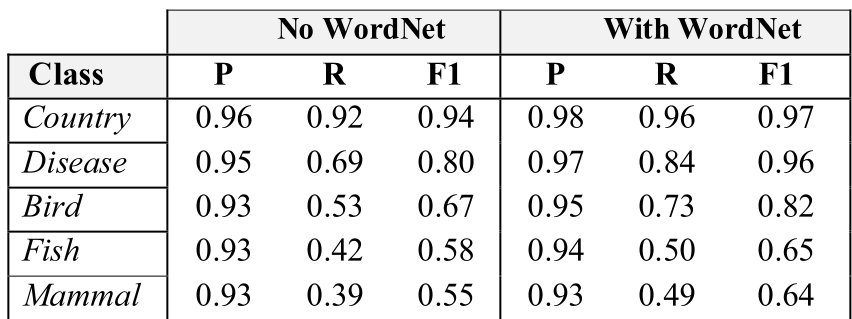
The researchers tested the system on five distinct categories: Country, Disease, Bird, Fish, and Mammal.
Key Findings:
- The Power of Semantics: Adding WordNet similarity scores significantly boosted the F1-measure across all classes. For "Disease," the F1-score jumped from 0.80 to 0.96.
- Competitive Performance: When compared against "Top 10" algorithms like SVM (SMO) and C4.5 (J48), the ILP approach held its own, matching their performance while providing the added benefit of human-readable rules.
Critical Analysis & The Future
While the results are impressive, the paper notes a few limitations:
- WordNet Dependency: Performance drops for specific biological classes (Fish, Mammal) because many instances are missing from WordNet's hierarchy.
- Linguistic Variation: The current use of flat lexico-syntactic features can miss complex sentence structures. The authors propose moving toward Dependency Grammar (graph-based parsing) in future iterations to improve robustness.
Takeaway for Practitioners
This work highlights that Symbolic AI still has a vital role in our era of statistical dominance. For tasks where domain expertise is available and the cost of "hallucination" or "black-box errors" is high, an ILP-based approach offers a structured, verifiable, and scalable path to knowledge acquisition.
Conclusion
By combining the "messy" data of the Web with the "clean" logic of ILP, Lima et al. have demonstrated a pathway toward autonomous knowledge base growth that remains firmly under the interpretative control of human engineers.