
Beyond Static Data Warehousing: An Ontology-Service Approach to Telecom Business Intelligence
Ontology Services-Based Information Integration in Mining Telecom Business Intelligence
The paper proposes an ontology services-based integration framework for Mining Telecom Business Intelligence (BI). It specifically moves beyond the simple "packing" of Data Warehouses, OLAP, and Data Mining engines by introducing a three-tier ontology mapping system (Conceptual, Global, and Physical) to handle dynamic business requirements.
TL;DR
Modern Business Intelligence (BI) is often hampered by a "static model trap"—systems are designed for a specific set of requirements and fail when the business evolves. This paper introduces an Ontology Services-Based Infrastructure that acts as a semantic bridge between user concepts and physical data. By utilizing a three-tier mapping system (Conceptual, Global, Physical), the researchers achieved a flexible BI environment that allows telecom operators to adapt to new decision-making needs without rebuilding their data warehouses.
Background: The 85% Failure Rate
In the telecom industry, data is massive and heterogeneous, spread across Billing, MIS, ERP, and Switch systems. Traditional BI solutions simply "pack" tools together. However, research indicates that 85% of Data Warehouse (DW) projects fail to meet objectives because they rely on predefined data models created at design time. When a business manager wants a new dimension of analysis, the static linkage between the UI and the database breaks.
The authors' insight is that the missing link is a Communication Channel—a dynamic translation layer that understands that "Customer_Name" in a UI might map to "User_Label" in an Oracle DB or "Cust_ID" in a DB2 instance, and that these relationships change over time.
Methodology: The Three-Tier Ontology Architecture
The proposed solution centers on a hybrid ontology approach. Unlike a single global schema, this framework maintains three distinct views:
1. The Conceptual View (Top-Level)
This is the "Business Language" layer. It uses a Concept Category Directory (CCD) where terms like "Service Provider" are defined independently of how they are stored. It focuses on what the business wants to know.
2. The Global Analytical View (Middle-Level)
This layer wraps technical metadata from the Data Warehouse and OLAP engines. It uses Key-Value Tuples (KVT) to describe dimensions and measures. It acts as the bridge, knowing which data warehouse elements satisfy which business concepts.
3. The Physical View (Low-Level)
This is the "Data Reality." it represents the actual tables and attributes in the Enterprise Information Systems (EIS).
The Mediator: Ontology Mapping & Query Parsing
The heart of the paper is the mediation service. When a user creates a query in the UI using business terms, the mediator parses it through the three levels to generate the specific SQL or API calls needed for the underlying databases.
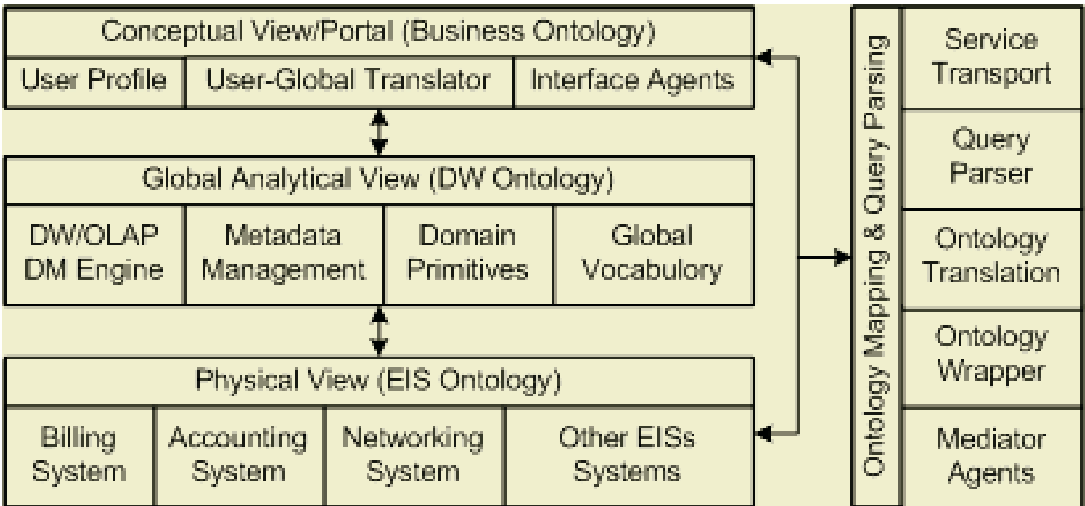 Figure 1: The mapping process between Conceptual, Global, and Physical views.
Key Innovations in Representation
The authors define Ontology Service Item Atoms using a formal structure:
<ST>k:v</ST>, <I>k:v</I>, <O>k:v</O>
This allows for programmatic registration of Data Mining (DM) algorithms. For example, a Decision Tree algorithm can be registered as an ontology service, making it discoverable and invokable by the BI portal dynamically.
Experimental Results: The IOAS Prototype
The researchers built the IOAS (Intelligence Ontology Integration System) on top of a real-world telecom stack involving IBM DB2, Oracle, and Informix.
Significant Advantages:
- Semantic Transparency: Users are shielded from the "alphabet soup" of backend database column names.
- Adaptability: New data sources can be mapped into the "Global Analytical View" without changing the top-level business reports.
- Algorithm Integration: Data mining engines (like IBM Intelligent Miner) are treated as services rather than isolated black boxes.
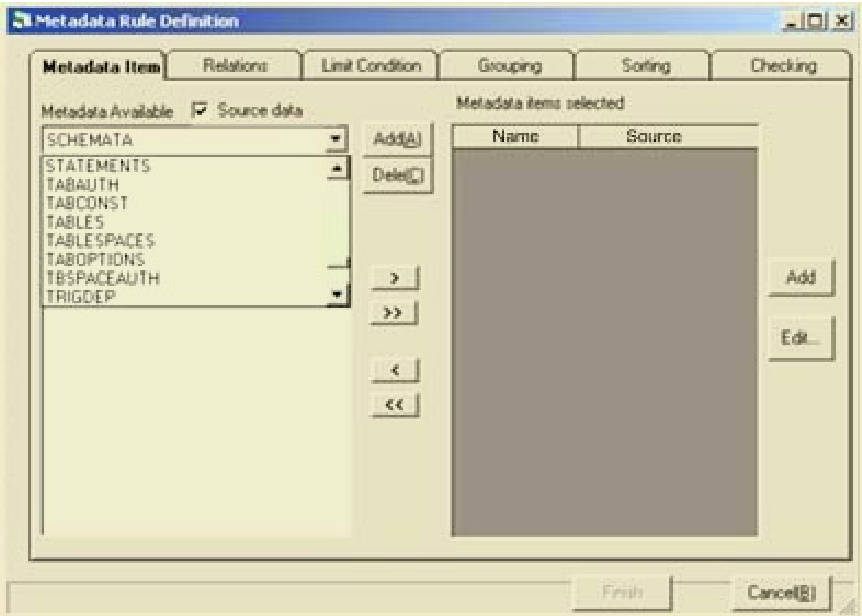 Figure 2: The interactive module used for online definition of query rules and metadata mapping.
Critical Insight & Conclusion
The true value of this work lies in its Inductive Bias toward flexibility. While most BI vendors sell "pre-built dashboards," this paper argues for "pre-built semantic frameworks."
Limitations & Future Work
While the system is robust for structured data, the authors acknowledge that moving toward FIPA-compatible (Foundation for Intelligent Physical Agents) ontology services is necessary for even higher levels of autonomy. Furthermore, as business environments become "evolutionary," the manual mapping of ontologies may eventually need to be replaced by automated machine-learning-based schema matching.
In summary, the transition from "packed tools" to "integrated ontology services" is what transforms a static data silo into a dynamic Business Intelligence ecosystem.