
Dynamic Grammars: A Logic-Driven Approach to Biological Data Mining
Ontology specific data mining based on dynamic grammars
The paper introduces a formal grammar-based engine for biological sequence mining that bridges the gap between deterministic regular expressions and non-deterministic sequence alignment. This "BioRegEx" approach allows users to perform advanced, ontology-driven queries on biological databases with dynamic runtime scoring.
TL;DR
In the realm of bioinformatics, the choice between "exact matching" (Regular Expressions) and "fuzzy similarity" (Alignment) has often been a trade-off. This paper introduces a Grammar-Based Mining Engine that fuses these paradigms. By treating biological sequences as languages governed by production rules, the authors allow researchers to build complex, ontology-driven queries that are both deterministic and robust to evolutionary mutations.
Problem & Motivation: The Limits of Heuristics
For decades, BLAST has been the gold standard for homology searches. However, the authors argue that "one size does not fit all."
Current sequence alignment tools suffer from three major bottlenecks:
- Statistical Blindness: Heuristics may discard sub-sequences that are biologically significant but statistically "quiet."
- Fixed Logic: It is difficult to integrate "expert knowledge" (e.g., specific constraints on gap penalties) into standard alignment searches.
- Disconnected Data: You usually cannot filter a database based on record metadata (like protein function) and perform local alignment simultaneously.
The insight here is to treat the search query as a Formal Grammar. If we can describe a biological motif as a set of production rules, we can use the power of automata theory to find the "optimal path" between our model and the database records.
Methodology: The Grammar Mining Engine
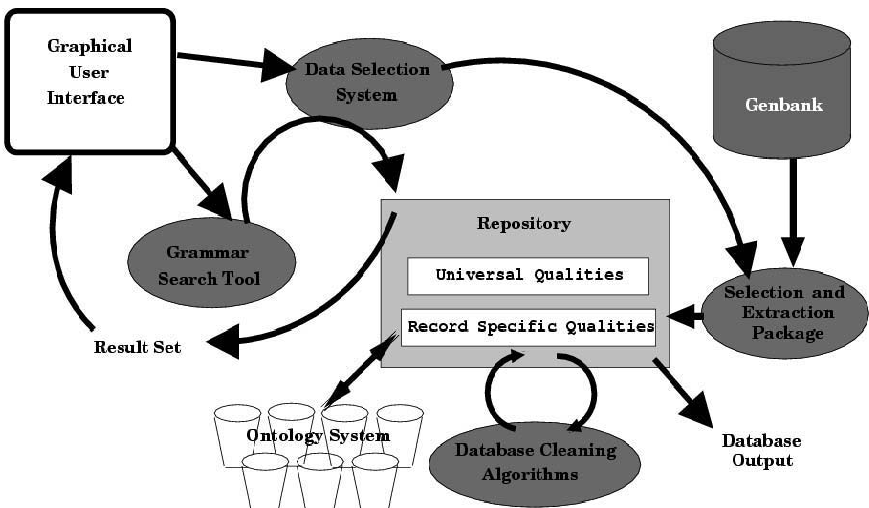
The core of the proposal is a multi-component architecture that translates high-level biological queries into low-level execution.
System Architecture
The workflow is divided into four distinct layers:
- Record Extraction: Parses databases like Genbank and filters records based on user-defined metadata.
- Dynamic SQL Generation: Converts the deterministic parts of a query into SQL for fast database retrieval.
- Evaluation Engine: The "brain" of the system. It handles the non-deterministic elements (the fuzzy matching) by calculating the minimum penalty for transforming a grammar into a target sequence.
- Ontology System: A persistent layer where users can define specialized relationships (e.g., "binding sites") and save them as reusable templates.
The "BioRegEx" Language
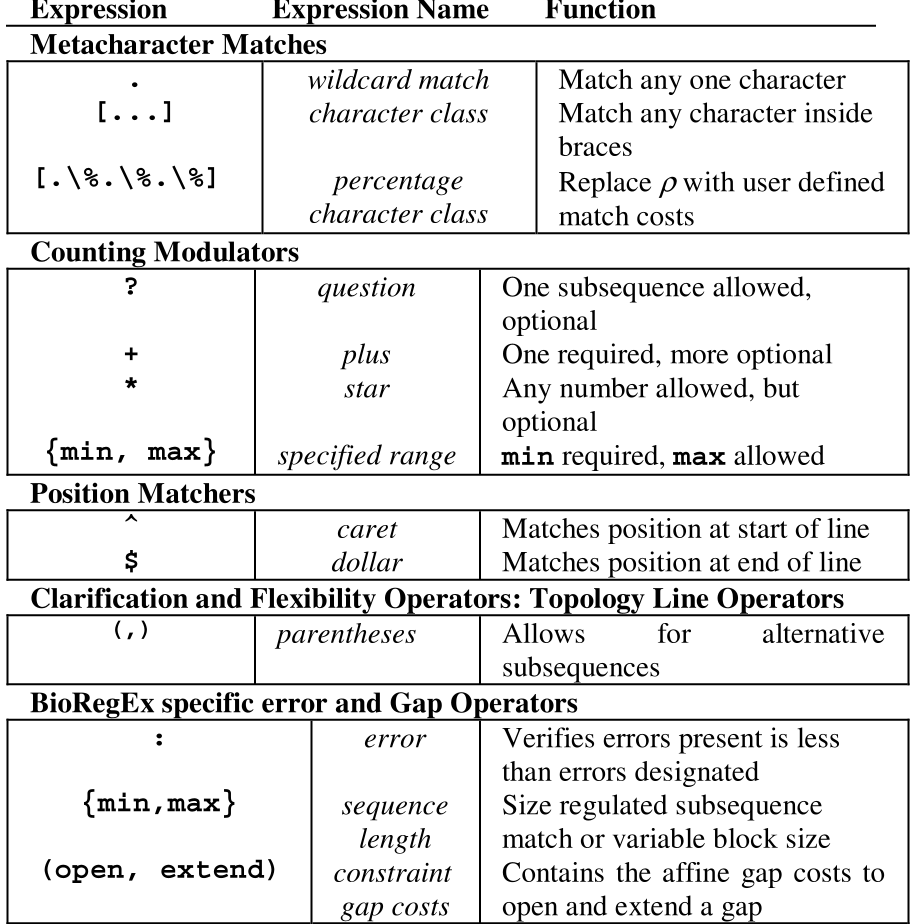
The authors defined a specialized alphabet of operators to handle biological uncertainty. This includes:
- Counting Modulators:
+,*,{min, max}for repeating motifs. - Position Matchers:
^and$for anchoring to start/end of lines. - Bio-Specific Operators: Advanced gap costs (open/extend) and error constraints embedded directly in the query string.
Experiments & Results
The authors focus on the computational efficiency and flexibility of the engine. By constraining the grammar evaluation to a complexity of O(mnd) (where m is target length, n is grammar length, and d is the number of records), the tool remains viable for large-scale databases.
Scoring Flexibility
Unlike BLAST, which uses static substitution matrices (like BLOSUM), this engine allows for Dynamic Runtime Scoring. A user can specify that a "mismatch" at a specific position in a motif should be penalized more heavily than elsewhere, providing a level of surgical precision in sequence mining.
Critical Analysis & Conclusion
Takeaway
The true value of this paper lies in its Ontology-Specific philosophy. It moves us away from "black-box" sequence comparison toward a "white-box" approach where the researcher’s domain expertise is encoded directly into the search grammar.
Limitations
While the O(mnd) complexity is theoretically sound, the overhead of dynamic SQL generation and non-deterministic path evaluation might still lag behind specialized bit-parallel algorithms for extremely large genomic datasets. Furthermore, the paper focuses heavily on the framework; more empirical biological discoveries made with this tool would strengthen the case for its adoption over traditional HMM-based approaches.
Future Outlook
As we move into an era of personalized medicine, tools that allow for runtime-defined similarity schemes will be essential. This grammar-based approach serves as a precursor to modern "semantic searches" in biological databases.