
Structuring the Harvest: A Semantic Ontology for Big Data Decision-Making in Grain Production
Ontology for Structuring a Digital Databases for Decision Making in Grain Production
This paper proposes a specialized ontology and cloud-based architecture for structuring digital databases to support decision-making in grain production. It introduces a three-stage methodology encompassing macro-level architecture, a semantic process model (OntoUML), and pseudocode implementation to integrate heterogeneous big data sources into a unified Data Lake.
TL;DR
Agriculture 4.0 is drowning in data but starving for insights. This paper introduces a robust Ontological Architecture designed for cloud environments that transforms heterogeneous agricultural Big Data (satellites, IoT, weather) into a semantically structured format. By leveraging OntoUML and a Data Lake approach, the researchers provide a scalable roadmap for automated decision-making in grain production.
Problem & Motivation: The Heterogeneity Trap
In the era of precision agriculture, data is generated by everything: drones, soil sensors, satellite imagery (NDVI), and automated weather stations. However, this data exists in "silos"—different formats (XML, CSV, JSON), different granularities, and different semantic meanings.
Existing Extract-Transform-Load (ETL) processes often struggle with the sheer scale and variety of agricultural "Big Data." The authors argue that without a semantic layer, decision-support systems cannot truly understand the relationships between weather patterns, soil health, and crop yield, leading to sub-optimal risk analysis.
Methodology: The Three-Stage Semantic Pipeline
The authors propose a sophisticated architecture that bridges the gap between raw data collection and intelligent decision models.
1. Cloud-Native Architecture
The system operates across Public Clouds (fetching satellite and climate data) and Private Clouds (handling proprietary farm IoT data). Central to this is the Data Lake, which stores raw data in "buckets" before it is processed.
2. Semantic Analysis & OntoUML
The "magic" happens in the Semantic Analyzer. Using OntoUML (a language based on the Unified Foundational Ontology), the authors define the conceptual relationships of grain production. Elements like "Relative Air Humidity," "Vegetation Index," and "Production States" are not just numbers; they are concepts linked by logical rules.
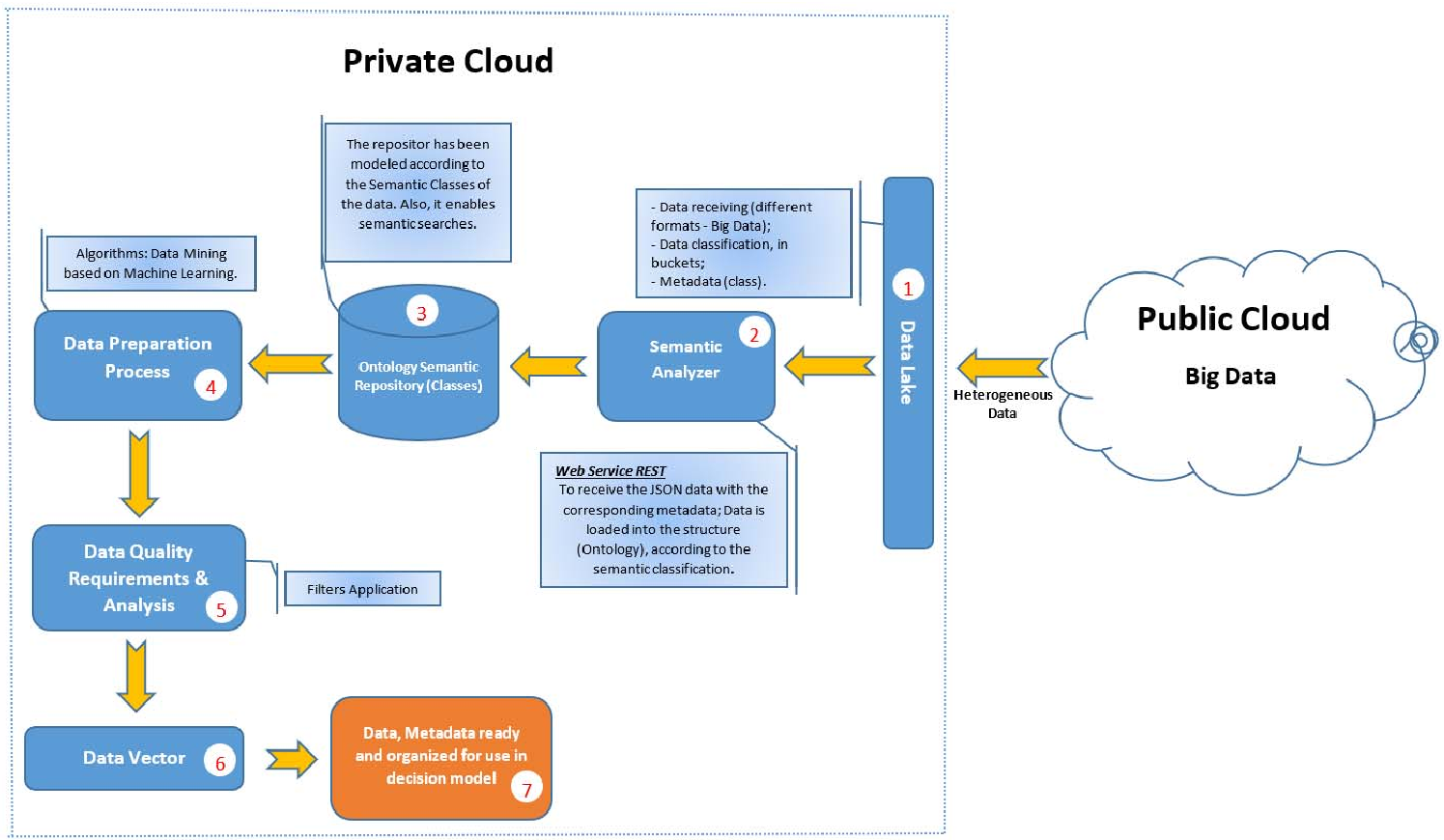 Figure 1: The overarching architecture from data ingestion to organized decision vectors.
3. Implementation via Pseudocode
To ensure the theory works in practice, the authors provide a pseudocode implementation for cloud environments. This involves:
- REST Services: For automating data distribution.
- Machine Learning: For data mining and quality filtering (cleansing the data before it hits the decision model).
- N-Triples/RDF: Converting concepts into a graph database format that can be queried using SPARQL.
Experiments & Case Study: Grain Production
The researchers validated their ontology using a case study focused on grain production risk. They mapped variables such as:
- Meteorology: Humidity, precipitation, max/min temperature.
- Imaging: NDVI (Normalized Difference Vegetation Index).
- States: The evolutionary phases of the crop.
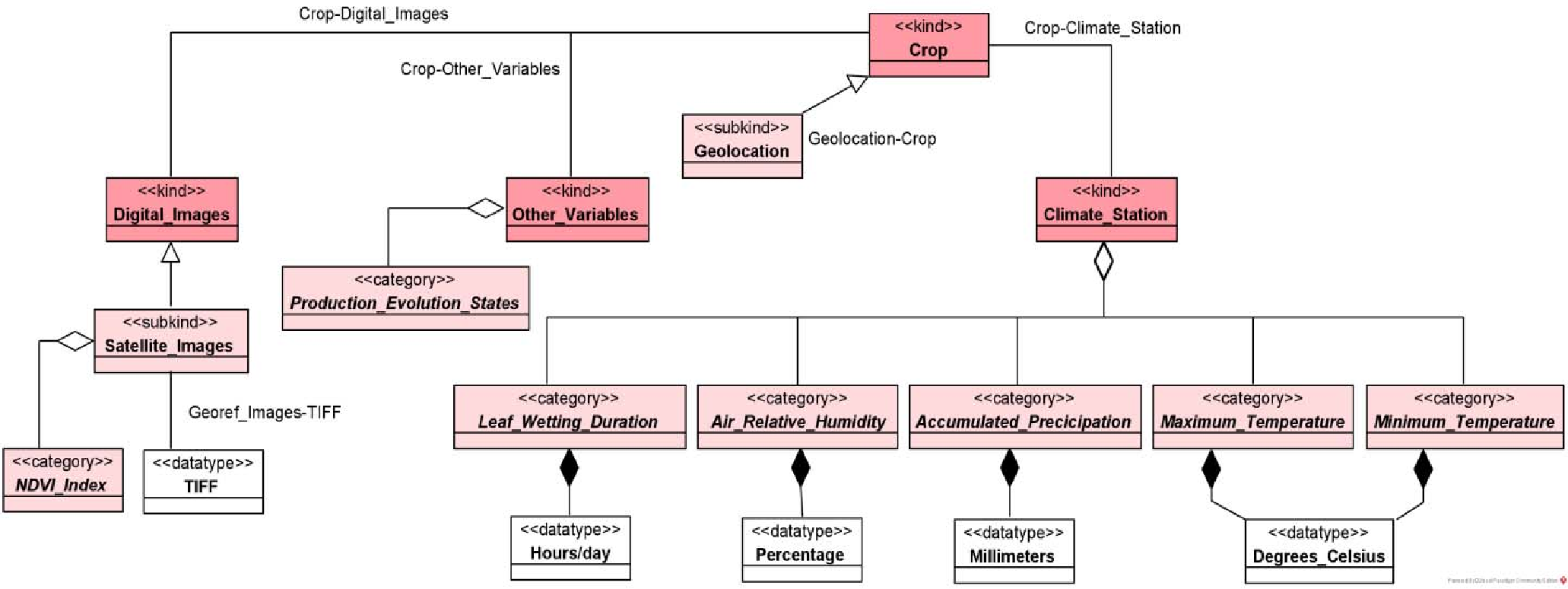 Figure 2: The domain-specific OntoUML diagram for grain production risk analysis.
The study demonstrates how these disparate data points are converted into a unified Data Vector. This vector serves as a clean, high-dimensional input for machine learning models that predict crop success or failure.
Critical Analysis & Conclusion
The SOTA Advantage
Unlike traditional relational databases, this ontological approach provides Interoperability and Elasticity. By using a semantic repository (like OpenLink Virtuoso), the system can handle "schema-on-read," allowing researchers to add new sensor types without rewriting the entire database structure.
Limitations & Future Work
While the architecture is logically sound, the paper focuses primarily on the structuring of data. The "Future Work" section rightly points out the next hurdle: Real-time execution. Currently, the path from Data Lake to Semantic Repository involves multiple processing stages that may introduce latency—a critical factor for autonomous field robotics or immediate frost warnings.
Final Takeaway
This paper is a significant contribution to the Bio-Economy and Digital Agriculture. It moves the needle from "data storage" to "data understanding," providing a semantic backbone that is essential for the transition to fully automated, AI-driven farming.