
Bridging Expert Wisdom and Algorithms: Enhancing Machine Learning with Feature Ontologies
Ontology – Supported Machine Learning and Decision Support in Biomedicine
This paper introduces the "Feature Ontology" framework, a method to integrate domain-specific ontological knowledge with machine learning by redefining instance similarity. It specifically target SOTA improvements in biomedical decision support, such as predicting Atrial Septal Defect (ASD) development.
TL;DR
In the high-stakes world of biomedicine, data is rarely "flat," yet most machine learning models treat it that way. This paper proposes a Feature Ontology framework that integrates structured domain knowledge (like UMLS or SNOMED) directly into the heart of machine learning: the Similarity Metric. By transforming feature sets into weighted hierarchical structures, the authors provide a way to balance heterogeneous data—ensuring that a thousand imaging pixels don't drown out a single, critical clinical marker.
The Problem: The "Flat Vector" Fallacy
In traditional machine learning, an instance is typically represented as a single feature vector. However, in medicine, a patient record is a complex tapestry of:
- Demographics (Age, Gender)
- Clinical Measurements (Blood pressure, Lab results)
- High-Dimensional Data (Genomics, MRI images)
If you feed these into a standard k-Nearest Neighbor (k-NN) or SVM, the sheer volume of imaging features often creates a "numerical bias," where the model perceives two patients as similar purely based on image noise while ignoring vital diagnostic differences. The authors argue that current "naïve" approaches suffer from overfitting and the "curse of dimensionality" because they lack semantic awareness.
Methodology: The Feature Ontology
The core innovation is the Feature Ontology, a graph-based structure that acts as a bridge between data-driven patterns and expert-driven rules.
1. Hierarchical Weighting
Instead of assigning weights to each individual feature, experts assign weights to branches of a semantic tree. For example, "Imaging" and "Clinical Data" might each be given a 50% weight at the root, regardless of how many sub-features they contain.
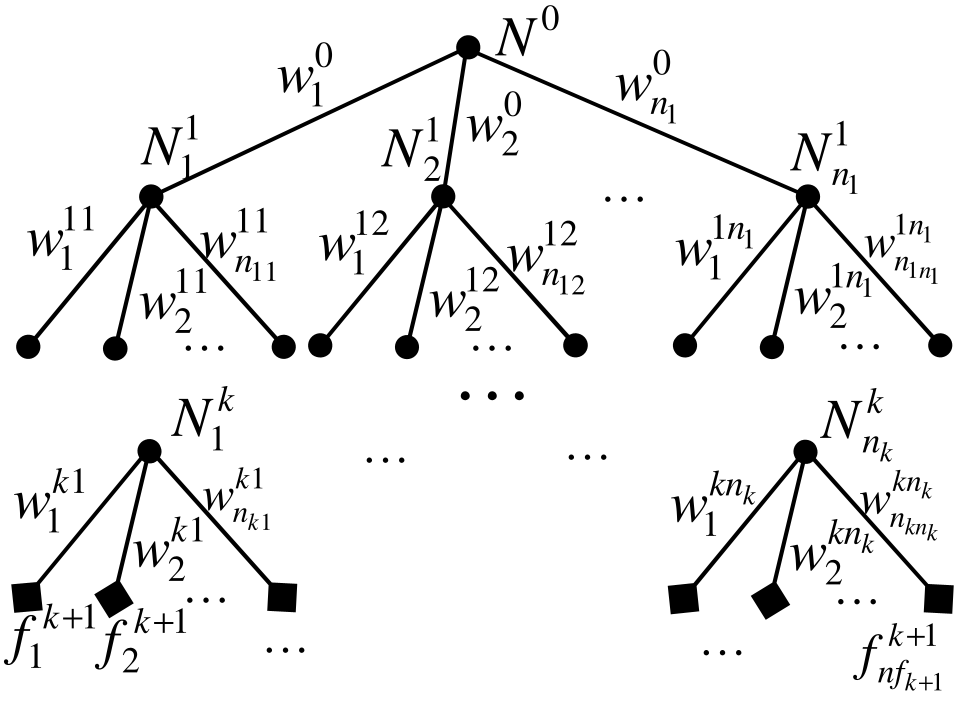 Figure: The weight of a specific feature is the product of all weights along its path from the root. This "penalizes" features that are buried deep in the hierarchy or belong to overcrowded categories.
2. Semantic Redefinition of Distance
By integrating existing medical standards like MeSH or SNOMED CT, the model doesn't just see numbers; it sees relationships. If an ontology specifies that two features are synonyms or highly correlated (e.g., Right Ventricle volume measured via Ultrasound vs. MRI), the distance function can adjust to prevent redundancy from skewing the results.
Case Study: Atrial Septal Defect (ASD)
The authors apply this to the Health-e-Child project, focusing on ASD—a congenital heart defect. Predicting whether a "hole in the heart" will close spontaneously or require surgery involves a massive, unbalanced feature space.
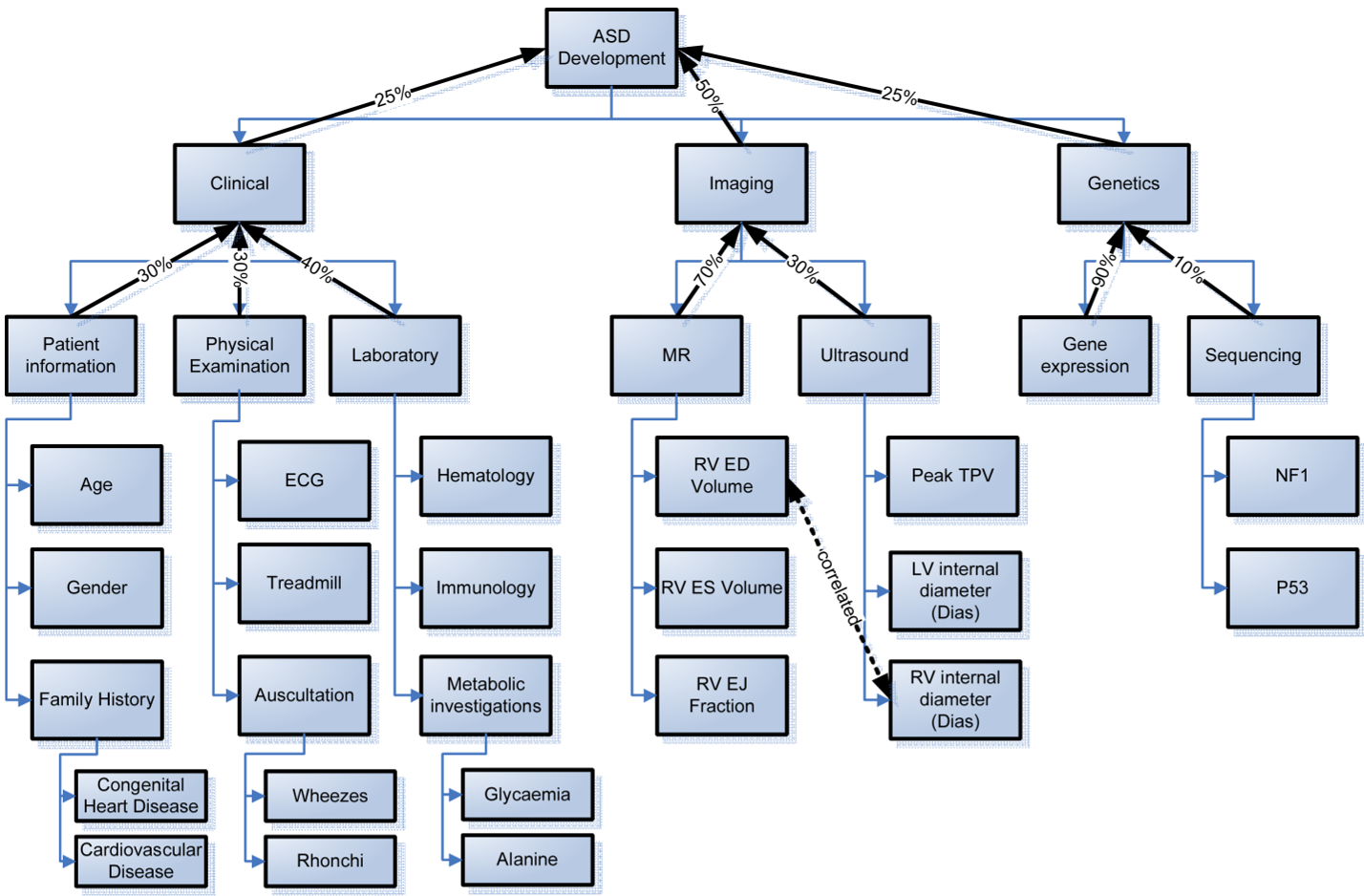 Figure: An excerpt of the ASD feature ontology. By mapping clinical concepts to standard ontologies, the system can extract "normal ranges" for features, helping with outlier detection and more accurate metric normalization.
Evaluation: Two Paths to Truth
How do you know the new similarity metric is better? The paper proposes two validation strategies:
- Expert-Perceived Similarity: Comparing the model's rankings of "similar patients" against rankings provided by human cardiologists (using Spearman correlation).
- The Wrapper Approach: Using the distance function within a k-NN classifier and measuring if it leads to higher diagnostic accuracy on unseen data.
Critical Insight & Conclusion
The true value of this work lies in its Interpretability. By using a Feature Ontology, the researchers turn the "distance metric" into a flexible, human-readable wrapper. An expert can look at the GUI, see that "Imaging" is weighted too heavily, and tweak the branch weight directly.
Takeaway: As we move toward Personalized Medicine, the "black box" approach of pure data-driven ML is unsustainable. This paper demonstrates that Ontology-Supported Machine Learning is not just about better accuracy—it's about creating a collaborative environment where expert intuition directs algorithmic power.
Future Outlook: The next step is automating the learning of these branch weights using reinforcement learning, allowing the ontology to evolve dynamically as new patient data arrives.