
ONTOMO: Democratizing Ontology Building via Web-Scale Bootstrapping
ONTOMO: web-based ontology building system: ---instance recommendation using bootstrapping---
The paper introduces ONTOMO, a web-based ontology building system designed to leverage collective intelligence through a high-level Flex-based interface. Its primary contribution is an instance recommendation mechanism that utilizes bootstrapping and a precision filter to automate the extraction of proper nouns from the web.
TL;DR
Building ontologies—the structured "vocabularies" of the Semantic Web—has historically been a chore for experts. ONTOMO changes the game by introducing a web-based, collaborative editor that uses bootstrapping to recommend new instances. By providing just a few "seed" words, the system crawls the web to find related entities, significantly boosting the speed and scale of knowledge graph construction for ordinary users.
The Bottleneck: Why Manual Ontology Building Fails
In the quest for a more "intelligent" web, ontologies provide the necessary structure. However, the "Knowledge Acquisition Bottleneck" remains a major hurdle.
- Expert Exclusivity: Tools like Protégé are powerful but have steep learning curves.
- Data Sparsity: Manually finding every instance of a class (e.g., every car brand or smartphone model) is impossible.
- Noisy Data: Automated web extraction often returns "garbage" along with useful data, leading to low precision.
ONTOMO's insight is to treat ontology building as a Collective Intelligence task, supported by an automated recommendation engine that "learns" from a few user inputs.
Methodology: The "Bootstrapping + Filter" Engine
1. Bootstrapping (Pattern Growth)
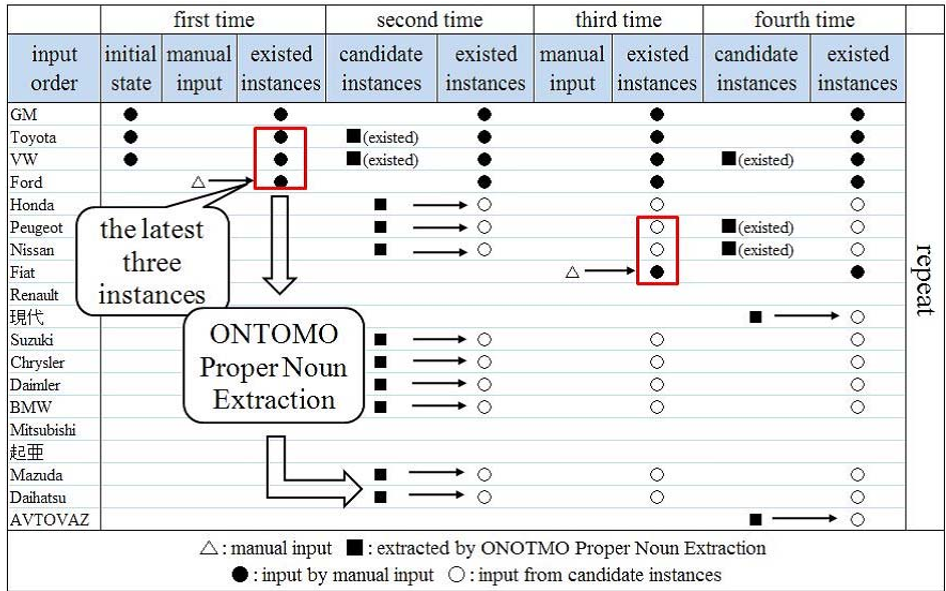
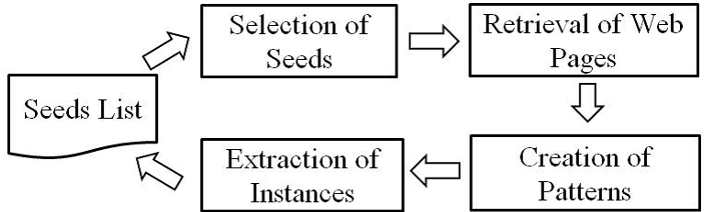
The core of ONTOMO's recommendation is a recursive process. You give it three seeds: Toyota, GM, and Ford. The system:
- Scans web pages to find common patterns surrounding these words (e.g., "The latest models from [Seed] and ...").
- Uses these patterns to extract new candidates like Honda or Volkswagen.
- Feeds those new candidates back into the loop to find even more patterns.
2. The Precision Filter
Web extraction is notoriously noisy. To fix this, ONTOMO employs a Precision Filter:
- It removes instances that are already identified in the current class.
- It identifies "distractor" instances from other classes to verify borders.
- This creates a cleaner subset () where the ratio of correct to incorrect instances is much higher.
Visualizing the Ontology
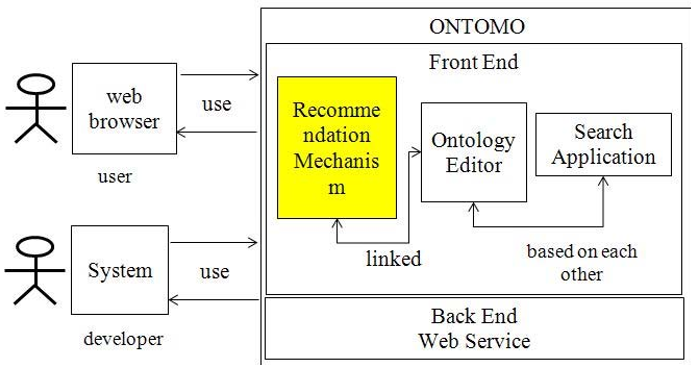
To make the structure intuitive for non-experts, ONTOMO utilizes SpringGraph, a force-directed graph library. Instead of staring at XML or deep hierarchies, users interact with a visual web of nodes (classes and instances) and edges (properties).
Experimental Results: Faster Convergence
The authors tested the system on car manufacturers.
- Without the system: Finding a complete set of instances takes a high number of manual interactions.
- With ONTOMO's Precision Filter: The recall (finding all correct items) hit 100% after only 6 manual confirmations.
 Above: The graph shows how precision climbs rapidly as the filter identifies and removes noise.
Critical Analysis & Takeaways
ONTOMO represents an early and effective attempt to merge Information Extraction (IE) with Human-Computer Interaction (HCI) in the semantic domain.
Strengths:
- Efficiency: Reducing the "work" to just 6 steps for 100% recall is a 10x improvement over manual entry.
- Accessibility: Transitioning from specialized Java apps to web-based Flash (at the time) made the tool widely available.
Limitations:
- Seed Sensitivity: The quality of the final ontology depends heavily on the initial seeds provided by the user.
- Context Drift: In more ambiguous categories (e.g., "Apple" the company vs "Apple" the fruit), the bootstrapping might wander off-topic without stronger semantic grounding.
Looking Ahead: Modern systems now use Large Language Models (LLMs) for similar tasks, but the fundamental logic of ONTOMO—using iteration and precision filtering to refine collective knowledge—remains the blueprint for modern Knowledge Graph construction.