
Reimagining the Hearth: Leveraging Smart TVs as a Holistic Gateway for Elderly Care
An Open Architecture to Support Social and Health Services in a Smart TV Environment
This paper presents an open architecture for providing integrated social and health services to senior citizens using Smart TV technology. The system, built on the KODI media center and standard HTPC hardware, successfully deploys a diverse ecosystem of applications including vital signs monitoring, tele-consultation, and cognitive exergames.
TL;DR
With the global elderly population projected to hit 2 billion by 2050, the demand for home-based care is skyrocketing. This paper introduces an open, Smart TV-based architecture that bypasses the "digital divide" by using a familiar household interface to deliver a comprehensive ecosystem of healthcare (RPM, telemedicine) and social (social networks, cognitive games) services.
Background: The Familiarity Gap
Despite the proliferation of health-tech tablets and smartphones, many seniors remain reluctant to adopt them. The primary friction points are interface anxiety and the fragmentation of services. A user may have a pendant for falls, a tablet for vitals, and a PC for social connection—none of which talk to each other. The authors argue that the TV, the "central hearth" of the home, is the optimal platform to consolidate these services while maintaining high user acceptance.
Problem & Motivation: Beyond Isolated Apps
Current telecare systems suffer from being "closed loops." A vital signs monitor rarely influences the user's entertainment or social agenda. The motivation behind this work was twofold:
- Overcome the Digital Divide: Leverage the "10-foot UI" that older adults already trust.
- Create an Ecosystem: Move away from isolated apps toward a unified environment where health, social, and entertainment modules share an authentication and communication backbone.
Methodology: The Open Architecture
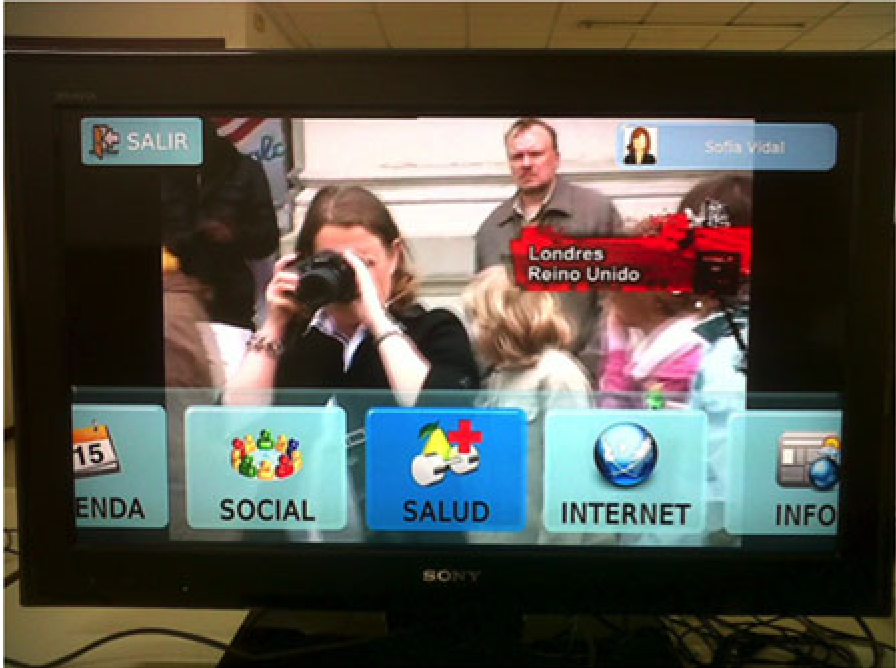
The researchers built their solution on KODI (formerly XBMC), an open-source media center software. This choice provided the flexibility to integrate diverse hardware through a standard PC-based STB (Set-Top Box).
Core Components:
- Extensive Peripheral Support: By using an HTPC (Home Theater PC), the system natively supports Bluetooth and USB devices, allowing the integration of blood pressure monitors, Nintendo WiiMotes for gesture control, and Microsoft Kinect for fall detection/exergames.
- The XMPP Backbone: The system uses a modified XMPP (extensible Messaging and Presence Protocol) to allow applications to "talk" to each other. For example, a health alert can trigger a popup on the TV screen while the user is watching a broadcast.
- Single Sign-On (SSO): A token-based system ensures that once a senior logs into the TV, they are automatically authenticated for Facebook, Twitter, and medical portals.
 The client-side architecture showing the integration of KODI add-ons with external sensors and the central communication module.
Experiments & Results: Real-World Validation
The platform was tested in the rural-urban environment of Galicia, Spain, with 62 senior citizens (65+ years old).
Key Findings:
- Ease of Use: 93% of participants believed the TV-based system was easier than a PC.
- Service Popularity: Cognitive games (puzzles, sequence sorting) and physical rehabilitation videos were the most used features.
- Social Impact: 77% felt the technology brought them closer to the modern digital world, rather than isolating them further.
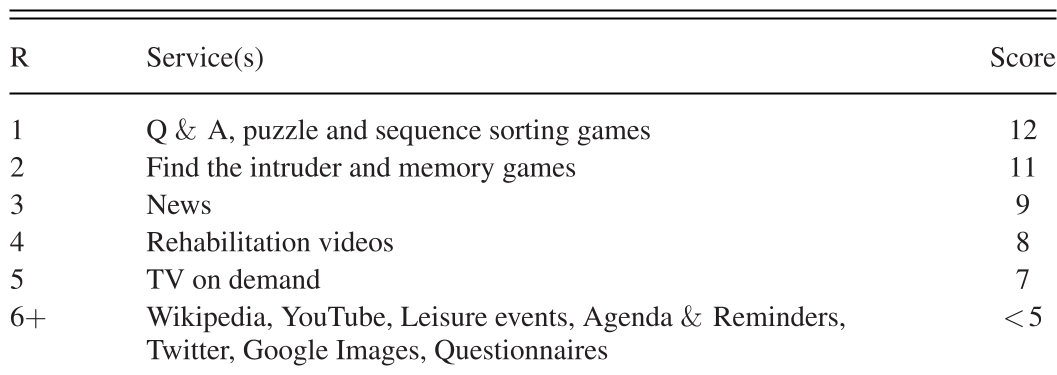 Ranking of services by user preference: Games and rehabilitation videos clearly outpaced traditional social media like Twitter.
Critical Analysis & Conclusion
Takeaway
The genius of this approach isn't in its technological complexity, but in its psychological centering. By transforming a "passive" screen into an "interactive" health hub, the authors addressed the fundamental barriers of cost and intrusiveness.
Limitations & Future Work
The reliance on HTPC hardware was necessary for the research phase to handle external drivers, but for mass adoption, this logic needs to be embedded within native Smart TV OSs (Android TV, Tizen). Furthermore, while social media acceptance was high (80%), actual usage was lower than expected because many seniors lacked an existing digital social network. Future iterations should focus on automated social onboarding to help seniors connect with their local community directly through the TV.
Ultimately, this study confirms that the Smart TV isn't just for entertainment—it's a clinical and social lifeline that hides complexity in plain sight.