
Open or Blocked Skies? Decoding the Power of Community Blocklists on Bluesky
Open or Blocked Skies? Community Moderation Practices in Bluesky
This paper presents the first large-scale longitudinal study of community-driven moderation on Bluesky, focusing on the scale and impact of individual blocking and public blocklists. By analyzing 1.2 billion posts from 34 million users, the authors map an ecosystem where community blocklists generate over 16 billion unique block edges, 100x more than individual blocking.
TL;DR
Moderation is no longer just a "top-down" platform decision. In the first large-scale study of its kind, researchers have analyzed the Bluesky moderation ecosystem, revealing that community-driven "blocklists" are now the dominant force in content filtering—generating 100 times more blocking actions than traditional individual blocks. While these lists target the most toxic and politically polarized users, being blocked surprisingly often leads to an increase in a user's activity and popularity.
The Transparency Revolution in Moderation
For decades, the "black box" of social media moderation—where platforms like X or Facebook hide who is blocked and why—has frustrated researchers. Bluesky’s AT Protocol changes the game by making moderation actions public by default. This paper exploits that transparency to map a sprawling ecosystem of 34 million users, showing that decentralized moderation is not just a niche feature; it is the infrastructure of the network.
Why the Community Takes Over: The Problem with Centralization
Centralized moderation faces the "impossible scale" problem. A single team cannot possibly navigate the nuanced cultural norms of millions of diverse users without appearing biased or slow.
The authors identify a shift toward Community-Driven Moderation:
- Individual Blocks: Selective, high-effort, personal.
- Community Blocklists: Delegated, high-impact, and scalable. A user simply subscribes to a list created by a trusted curator (e.g., a "Spam Bot List" or a "Political Extremist List"), and thousands of accounts are instantly filtered from their view.
Methodology: Mapping the Ecosystem
The researchers didn't just count blocks; they built a behavioral profile of the "blocked" and the "blockers."
1. The Power of the Few
One of the most striking findings is the concentration of power. Active blocklists are managed by only 0.043% of users. This "re-centralization" means that a handful of curators decide what a significant portion of the platform sees.
2. Who Gets Blocked?
The study used XGBoost classifiers to determine which features predict a block.
- Popularity & Visibility: The most active users are, counter-intuitively, the most blocked.
- Toxicity: Users on blocklists show toxicity scores 10x higher than the average.
- Topics: Politics, Adult content, and Crypto are the primary magnets for blocks.
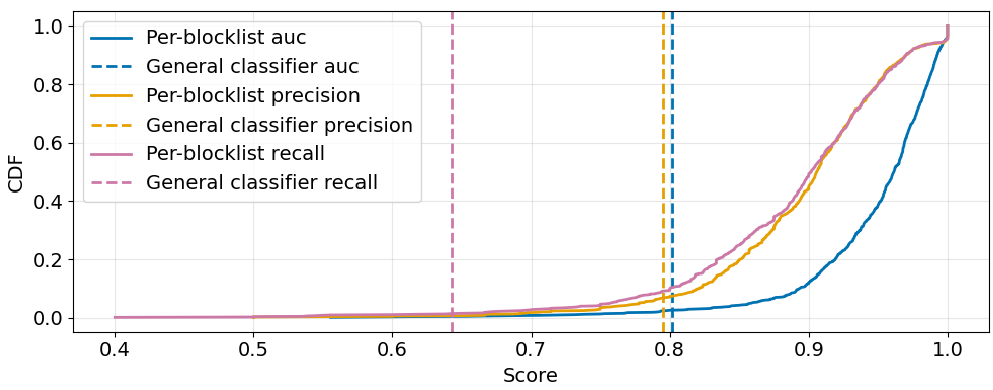 Figure: The researchers found that per-blocklist classifiers (bespoke models) performed significantly better than a general "global" model, proving that different communities have wildly different moderation "philosophies."
The Causal Paradox: Does Blocking Actually Work?
The paper employs Generalized Propensity Score (GPS) to answer a critical question: What happens to a user after they are added to a major blocklist?
In a traditional sense, you might expect them to go away. The data suggests the opposite.
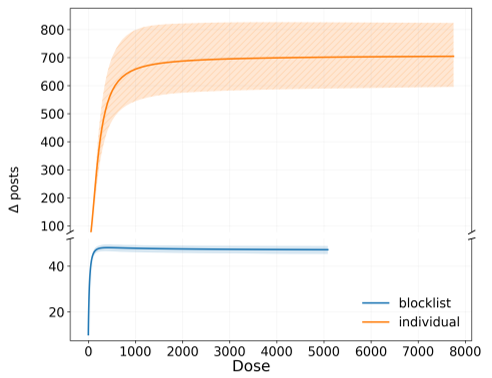 Figure: The Dose-Response curves for posts, toxicity, and incoming follows. Note the upward trend as the "dose" (number of blocks) increases.
Key Findings from the Causal Analysis:
- Psychological Reactance: Blocked users often increase their posting frequency to "reaffirm agency."
- Community Solidarity: When a user is added to a "partisan" blocklist, members of their own tribe often respond by following and liking them more as an act of solidarity.
- Filter, Not Silence: Blocking on Bluesky effectively removes users from the feeds of those who don't want to see them, but it fails to decrease the overall "volume" or popularity of the blocked party in the wider network.
Critical Insight: The Future of Pluralistic Moderation
This study provides empirical grounding for what the authors call "pluralistic moderation." Instead of a single "Global Truth," Bluesky allows for multiple, overlapping sub-communities to define their own boundaries.
However, the risks are real:
- Opaque Curators: If a list curator makes a mistake, thousands of users may "blindly" block an innocent account.
- Echo Chambers: By making it easy to block entire ideological groups, the system may inadvertently accelerate social fragmentation.
Conclusion
"Open or Blocked Skies?" suggests that while community moderation solves the scalability issue of centralized platforms, it introduces a new challenge: the governance of the curators. As we move toward decentralized social media, the power to "delete" someone from your reality is becoming a shared community tool, for better or for worse.