
Unlocking Intelligence: Leveraging Linked Open Data (LOD) for Organized Crime Prevention
Open data analysis for environmental scanning in security-oriented strategic analysis
This paper introduces a general framework for leveraging Linked Open Data (LOD) and Semantic Web technologies for environmental scanning in security-oriented strategic analysis. Specifically, it demonstrates how integrating heterogeneous data sources like EUROSTAT and DBPedia through RDF and SPARQL can identify macro-economic indicators (e.g., unemployment rates) that correlate with organized crime patterns.
Executive Summary
TL;DR: This research bridges the gap between the World Wide Web of Data and security intelligence. By employing Semantic Web technologies (RDF/SPARQL) and data mining, the authors demonstrate how seemingly unrelated public datasets—like metal market prices or regional unemployment—can be fused to provide early warnings for organized crime activities.
Positioning: This work positions itself as a foundational structural framework, advocating for the transition from traditional "data silos" to a "Semantic Web" approach in strategic analysis. It moves beyond mere data collection into the realm of Knowledge Fusion.
The Problem: The "Needle in the Haystack" of Heterogeneous Data
Strategic analysts in Law Enforcement Agencies (LEAs) perform "Environmental Scanning"—the process of identifying "weak signals" that precede security threats. However, they are currently overwhelmed by:
- Semantic Heterogeneity: Data from the World Bank, EUROSTAT, and social networks use different formats and terminologies.
- The Globalization of Crime: Organized crime behaves like a market; identifying indicators requires a macro-economic view that single-source data cannot provide.
- Scaling Issues: Manually mapping relationships between datasets is labor-intensive and error-prone.
Methodology: Building Semantic Rails for Data Mining
The authors propose a multi-layered approach to unify data before applying mining algorithms.
1. The Semantic Stack
By representing data as RDF Triples (Subject-Property-Object), the framework creates a graph of knowledge. Key vocabularies like the RDF Data Cube Vocabulary allow analysts to treat statistical spreadsheets as multi-dimensional connected nodes.
2. Information Fusion & Alignment
The core of the methodology lies in Ontology Matching. By using resources like DBPedia (the semantic version of Wikipedia) and GeoNames, the framework can automatically resolve that "Germany" in one dataset is the same entity as "Deutschland" in another.
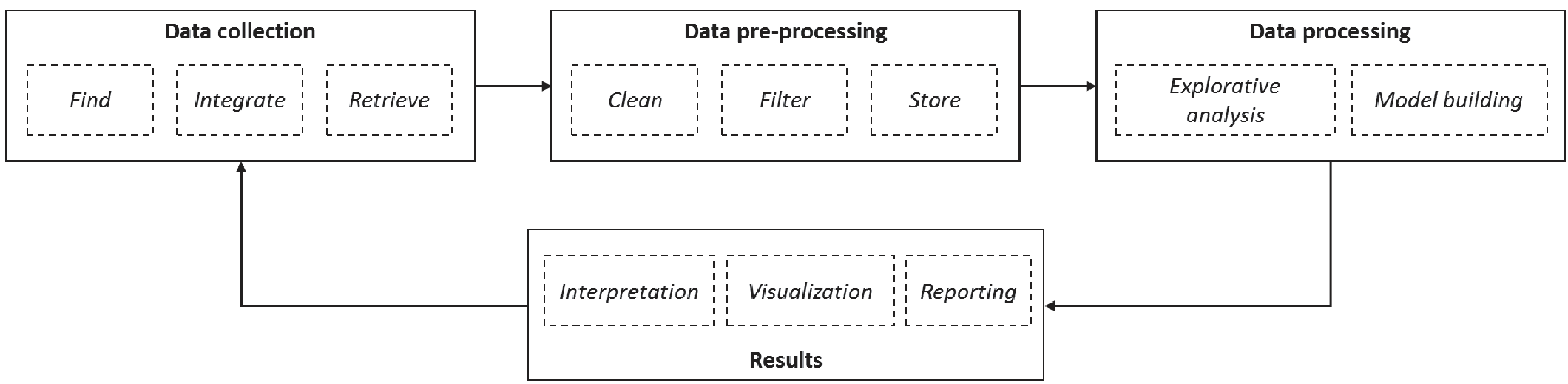 The four stages of the proposed logic: Collection (via SPARQL), Pre-processing (Alignment), Processing (Clustering/Regression), and Inspection.
Use Case: Unemployment Trends and Social Indicators
To prove the concept, the authors queried three distinct sources: EUROSTAT (for stats), GeoNames (for spatial relations), and DBPedia (for cultural context).
The query targeted: "Unemployment rates by sex in regions where German is an official language."
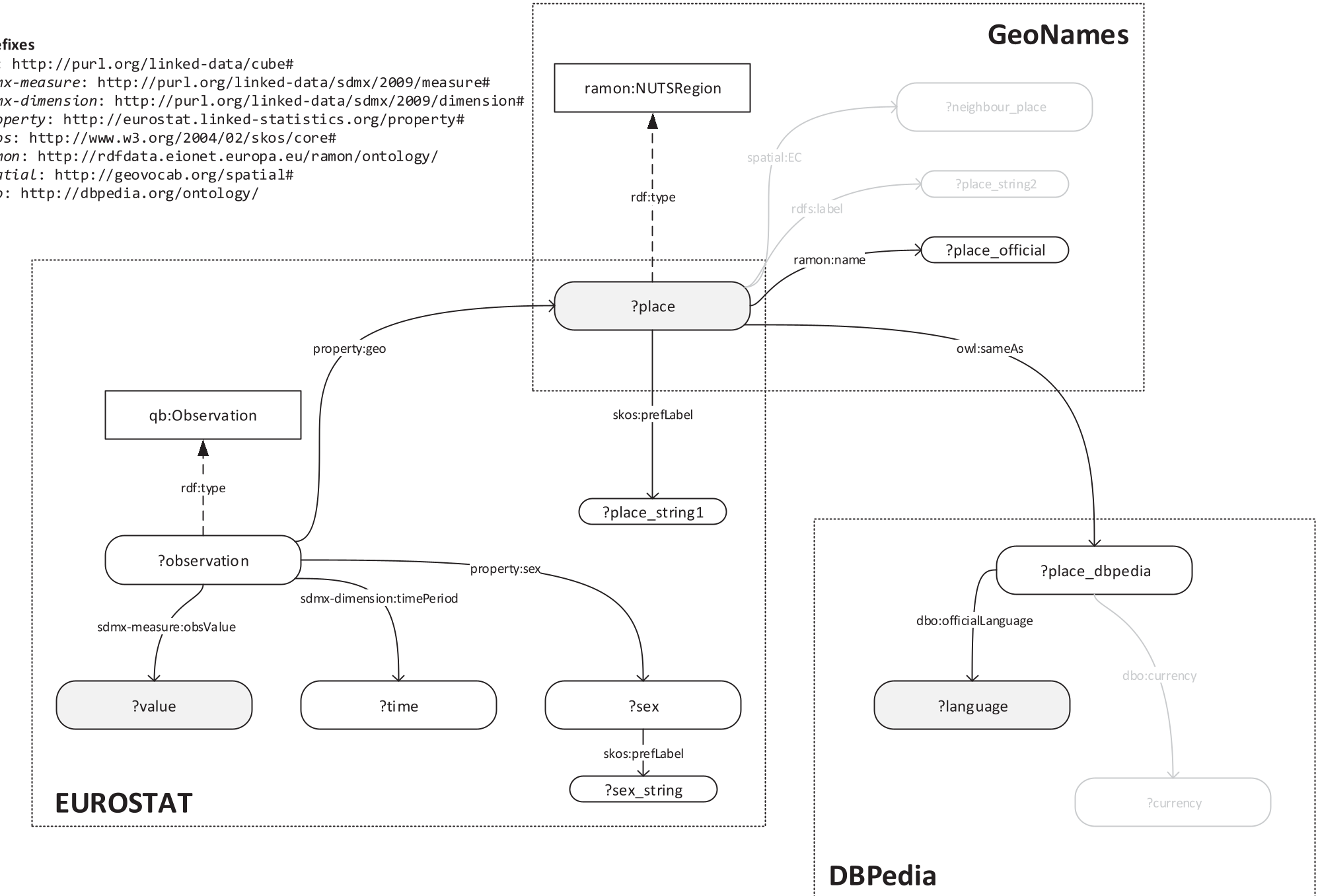 This graph pattern demonstrates how SPARQL traverses different datasets to join variables.?place connects EUROSTAT to GeoNames, while language properties link to DBPedia.
Results of the Analysis
Using Fuzzy Clustering, the research identified that regional unemployment trends following the 2008 economic crisis were not uniform across German-speaking territories.
- Austria vs. Germany: Despite similar average values, the evolution of rates differed significantly.
- Strategic Value: Such anomalies are "indicators." In forensic scenarios, sudden shifts in these clusters can be correlated with shifts in criminal activity (like the documented link between copper prices and cable theft).
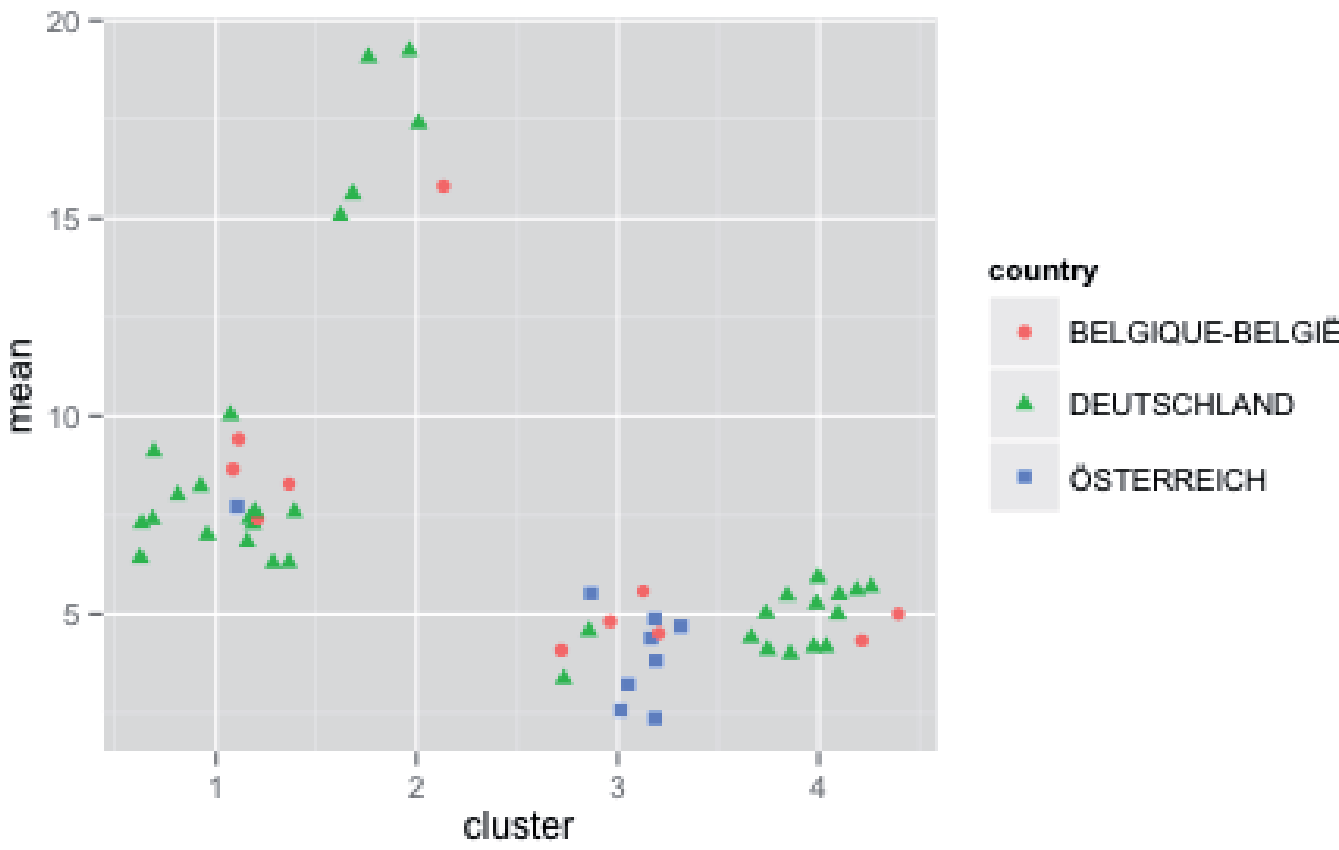 Cluster representation showing regional groupings; identifying these patterns allows analysts to focus resources on "exceptional" regional behaviors.
Critical Insight & Conclusion
The true value of this work is the realization that Open Data is a sensor network. While individual data points (like a regional unemployment spike) might seem irrelevant to a police officer, to a strategic analyst, they are facilitators of crime.
Limitations:
- SPARQL Reliability: Public endpoints are often unstable, requiring local mirrors of large datasets.
- The "Big Data" Gap: Bridging Semantic Web tools with high-velocity "Big Data" architectures (like Spark or Flink) remains an engineering challenge.
Future Outlook: The integration of Fuzzy Ontologies will be crucial. Since real-world data is often imprecise or "noisy," allowing for probabilistic relationships in the knowledge graph will make these early-warning systems much more robust for real-world deployment.