
From Publication to Impact: Reforming the Open Government Data Paradigm
Open data to solve societal issues: workshop
This paper outlines a high-level academic workshop from dg.o 2015 focused on transitioning Open Government Data (OGD) from simple publication to active societal impact. It introduces frameworks for scaling data consumption, leveraging "Linked Open Data" for sustainable development, and fostering new organizational roles like Chief Data Officers.
TL;DR
While many governments have successfully "opened" their data, the mere existence of a portal does not equate to societal value. This work, presented at the dg.o conference, advocates for a shift from transparency-by-default to utility-by-design, focusing on new organizational roles like Chief Data Officers and the integration of "Linked Open Data" to solve complex societal issues like sustainable development.
Background: The Gap in the Open Data Movement
Open Government Data (OGD) was initially driven by a dual promise: increasing political transparency and fostering economic collaboration through civic hackathons. However, after the first wave of implementation, a "research debt" emerged. We have reached a point where data is abundant, but its managerial implementation and actual reuse remain poorly understood.
The authors argue that we are moving from a "policy-oriented" phase to an "impact-oriented" phase, where the focus shifts toward how data changes the internal culture of government agencies.
The Core Challenge: Beyond the Portal
The primary hurdle identified is that government organizations often treat open data as a technical checkbox rather than a managerial transformation.
- The Mindset Barrier: How do we change the internal practices of civil servants to utilize external innovations?
- The Accountability Paradox: Does setting up a platform actually lead to higher perceived transparency? Evidence is still remarkably thin.
- Sustainability of Innovation: Innovative "Civic Tech" apps generated in hackathons often die because they lack a sustainable path into government operations.
Methodology: The Next-Generation Ecosystem
The workshop organizers propose a multi-disciplinary approach to scale the impact of OGD. The core methodology involves:
1. Architectural Scaling
Integrating fragmented data portals into cohesive ecosystems and leveraging Linked Open Data (semantic web) to ensure datasets from different agencies can "talk" to each other.
2. Organizational Evolution (iLabs)
The introduction of Innovation Laboratories (iLabs)—dedicated spaces where stakeholders and government officials co-locate—replaces the sporadic nature of hackathons with sustained collaboration.
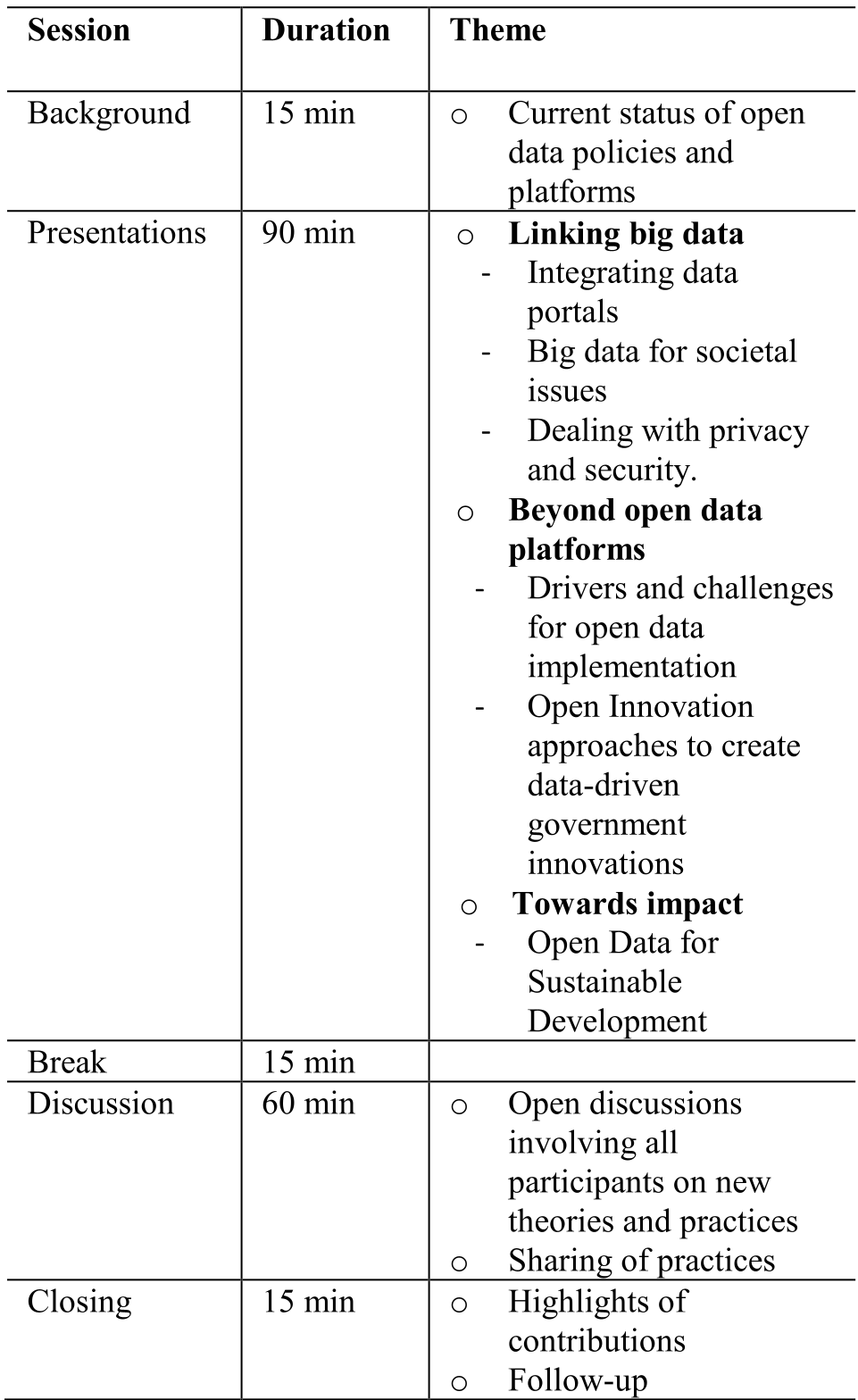 The workshop structure highlights the transition from technical background to societal impact and open innovation.
Experiments and Discussions: Linking Data to Development
The workshop emphasizes that "Bio Data" and "Social Media Conversations" are the next frontiers for OGD. By harvesting conversation data and linking it with official administrative records, governments can move toward a more "real-time" responsiveness to societal issues.
Key Pillars for Implementation:
- Integration: Merging big data and privacy protections.
- Drive: Identifying specific organizational drivers that motivate Chief Data Officers.
- Impact: Aligning data release with Sustainable Development Goals (SDGs).
Critical Insight & Future Outlook
The value of this work lies in its early recognition of Open Data Ecosystems over Open Data Portals. It challenges the industry to look beyond the "machine-readable" technicality and solve the "human-readable" organizational challenge.
Takeaway for Today: For modern AI and LLM applications, government data is the ultimate "Ground Truth" training set. However, without the semantic linking and organizational bridges proposed in this workshop, this data remains "dark" and unusable for high-stakes societal AI.
Future Challenges
The authors acknowledge that privacy and security remain the "Gordian Knot" of the open data movement. As we link more big data for societal good, the risks of re-identification and data misuse grow alongside the potential benefits.