
OCPR: Beyond Retrieval — Bridging the Comprehension Gap in Scientific Reading
Open educational resource based information understanding via pdf document interaction
This paper introduces the OER-based Collaborative PDF Reader (OCPR), a system designed to bridge the gap between "information access" and "information understanding." It automatically recommends high-quality Open Educational Resources (OERs)—such as slides, videos, and source code—to help students and researchers grasp complex scientific papers through interactive scaffolding.
TL;DR
Reading a scientific paper is often harder than finding one. This paper introduces the OER-based Collaborative PDF Reader (OCPR), an innovative system that transforms the solitary act of reading into an interactive learning experience. By mapping a reader's specific confusion to a vast library of Open Educational Resources (OERs) like YouTube videos, GitHub code, and Wikipedia pages, OCPR provides the "scaffolding" necessary to move from merely accessing information to truly understanding it.
The "Understanding" Problem: Access is Not Insight
The digital age has solved the problem of access. We can download almost any paper in seconds. However, the authors argue that Information Access Information Understanding.
For students and junior researchers, a paper is often a dense thicket of jargon and complex logic. While external aids like lecture slides or tutorials exist, they are scattered across the web (SlideShare, TED, GitHub). The cognitive load required to find these resources while reading often breaks the learner's flow. OCPR's motivation is to bring these resources to the reader at the exact moment of need.
Methodology: The Mechanics of Scaffolding
The system treats the PDF reader as a sensor for "Information Needs." These needs are categorized into two types:
- Implicit Needs: The student highlights a difficult passage.
- Explicit Needs: The student types a specific question.
The Recommendation Engine
To identify the best OER, the system employs an Inference Network Model based on three core hypotheses:
- Keyword Hypothesis: Focuses on the global topics of the paper.
- Paper Hypothesis: Focuses on resources specifically tied to that publication.
- Information Need Hypothesis: Focuses on matching the immediate context of the user's query or highlight.
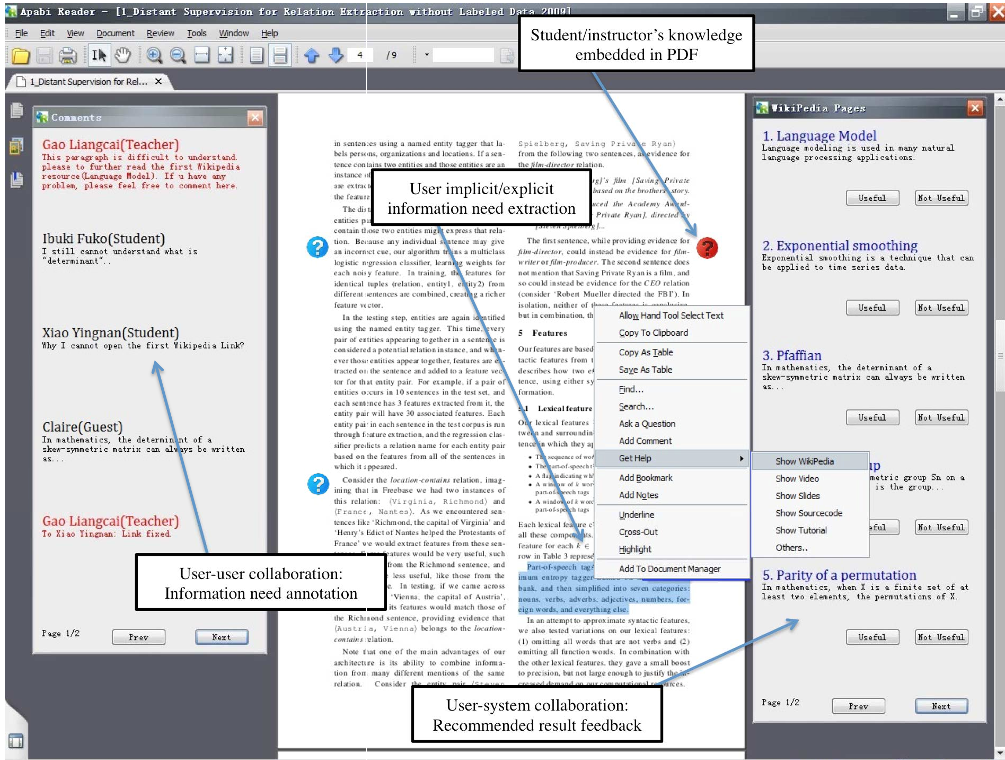
Learning from Feedback
A standout feature is the Relevance Feedback mechanism. The system refines its understanding of a user's need () by adjusting for resources marked as "useful" () or "not useful" (). This allows the recommendation algorithm to evolve based on actual human utility.
Experiments & Results: Does it Work?
The authors validated the system using 334 OER recommendations judged by participants. Accuracy was measured using two primary metrics:
- MRR (Mean Reciprocal Rank): 0.499 — This means the "golden" resource was usually the second item the user saw.
- NDCG@5: 0.8350 — This indicates that the top 5 results are highly relevant and well-ordered.
These results suggest that even with a fully automatic approach, the system can effectively pinpoint which external lecture or tutorial will help a student understand a specific section of a paper.
Deep Insight & Future Outlook
The OCPR paper (WebSci '14) was ahead of its time in recognizing that the PDF is not a destination, but a portal.
Strengths
The "scaffolding" approach acknowledges that research papers are not self-contained; they exist in an ecosystem of knowledge. By integrating social media and OERs, OCPR democratizes high-level research.
Limitations & Evolution
The study notes a lack of large-scale data for parameter tuning at the time. In today's landscape, the integration of Large Language Models (LLMs) could take this further—not just by recommending a video, but by summarizing that video specifically in relation to the highlighted text.
Conclusion
OCPR represents a shift from "Search Engines" to "Understanding Engines." For the modern researcher or student, tools that synthesize cross-platform knowledge directly into the reading workflow are no longer a luxury—they are a necessity for navigating the ever-growing ocean of scientific literature.