
Digital Participation or Digital Cage? Redefining the Ladder of Engagement in Authoritarian States
Open Governance in Authoritarian States: A Framework for Assessing Digital Participation in the Age of Mass Surveillance
This paper proposes a revised analytical framework for digital participation, specifically tailored for authoritarian states. It introduces an adapted version of Arnstein’s "Ladder of Participation" to account for modern digital realities such as mass surveillance and "cosmetic" e-participation.
TL;DR
In the digital age, "e-participation" is often hailed as a tool for empowerment. However, in authoritarian contexts, these same tools frequently serve as "cosmetic" facades or instruments for mass surveillance. Fadi Salem's research challenges the democratic bias of existing participation models and proposes a new "Ladder of Participation" that accounts for government control and surveillance as inherent stages of digital interaction.
Academic Positioning: This work represents a critical theoretical shift from the "Collective Action" focus (e.g., Arab Spring revolts) toward a systemic understanding of how autocracies institutionalize digital tools to maintain power.
Problem & Motivation: The Democratic Blindspot
Most literature on digital governance assumes a "technology-deterministic" view: that more technology inevitably leads to more democracy. Frameworks from the OECD or UN often measure "progress" based on how many digital tools a government provides.
However, the author points out two critical failures in this logic:
- The Collective Action Bias: Research in authoritarian states usually only focuses on how citizens use the internet to overthrow regimes, ignoring the day-to-day administrative "participation" used by regimes to stabilize themselves.
- The Zero-Sum Power Myth: Traditional models like Arnstein's (1969) assume that as citizens gain power, the government must lose it. In reality, digital participation can actually increase a state's power through data collection and social capital building.
Methodology: Updating Arnstein for the 21st Century
The paper builds upon the classic Arnstein’s Ladder of Participation, which originally identified eight rungs ranging from "Manipulation" to "Citizen Control." Salem adapts this by stripping away the "Citizen Control" rung (which is inherently incompatible with authoritarianism) and adding rungs that characterize the modern digital autocracy.
The Proposed Analytical Framework
The core of the paper is the "Extended Ladder," which categorizes interactions into three levels: Non-participation, Tokenism, and Participation.
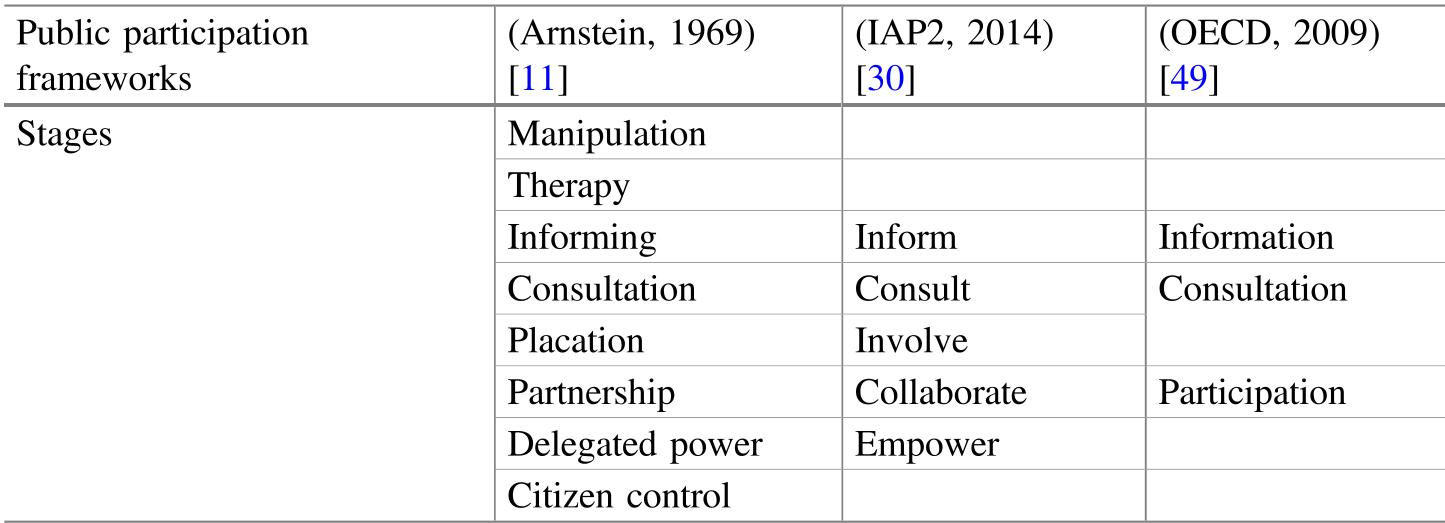 Table 1: Comparison of classic, non-internet specific participation frameworks.
The innovation lies in the new rungs added to address the digital reality:
- Surveillance: Platforms exist, but their primary purpose is to profile and monitor rather than to solicit input.
- Façade: Aesthetic "openness" that has no functional impact on policy.
- Selective Participation: Inviting chosen "elites" to participate in closed online processes to maintain the appearance of consensus.
Experiments & Results: Mapping the Gap
Through an extensive meta-analysis of existing e-participation frameworks (including those from the UN and European Commission), Salem highlights that current metrics are "neutral" to a fault—they fail to ask why a government is providing a platform.
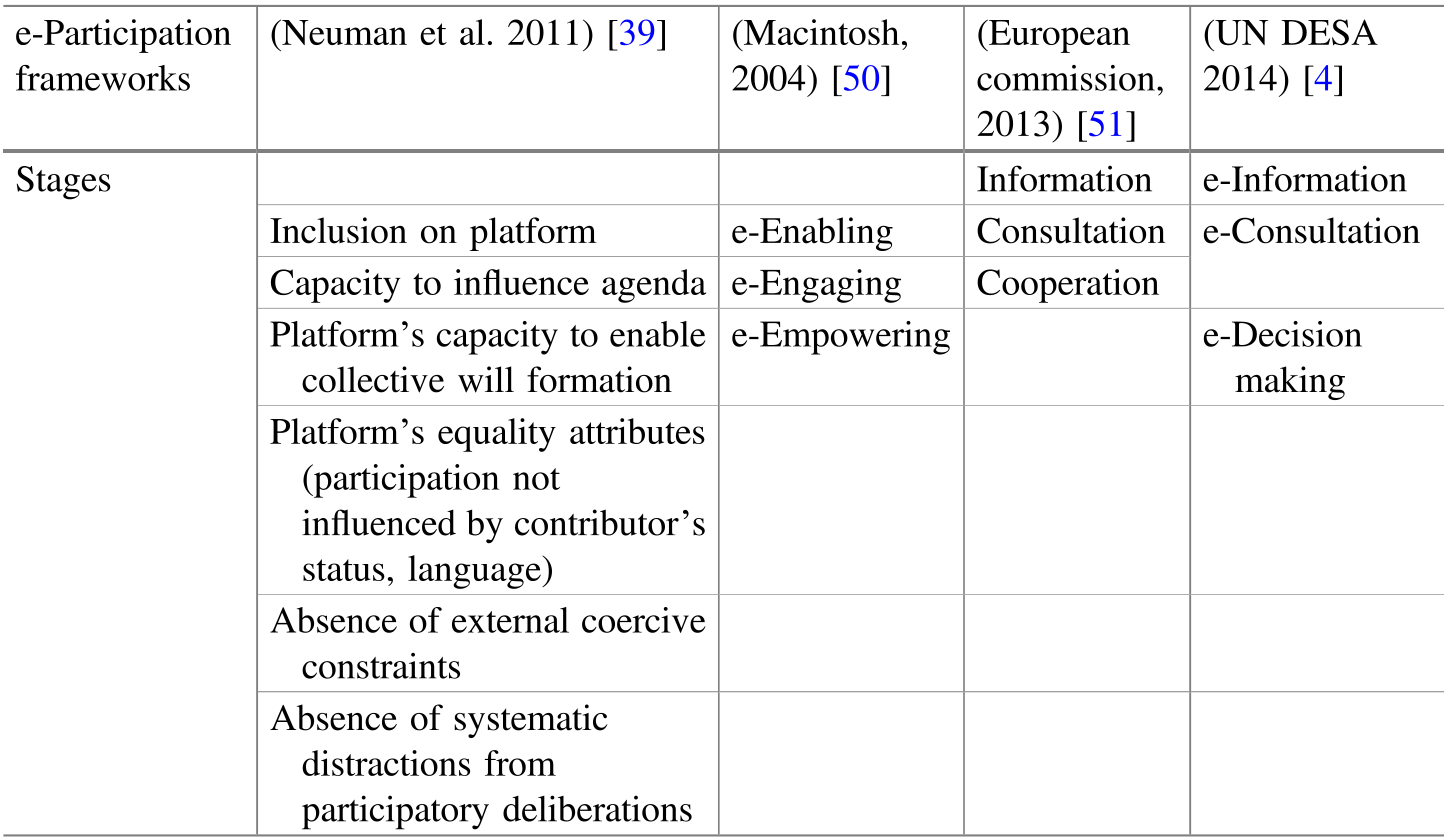 Table 2: Comparison of internet-focused participation models showing the lack of surveillance/control metrics.
Key insights from the analysis include:
- Managerial Efficiency vs. Democratic Potential: Many authoritarian states adopt "managerial" digital governance (making services faster) to marginalize "participatory" governance (giving citizens a vote).
- The Surveillance Paradox: In many cases, what appears to be a SOTA (State of the Art) e-participation tool is actually a data-mining operation.
Critical Analysis & Conclusion
Salem's framework is a necessary intervention. It moves us away from the naive belief that an "e-government" portal is a sign of a healthy democracy.
Takeaways for Researchers and Policymakers:
- Universal Utility: While designed for authoritarian states, this framework is increasingly relevant for democracies where mass surveillance and data privacy breaches are becoming "normalized" under the guise of smart city initiatives.
- Skepticism of Metrics: Literacy and internet penetration rates are no longer sufficient to measure "openness." We must look at the intent and outcome of the interaction.
Limitations: The paper is primarily theoretical/conceptual. Future work requires empirical validation—applying this ladder to specific case studies (e.g., China's Social Credit System or Gulf State "Smart Government" portals) to see how accurately it maps to real-world outcomes.
Conclusion: True "Empowerment" in the digital age requires a transparent process where outcomes that conflict with government agendas are still reported. Anything less is merely a rung on the ladder of tokenism or, worse, a tool for the electronic eye.