
Social Network Architecture: The Open-Source Engine Powering Giants like Facebook and Spotify
Open-Source Technologies Realizing Social Networks: A Multiple Descriptive Case-Study
This paper explores the foundational role of open-source software (OSS) in modern social networking platforms through a multiple-case study of Facebook, Spotify, and Netlog. It defines a comprehensive "open-source technological stack" used by these industry leaders and characterizes the nature of their collaboration with OSS communities.
TL;DR
This study investigates the "hidden" skeleton of social networking giants—Facebook, Spotify, and Netlog—revealing their heavy reliance on open-source software (OSS). By proposing a standardized 16-tier technological stack, the paper argues that OSS is not just a cost-saving tool but a fundamental enabler of the rapid prototyping and complex problem-solving required for global-scale social platforms.
Background: Beyond the Social Graph
For years, academia has obsessed over the social aspect of networks—the "who follows whom." However, this paper pivots the lens toward the technical infrastructure. It positions social networking providers not just as service platforms, but as sophisticated software houses that survive and thrive through the strategic consumption and contribution of public domain code.
The "Why": Motivation for Open-Source Adoption
The research highlights a recurring tension between proprietary "big-box" solutions and open-source flexibility. The paper identifies three main drivers for OSS dominance:
- Iterative Agility: Startups like Spotify and Facebook adopted OSS naturally from day one because it facilitates the "rapid-prototyping" cycles essential for the "fail-fast" culture of internet entrepreneurship.
- Community-Speed Debugging: Unlike the "tedious" and "slow" processes of proprietary cloud vendors, OSS allows developers to fix complex bugs through direct, ad-hoc chats with the project's core maintainers.
- Resistance to "One-Size-Fits-All": Proprietary vendors often focus on user-base expansion rather than the hyper-specific architectural needs of a social network scaling to millions of concurrent users.
Methodology: The Social Networking Stack
The author identifies a concrete "Stack" for realizing social applications. This isn't just a list of libraries; it’s a holistic architecture spanning from the OS kernel to business intelligence.
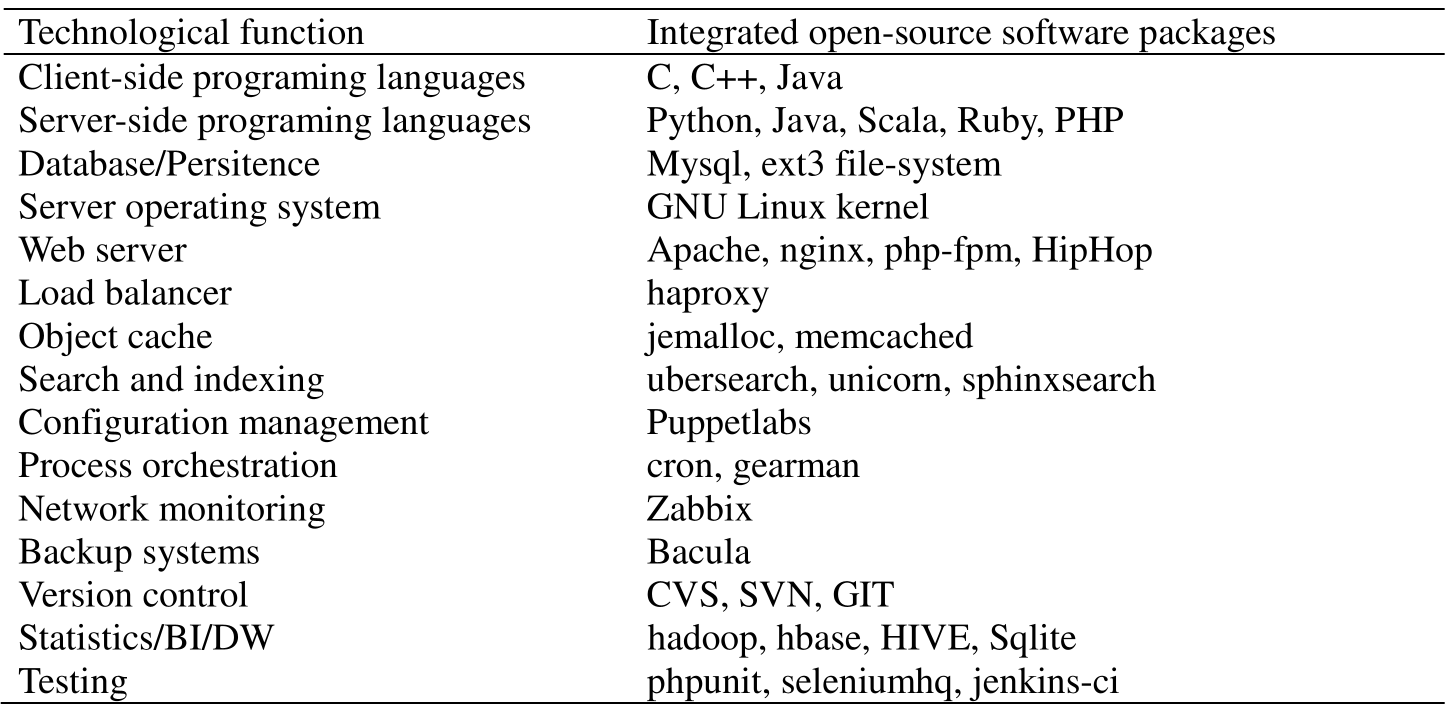
Table 1: The Open-Source Stack. Note the diversity: from the GNU Linux kernel to high-performance tools like HipHop (PHP optimization) and Cassandra/Hadoop for Big Data.
Key Insights: Community over Contracts
Perhaps the most profound finding is the nature of collaboration. Industrial players interact with the open-source world as human beings, not just "legal entities."
- The Personal Dimension: Success in fixing critical infrastructure often depends on the R&D staff’s personal reputation within the community.
- Internal Pressures: Interestingly, the paper notes that when social networks undergo ownership changes, there is often pressure from new management to switch to "enterprise" proprietary clouds—a move that R&D teams frequently resist due to the perceived inferiority and complexity of those systems.

Table 2: The study targeted three distinct geographic and functional leaders to ensure the observed OSS patterns were not localized anomalies.
Critical Analysis & Future Outlook
Takeaway: This paper serves as a vital historical and technical snapshot. It proves that the "secret sauce" of tech giants isn't necessarily a secret code—it's the ability to expertly orchestrate existing open-source components into a cohesive whole.
Limitations: As a 2011-era study, the stack has evolved. Modern architectures now rely more heavily on Kubernetes for orchestration and specialized AI/ML frameworks (like PyTorch) that were not yet SOTA at the time of writing.
Future Directions: The author suggests that future research should examine the economic impact of this OSS reliance. For developers and entrepreneurs, the lesson is clear: your ability to navigate the OSS ecosystem is just as important as your ability to write proprietary code.
Final Thought: In the world of high-tech social networks, "Standing on the shoulders of giants" translates literally to "Running on the Linux kernel and Apache."