
OpenClaw-RL: Turning Every Conversation into a Gradient Update
OpenClaw-RL: Train Any Agent Simply by Talking
OpenClaw-RL is a unified framework for training AI agents online by leveraging "next-state signals" (user replies, tool outputs, terminal states) as real-time learning sources. It achieves SOTA achievement by enabling personal agents to align with user preferences within roughly 10 conversation sessions while providing the first unified RL infrastructure for terminal, GUI, SWE, and tool-call environments.
TL;DR
The promise of AI agents is personal adaptation, yet most models remain static after deployment. OpenClaw-RL flips this script by treating every user reply, tool error, or GUI change as a training signal. By combining scalar rewards with a novel "Overlap-Guided" distillation process, the framework allows agents to learn and align with specific user preferences in as few as 10 sessions—all while building the first unified infrastructure for Terminal, GUI, SWE, and Tool-call environments.
Background: The Static Agent Problem
Current agentic systems (like Claude Code or OpenAI's latest models) generate massive amounts of interaction data. However, this data is usually treated as "exhaust"—stored in logs but rarely used to update the model in real-time. The difficulty lies in the asynchrony of deployment and the instability of Reinforcement Learning (RL) when applied to fluid, multi-turn conversations.
The Core Insight: Next-State Signals
OpenClaw-RL is built on a simple yet profound realization: The "next state" is a goldmine of supervision.
- Evaluative Signal: If a user says "No, that's wrong," it's a scalar reward ().
- Directive Signal: If a user says "You should have checked the file first," it's a token-level hint that can guide the model's internal probability distribution.
Methodology: Stable Hybrid Learning
To make real-time learning practical, the authors introduced two major innovations:
1. Asynchronous Infrastructure
The system decouples policy serving from training. As the user interacts with the agent, data is streamed to a separate RL server. This ensures the user never experiences "training lag."
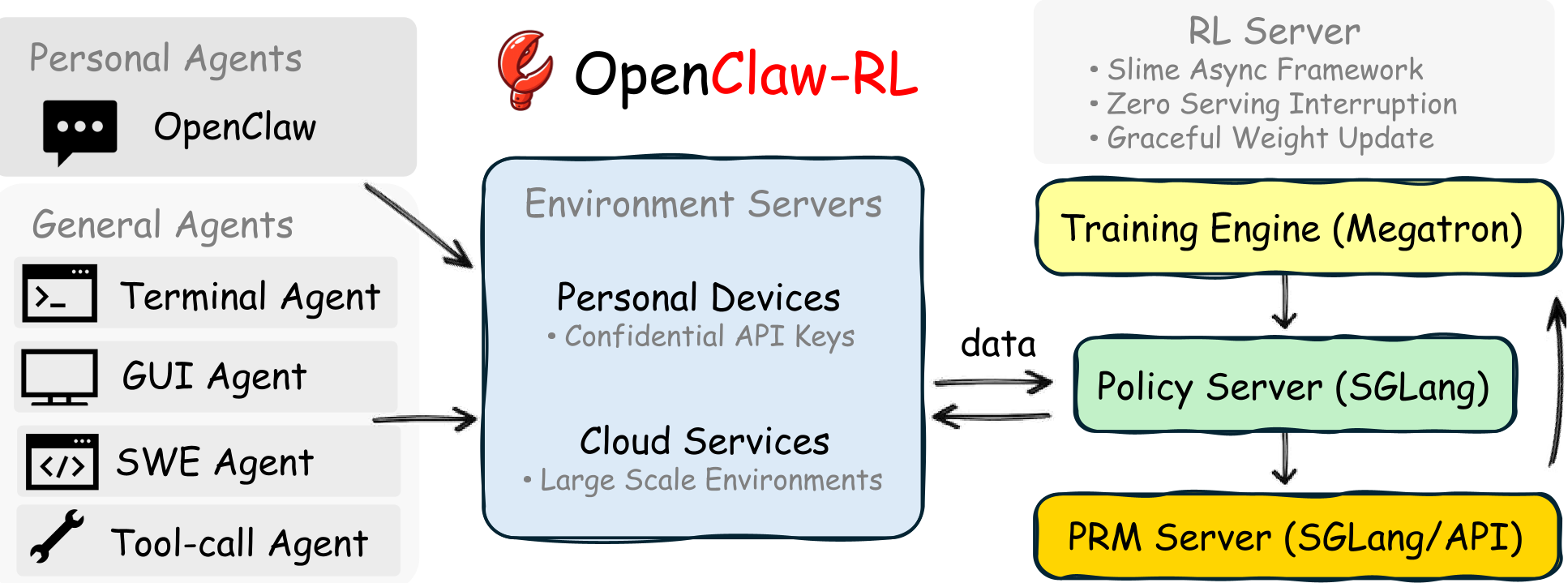 Figure 1: The OpenClaw-RL architecture, decoupling Environment, PRM Judge, Training (Megatron), and Serving (SGLang).
2. Overlap-Guided Hint Selection
The biggest risk in on-policy distillation is "teacher-student mismatch"—where a corrective hint pulls the model toward tokens it has near-zero probability of generating, leading to unstable gradients. OpenClaw-RL selects hints where the teacher's distribution has the highest top-k overlap with the student's existing distribution. This ensures the model learns "within its reach," maintaining stability.
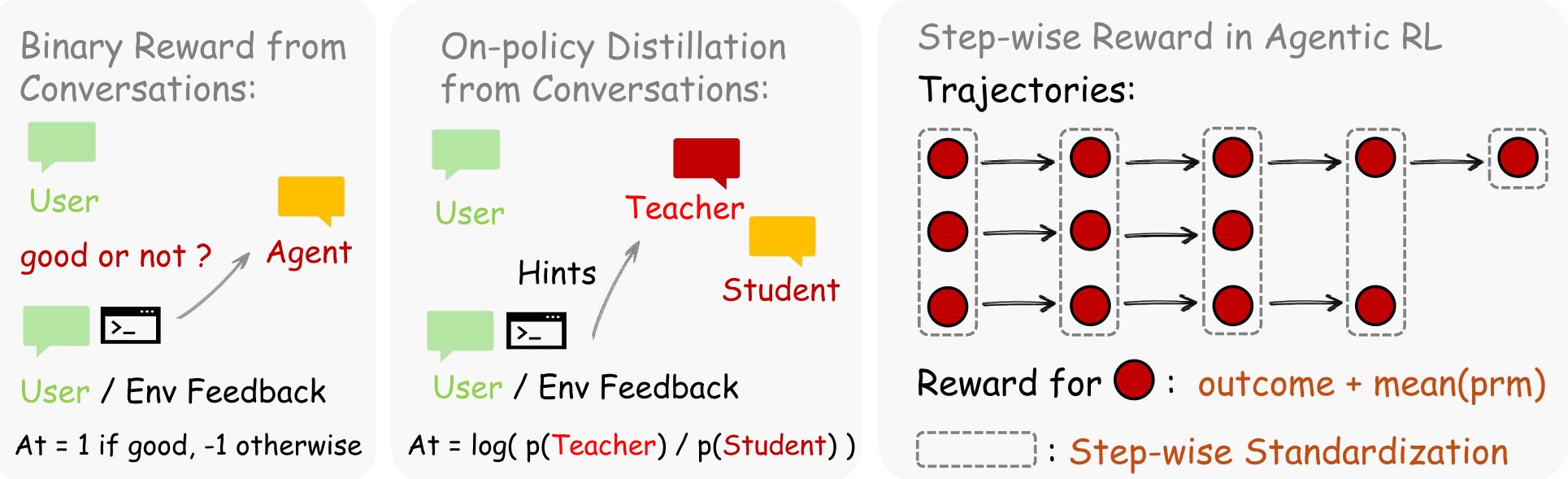 Figure 2: The Hybrid RL approach, unifying scalar rewards with hint-conditioned distillation.
Experiments: More than just "Personalization"
The authors tested OpenClaw-RL across two distinct horizons:
Personal Agents: The 10-Session Alignment
Simulating three roles (Student, TA, Teacher), the team found that the model could internalize complex persona constraints—like avoiding "AI-style" formatting or adopting a "friendly/patient" tone—within ~10 sessions. This significantly beat context-based memory methods like Mem0, which don't actually change the model weights and increase inference cost.
General Agents: The Unified Framework
OpenClaw-RL is the first to unify Terminal (shell), GUI (pixel-based), SWE (coding), and Tool-call agents. In long-horizon tasks, relying on terminal "Outcome Rewards" (success/fail) is often too sparse. By integrating "Process Rewards" (evaluating every step), the agent's performance in GUI tasks jumped significantly.
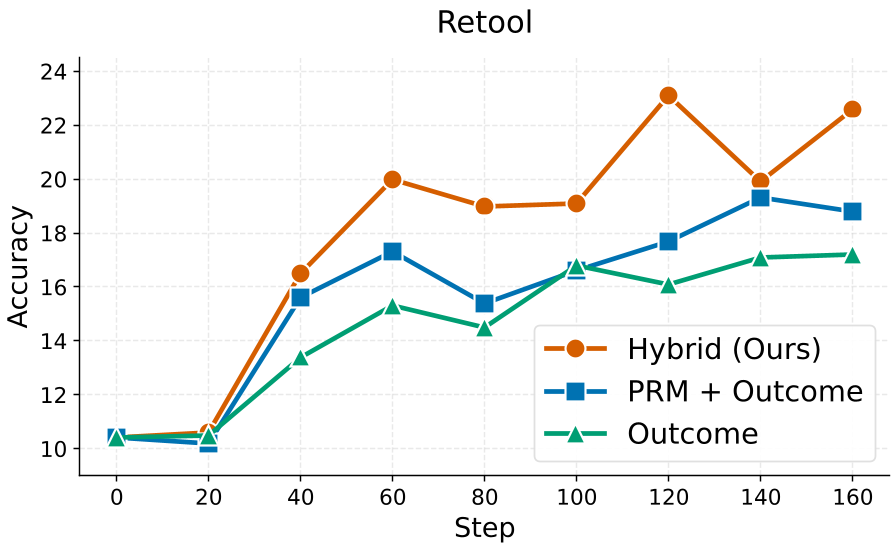 Figure 3: Hybrid RL shows superior training dynamics in multi-turn tool-call settings.
Critical Insight & Conclusion
The genius of OpenClaw-RL isn't just the math—it's the asynchronous pipeline. It proves that the barrier to "live learning" isn't just algorithmic; it's structural.
Takeaway: Future agents won't be shipped as "finished" products. They will be "blank slates" that specialize into the world's best coder, assistant, or teacher simply by being used.
Limitations: The paper notes that "malicious" user feedback could potentially poison a model. Identifying a "good" correction from a "bad" instruction remains the next hurdle for truly autonomous online RL.