
[OpenResearcher] Unlocking Deep Research: Reproducible Trajectory Synthesis with 100+ Step Reasoning
OpenResearcher: A Fully Open Pipeline for Long-Horizon Deep Research Trajectory Synthesis
OpenResearcher is a fully open-source pipeline for synthesizing long-horizon deep research trajectories by decoupling corpus bootstrapping from multi-turn synthesis. Using the GPT-OSS-120B teacher model and a 30B-A3B backbone, it achieves a SOTA 54.8% accuracy on BrowseComp-Plus, significantly outperforming proprietary models like GPT-4o and DeepSeek-R1.
TL;DR
Training "Deep Research" agents usually feels like a choice between two evils: paying thousands in Google Search API fees or settling for shallow 2-step reasoning traces. OpenResearcher breaks this cycle by moving the entire search-and-browse loop offline. By synthesizing 97K+ trajectories over a 15M-document local corpus, it produces a 30B model that smokes GPT-4o and DeepSeek-R1 on long-horizon research benchmarks.
The Motivation: Why Live Web Search is the Enemy of Progress
The current frontier of LLMs is shifting from simple chat to "Deep Research" (think OpenAI Deep Research or Grok DeepSearch). These agents don't just answer; they investigate. However, developing these systems faces a "triple threat" of bottlenecks:
- Cost & Rate Limits: Every failed reasoning path during data collection still drains your API credits.
- Instability: The web changes every second. You can't reproduce a training run if the "ground truth" search results vanished.
- Black-Box Observability: On the live web, you don't know exactly when the agent passed the "gold document" but failed to click it.
OpenResearcher solves this by decoupling one-time corpus collection from trajectory synthesis. They built an offline world for agents to play in.
Methodology: The Browser Primitives
The authors argue that "Search" isn't enough. Humans don't just look at snippets; we open tabs and Ctrl+F. OpenResearcher formalizes this into three minimal primitives:
- Search: Identify candidate sources (Top-K snippets).
- Open: Fetch the full content of a document.
- Find: Locate specific text within that document.
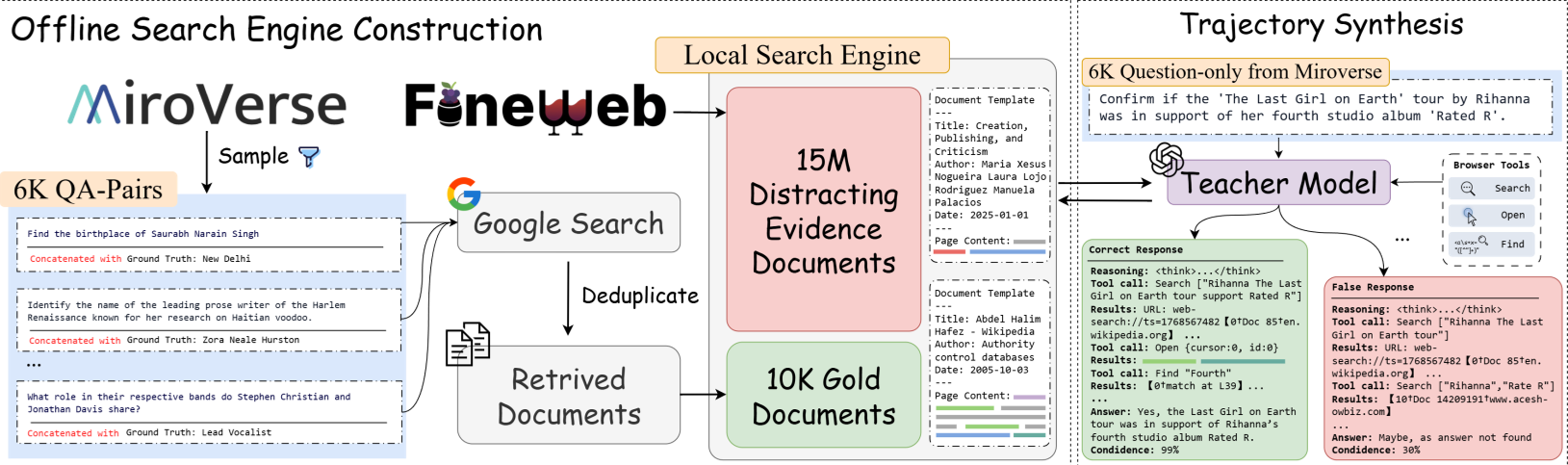 Figure 1: The OpenResearcher pipeline. One-time bootstrapping builds a 15M-document "mini-internet" for offline synthesis.
By forcing the teacher model (GPT-OSS-120B) to use these tools, the resulting data doesn't just contain the answer—it contains the navigation strategy required to find it.
The Long-Horizon Reality Check
Most datasets claim to be "multi-hop," but they are actually "two-hop." Real research is a marathon. OpenResearcher’s data includes a substantial "tail" of trajectories with 100+ tool calls.
The analysis reveals a fascinating "Efficiency Gap":
- Successful agents converge on the right facts in ~38 steps.
- Failed agents thrash around for ~71 steps. Failure isn't caused by a lack of "effort" (steps), but by poor query refinement.
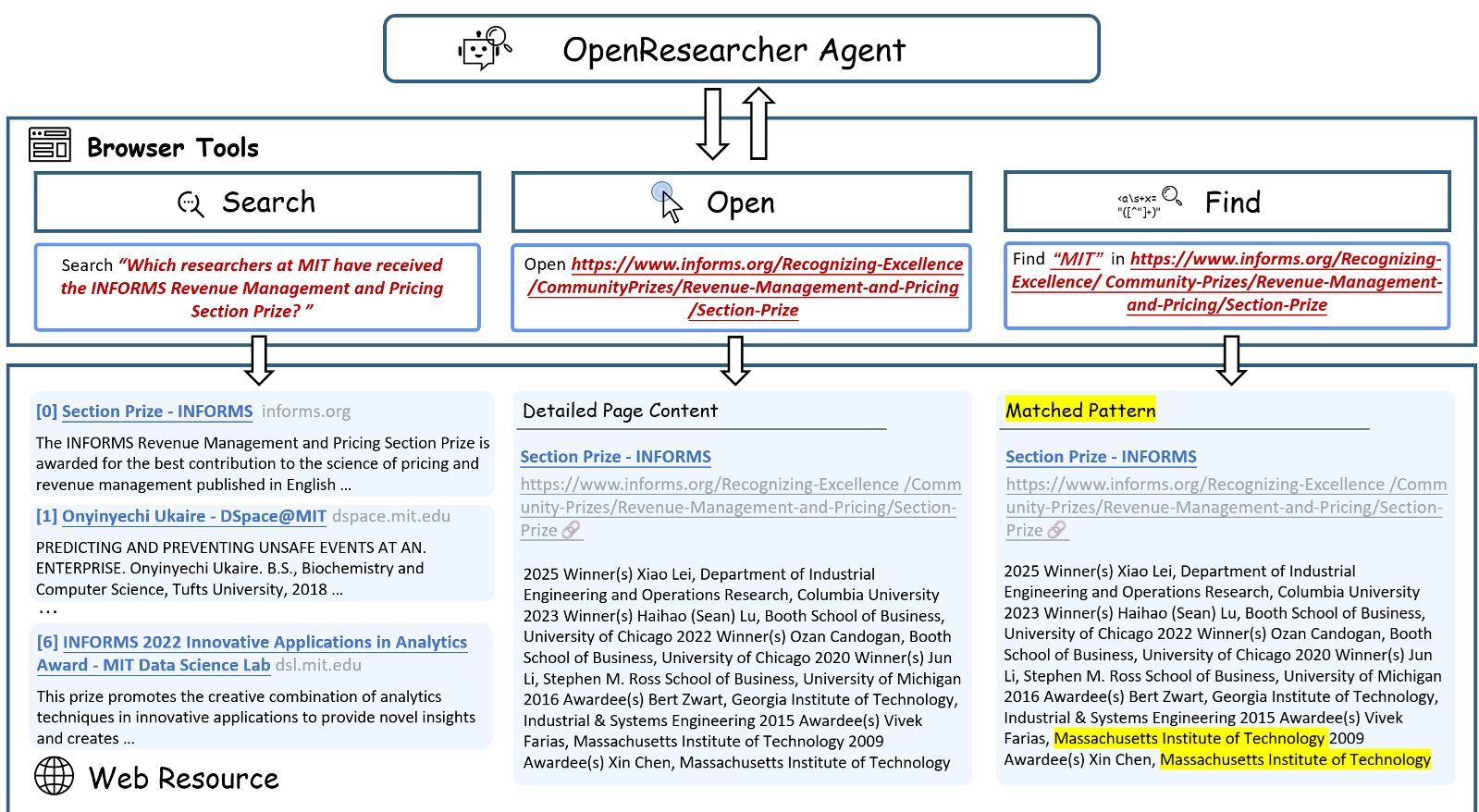 Figure 2: Moving from snippets to evidence localization via Search, Open, and Find.
Experiments: Crushing Proprietary Giants
The results are clear: specialized SFT on high-quality research trajectories is a superpower. The OpenResearcher-30B model achieved 54.8% on BrowseComp-Plus, nearly doubling the performance of the base model and significantly outperforming GPT-4 variants.
| Method | BrowseComp-Plus (Acc) |
|---|---|
| OpenResearcher (Ours) | 54.8 |
| Tongyi DeepResearch | 44.5 |
| GPT-4.1 | 36.4 |
| DeepSeek-R1 | 16.4 |
Table 1: Main performance results on closed-web benchmarks.
Crucially, the model transfers to the live web. Despite being trained only on an offline corpus, it achieved 64.1% on GAIA and 65.0% on xbench-DeepSearch using the live Serper API, proving that the logic of research is independent of the medium.
Critical Insights & Future Work
- Correctness isn't Everything: Interestingly, the authors found that training on "incorrect" trajectories still helps. Why? Because the model learns how to search and navigate, even if it eventually fumbles the final reasoning.
- The "Find" Tool is a Game Changer: Adding the
findprimitive lowered token usage and improved accuracy by allowing agents to skip the "skimming" and go straight to the facts. - Limitations: The system still struggles with table parsing and complex layout reasoning (as seen in Case Study 5).
Conclusion
OpenResearcher is a major win for the open-source community. It provides the blueprint for building deep research capabilities without a Silicon Valley budget. By focusing on offline reproducibility and explicit browser interactions, we can finally start scaling agentic reasoning to the hundreds (and thousands) of steps required for true scientific and professional research.
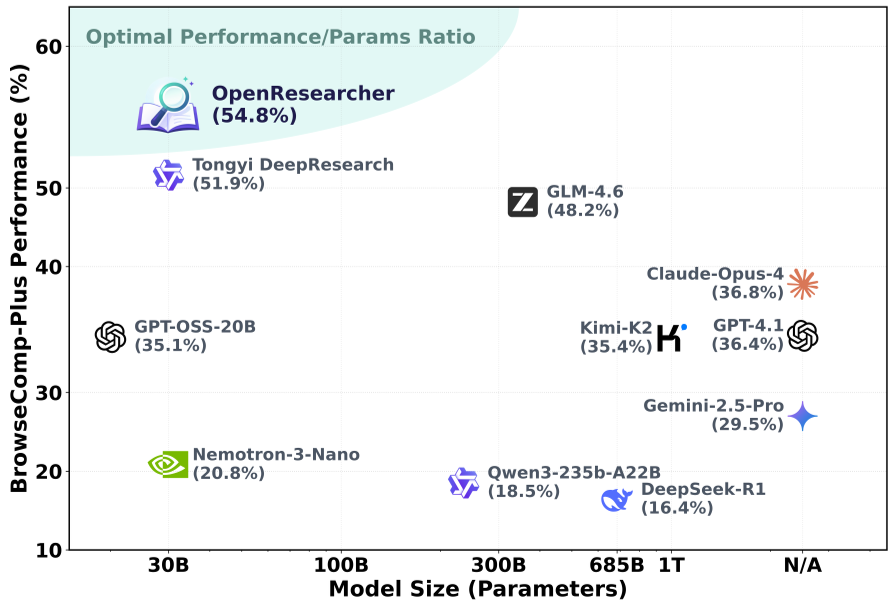 Figure 3: Efficiency vs. Accuracy on BrowseComp-Plus.