
[ArXiv 2025] OPENRESEARCHER: Shattering the Cost Barrier for Deep Research Agents
OpenResearcher: A Fully Open Pipeline for Long-Horizon Deep Research Trajectory Synthesis
OPENRESEARCHER is a fully open-source pipeline for synthesizing long-horizon deep research trajectories. It decouples corpus bootstrapping from synthesis to create a 15M-document offline environment, enabling a 30B-A3B model to achieve SFT performance (54.8% on BrowseComp-Plus) that rivals proprietary systems.
TL;DR
Unlocking "Deep Research" capabilities in LLMs usually requires burning thousands of dollars on Search APIs and dealing with the volatile nature of the live web. OPENRESEARCHER changes the game by moving the entire research loop offline. By creating a 15-million-document local corpus and using a "Search-Open-Find" primitive set, the researchers synthesized 97K high-quality trajectories. The result? A 30B model that punches way above its weight class, outperforming proprietary giants on complex research benchmarks.
The Problem: The Economic and Technical Fragility of Live Web Agents
Most current AI researchers (like OpenAI’s Deep Research or Grok) are "Live Web" dependent. This creates three critical bottlenecks:
- Cost: Every failed exploration path still costs API credits.
- Stability: The web changes daily. A trajectory generated today might be impossible to reproduce tomorrow.
- Shallow Logic: Most datasets only capture 2-5 "hops," whereas real human research often involves dozens of document inspections and query refinements.
Methodology: The Offline Synthesis Engine
The core innovation of OPENRESEARCHER is the decoupling of the corpus from the loop. Instead of calling Google at every step, the authors performed a one-time "bootstrapping" phase to gather "gold documents" for 6,000 complex questions, then buried them within a massive 15M-document distractor set from FineWeb.
The Browser Primitives: Search, Open, Find
The authors argue that "Search" alone is not "Research." They introduced three specific tools:
- Search: Broad retrieval of snippets.
- Open: Full-text access to specific documents (simulating a "click").
- Find: In-page exact string matching to localize evidence.
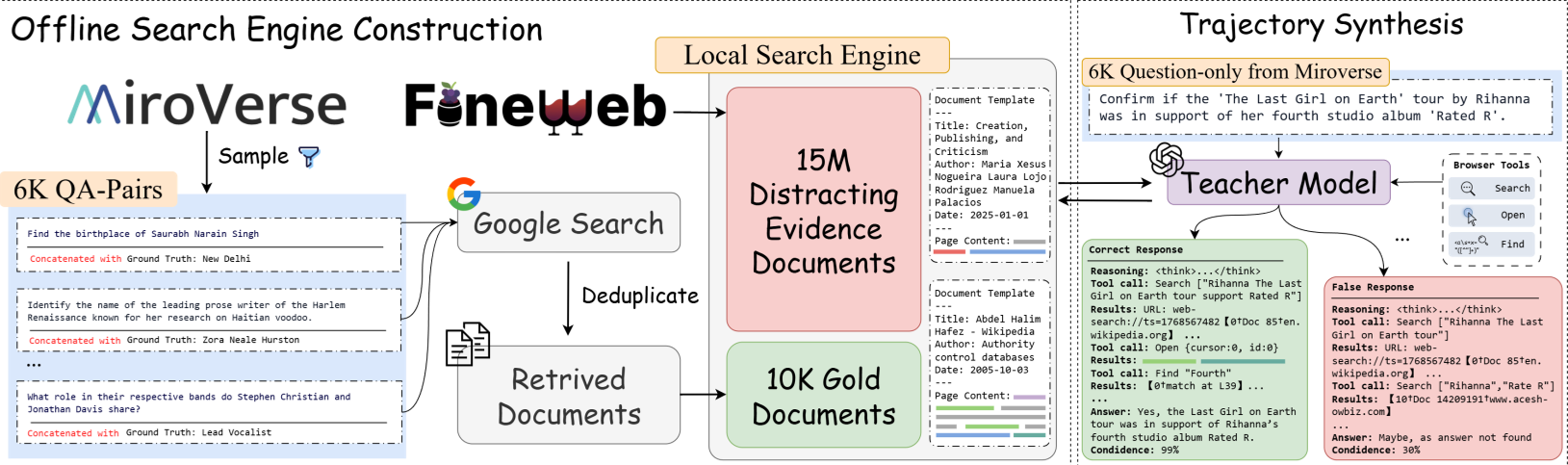 Figure 1: The OPENRESEARCHER pipeline: (1) QA collection, (2) One-time bootstrapping & distractors, (3) Offline trajectory synthesis via teacher models.
Experiments: Breaking the SOTA with a 30B Model
The authors fine-tuned a NVIDIA-Nemotron-3-Nano-30B (a Hybrid Mamba-Transformer) on 55K "answer-verified" trajectories.
Performance Highlights:
- BrowseComp-Plus: Reached 54.8% accuracy, a staggering +34% improvement over the base model.
- GAIA: Achieved 64.1%, outperforming much larger open-source models like WebSailor (72B).
- Efficiency: Failed trajectories were found to have nearly double the tool calls (71.7 vs 38.4) compared to successful ones, suggesting that "efficiency," not just "horizon length," is the true mark of a deep researcher.
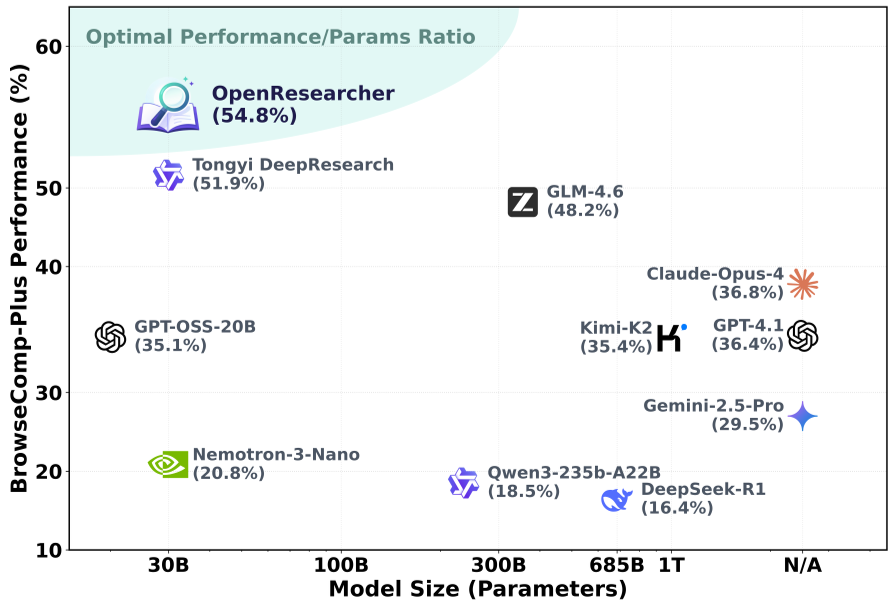 Figure 2: OPENRESEARCHER-30B-A3B vs. Proprietary and Open-Source Baselines on BrowseComp-Plus.
Deep Insights: Why Does it Work?
The ablation studies (RQ1-RQ5) provided several "Aha!" moments for the community:
- Evidence Exposure != Success: Merely "seeing" a document in search results only gives a ~61% chance of a correct answer. However, "opening" that same document pushes the probability to 86%.
- The Power of Find: Adding the
findtool reduced total token usage and tool calls, as it allowed the agent to skim and localize information rather than re-reading entire documents. - Correctness vs. Structure: Interestingly, the authors found that training on "incorrect" trajectories still provided useful supervision for search structure and tool-use etiquette, nearly matching the performance of "correct-only" training.
Critical Analysis & Conclusion
OPENRESEARCHER provides a blueprint for democratizing agentic research. By proving that a 30B model can compete with GPT-4 class models through high-quality trajectory synthesis, it shifts the focus from "bigger models" to "better data environments."
Limitations: The model still struggles with "search drift" or query-reasoning loops where it fails to reformulate queries when evidence is missing. Future Outlook: We expect this work to trigger a surge in "Offline-First" agent training, potentially leading to specialized research models that can be pre-packaged with specific domain-knowledge corpora (e.g., Medicine, Law) for private, high-security deep research.