
MVOC: Mastering the Chaos of Multi-Modal Opinions in Social Sensing
On Opinion Characterization in Social Sensing: A Multi-view Subspace Learning Approach
This paper introduces the Multi-View Opinion Characterization (MVOC) scheme, a novel framework designed to estimate sentiment and bias in social sensing data. By utilizing multi-view subspace learning, MVOC projects heterogeneous data (text and images) into a unified latent space, achieving significant performance gains over state-of-the-art baselines like CCA and LDA.
TL;DR
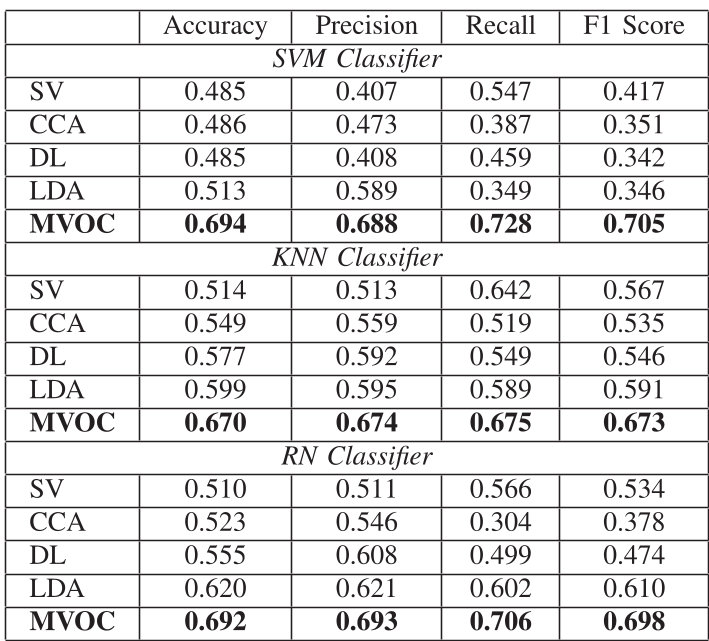
In the world of social sensing—where humans act as sensor nodes—data is a messy mix of text, images, and video. Most current AI models struggle when these modalities are imbalanced or incomplete. This paper presents MVOC (Multi-View Opinion Characterization), a framework that uses subspace learning to fuse disparate data types into a single "latent" language. The result? A staggering 18.1% boost in accuracy for sentiment classification on Twitter compared to existing SOTA methods.
Background: Why "Opinion Characterization" is Hard
Social sensing transforms platforms like Twitter or Instagram into real-time sensing networks. However, unlike physical sensors that output clean numerical data, human "sensors" provide unstructured content.
The researchers identify three critical "friction points" in current systems:
- Unstructured Nature: Deeply embedded sentiments in slang, @mentions, or blurry images.
- Heterogeneity: A tweet might have text, an image, or both; a system must handle both seamlessly.
- Modality Imbalance: People use text more on Twitter and images more on Instagram. Existing models often "overfit" to the dominant modality, leading to biased results.
Methodology: The Power of Subspace Learning
Instead of analyzing text and images separately and then averaging the results (which loses the contextual "bridge" between them), MVOC uses Multi-View Subspace Projection (MSP).
1. The Architecture
The workflow follows a three-stage pipeline: Meta-Data Extraction, Subspace Projection, and Characterization.
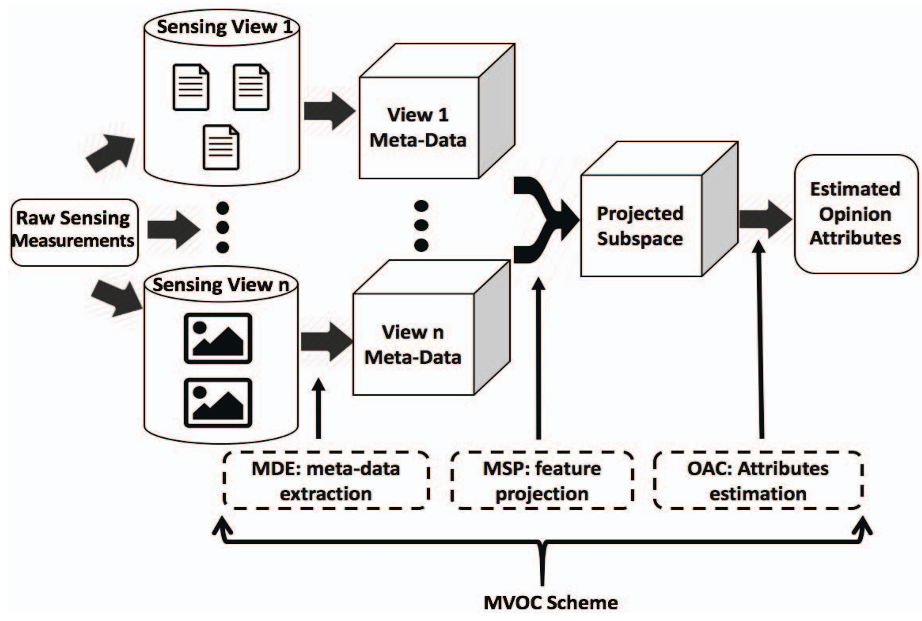
2. The Mathematical Insight
The "secret sauce" is in the objective function. The authors use matrix factorization to find a Latent Feature Vector (LFV) that represents the core "opinion" shared across views.
They introduce a weight parameter for each view. If you have 5,000 text posts but only 100 images, prevents the text from completely drowning out the visual evidence. The use of the -norm on the transformation matrix ensures sparsity, effectively picking only the most relevant features for the final opinion characterization.
Experimental Results: SOTA Comparison
The authors tested MVOC on a real-world Twitter dataset, specifically focused on "incomplete views" (tweets having only text or only images) to simulate real-world difficulties.
Key Findings:
- Versatility: Whether paired with SVM, KNN, or Radius-based Neighbors (RN) classifiers, MVOC consistently came out on top.
- Accuracy Leap: In the SVM tests, MVOC reached ~69% accuracy, while baselines like CCA (Canonical Correlation Analysis) and LDA (Latent Dirichlet Allocation) languished around 48-51%.
Modality Robustness
A core strength of MVOC is its stability. Even when the ratio of text to images was heavily skewed (5:1), the F1-score remained high. This proves that the subspace learning successfully captured the underlying sentiment regardless of which data modality was used to express it.
Deep Insight & Future Outlook
The brilliance of MVOC lies in its Inductive Bias: it assumes that different data modalities (views) are just different ways of observing the same underlying "opinion" manifold.
Limitations: The paper acknowledges that as the percentage of images increases, accuracy drops slightly. This is likely because current visual feature extractors (like GIST) are less "semantically dense" than NLP tools (like TF-IDF). Future iterations could integrate Deep Learning-based embeddings (like CLIP or ResNet features) into the MDE phase to narrow this gap.
Final Takeaway: MVOC provides a mathematical bridge for "filling in the gaps" of human sensors. For developers of disaster response or smart city systems, this offers a reliable way to gauge public sentiment and bias in the midst of data chaos.