
Beyond Keywords: Using Linguistic Modality and Tree Kernels for Smart Opinion Analysis
Opinion classification with tree kernel SVM using linguistic modality analysis
The paper introduces a method for classifying viewer opinions of TV programs into eight distinct categories by integrating linguistic modality analysis with dependency structure. The core approach utilizes a Tree Kernel Support Vector Machine (SVM) to process functional expressions and opinion-holding predicates, achieving a SOTA accuracy of up to 78.09%.
TL;DR
Researchers from NHK and the University of Tokyo have developed a system that categorizes TV viewer opinions by analyzing how something is said (modality) rather than just what words are used. By embedding modality and predicates into dependency trees and using a Tree Kernel SVM, they achieved a high classification accuracy of 78%, outperforming traditional keyword-based methods.
Background: Why Keywords Aren't Enough
In the world of sentiment analysis, most systems look for "good" or "bad" words. However, media feedback—like comments on TV shows—is much more complex. A viewer might say, "The theme is good, but the content is boring." A simple keyword search sees both "good" and "boring" and gets confused. To truly understand this, a system must recognize the sentence structure and the modality (the speaker's attitude, such as desire, doubt, or request).
Methodology: The Architecture of Subjectivity
The researchers proposed a dual-track system that processes sentences through three main components:
- Predicate Detector: Identifies 472 pre-defined opinion-holding verbs and adjectives.
- Modality Detector: Uses a specialized Japanese Functional Dictionary to identify 89 types of functional expressions (e.g., "should," "want," "they say").
- Integrated Judgment (Tree Kernel SVM): Instead of treating words like a random "bag," the system maps these features onto a dependency tree.
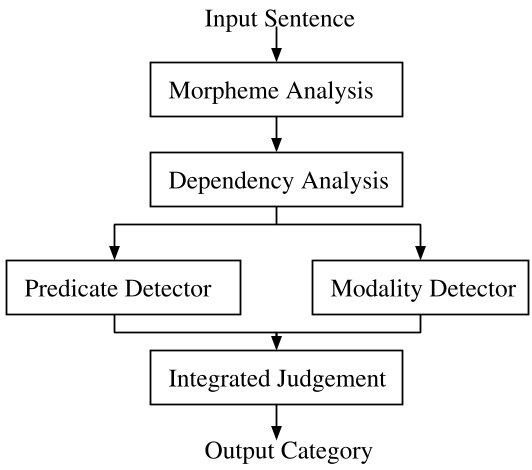 Figure 1: The system architecture showing parallel modality and predicate detection.
The "Tree Kernel" is the secret sauce here. It allows the SVM to compare the shapes of the dependency trees, helping the model realize that a negative modality at the end of a sentence often overrides a positive adjective at the beginning.
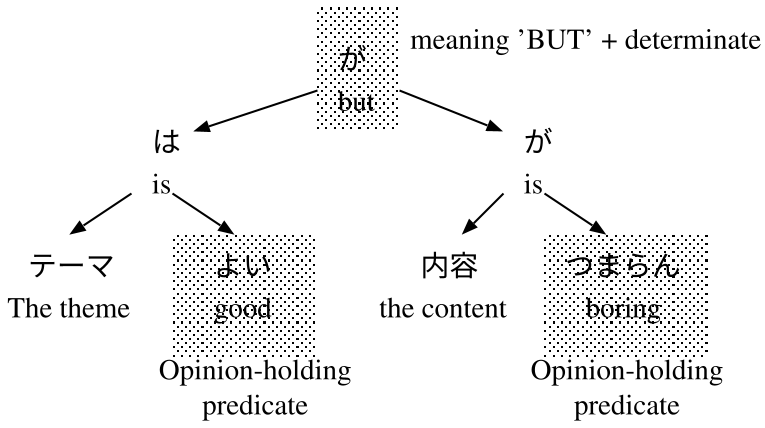 Figure 2: Example of how features are mapped onto a dependency tree (e.g., "The theme is good, but the content is boring").
Experimental Excellence
The team tested their method on a dataset of nearly 7,000 viewer comments across 8 categories, such as "Positive," "Negative," "Requests," and "Questions."
Key Results:
- Baseline (Bag-of-Words): 68.20% accuracy.
- Proposed Method (Bag + Dep-tree): 78.09% accuracy.
- Impact: The inclusion of structural information led to a 5.32% error reduction over the best non-tree-based model.
The "Leave-one-out" evaluation proved that the model generalizes well to new, unseen opinions, which is vital for real-world applications in media analytics.
Analysis: Why It Works
The success of this method lies in its Inductive Bias. By forcing the machine learning model to respect the grammatical hierarchy of the sentence, the researchers provided the "physics" of the language to the algorithm. This is particularly effective in Japanese, where the most important modality markers (like negation or requests) typically appear at the very end of the sentence.
Conclusion & Future Outlook
This work demonstrates that "sentiment" is not just about vocabulary; it is about the structural relationship between thoughts and attitudes. While modern LLMs (like GPT-4) now handle many of these nuances via massive data, this research provides a mathematically rigorous way to handle modality and structure which remains a core challenge in specialized NLU tasks.
Future developments could see these tree-based kernels integrated with deep learning embeddings to combine the "logic" of syntax with the "nuance" of neural representations.