
Opinion Dynamics Aware Marketing: Winning the War for the Consumer Mind
Opinion dynamics aware marketing strategies in duopolies
This paper introduces a game-theoretic framework to analyze duopolistic competition where two firms optimize targeted marketing strategies based on consumer opinion dynamics and social network topology. By modeling opinions as a linear consensus process and marketing as discrete interventions, the authors derive Nash Equilibria (NE) for firm investment.
TL;DR
In the digital age, a brand's value isn't just in the product—it's in the network. This paper explores how two competing firms (a duopoly) should spend their marketing budgets when they can see the "social graph" of their customers. By treating opinion evolution as a physical system (linear consensus) and the competition as a game, the authors uncover how firms can target specific "influencers" to maximize market share, and why sometimes, spending more can actually earn you less.
Perspective: From Homogeneous Masses to Networked Agents
Historically, marketing models treated the public as a "black box" or a homogeneous mass. If you spent on TV ads, you'd get market share. However, this ignores the social ripple effect. This paper shifts the coordinate system to a networked view, where the "opinion" of an agent is a continuous value reflecting their probability of purchasing from Firm 1.
The core insight is that firms aren't just buying an individual's preference; they are buying their influential power.
The Mechanics: How Opinions Move
The authors utilize a linear consensus model. Between marketing "jumps," consumers talk to each other, averaging their opinions with their neighbors based on a trust matrix (the Laplacian matrix ).
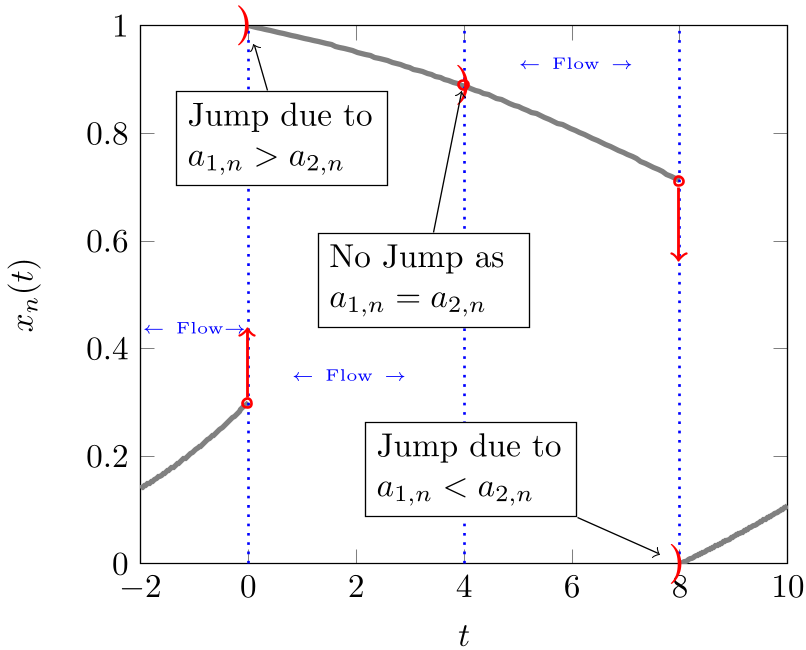
As shown in Figure 1, marketing campaigns happen at discrete intervals (). When Firm 1 invests in Agent and Firm 2 doesn't, that agent's opinion instantly snaps to 1 (pro-Firm 1). If both or neither invest, the opinion is dictated by the existing social momentum.
Agent Influential Power (AIP)
The most critical mathematical contribution is (AIP). It isn't just a measure of how many friends a person has; it’s a measure of how an intervention on that person today changes the time-averaged opinion of the entire network until the next campaign.
Methodology: The Static Game Decoupling
Analyzing a massive network game is computationally nightmarish. The authors prove a Spatial Decoupling property: the giant game can be broken down into tiny games—one for each consumer.
In each sub-game, the firm asks: "Is the cost of influencing this person (1 unit) less than the expected revenue gain ()?"
This leads to four regimes in the Nash Equilibrium (NE) space:
- Mutual Investment: Both firms target the same high-value influencer.
- Dominance: Only the firm with the higher valuation () or better initial starting position targets the agent.
- Mutual Neglect: The agent is too isolated or "un-influential" to justify the spend.
- Mixed Strategy: A state of "marketing war" where firms must randomize their spend to remain unpredictable.
Experimental Insights: The Paradox of Aggression
The numerical analysis reveals a fascinating behavior. When firms have no information on customer opinions, they tend toward a stable Pure NE. Firm 1, with a higher budget, naturally captures the market.
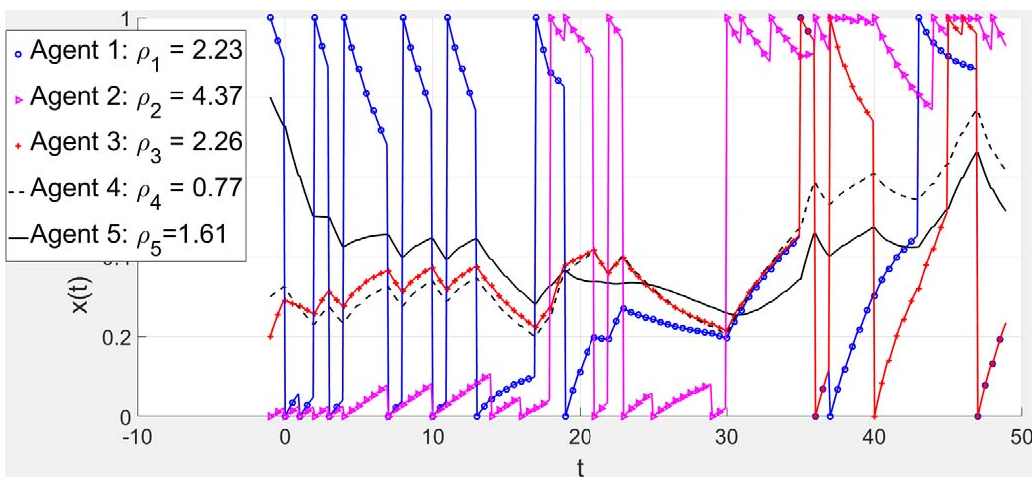
However, when firms have perfect information, they enter a "Mixed NE" regime. Because they can see exactly what the other is doing, they fluctuate.
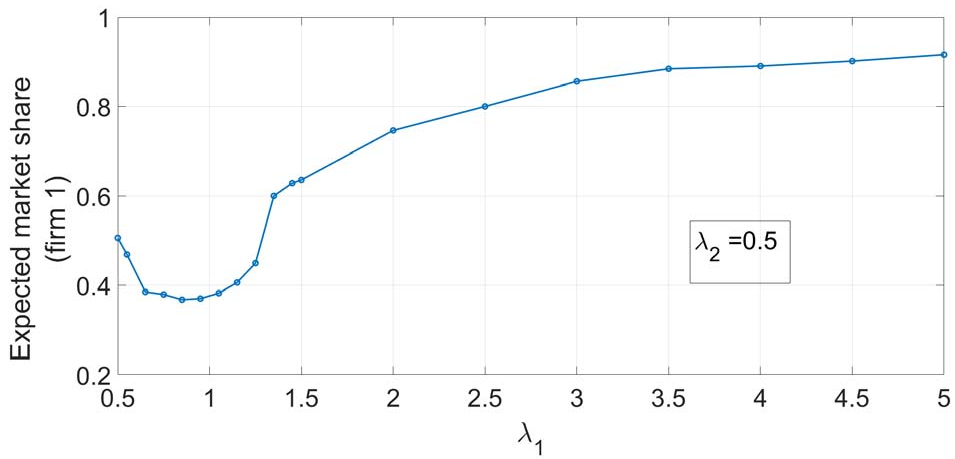
Even more surprising is the "Competitive Trap" shown in Figure 6. As Firm 1's willingness to spend () increases slightly above Firm 2's, their actual market share sometimes dips. This occurs because Firm 2 is forced into a defensive posture that neutralizes Firm 1's efforts. Only when Firm 1's budget becomes overwhelmingly large does it finally conquer the network.
Critical Takeaways & Future Directions
The paper effectively bridges the gap between Control Theory (opinion dynamics) and Game Theory.
- Strategic Advantage: Knowing the network structure is more valuable than having a larger budget if you can identify high- nodes.
- Limitation: The current model assumes a static network. In reality, marketing campaigns (especially divisive ones) can change the network structure itself, causing people to "unfollow" those they disagree with.
- Future Scope: The extension into Stochastic Games is the next frontier—modeling how today's marketing spend influences the "starting state" of tomorrow's competition.
In conclusion, this research provides a rigorous mathematical foundation for what many digital marketers intuitively know: in a connected world, you don't sell to everyone; you sell to the nodes that sell for you.