
Leader-Driven Opinion Dynamics: Steering Consensus and Polarization in Signed Networks
Opinion Dynamics Driven Under Leadership in Cooperation-Competition Social Networks
This paper introduces a leader-driven opinion evolution model built upon DeGroot-style dynamics within cooperation-competition social networks. Utilizing the properties of super-stochastic matrices, the authors establish algebraic conditions for achieving either global opinion consensus or opinion polarization under the influence of an influential leader.
TL;DR
Can a single persistent leader overturn the opinions of an entire group, even when members are competing with each other? This paper answers "Yes." By extending the classic DeGroot model to cooperation-competition networks (signed graphs), the authors provide a mathematical framework showing how a leader can drive a network toward a specific consensus or a balanced polarization.
Background & Motivation: Beyond Cooperation
In social psychology, the "minority influence" is a well-documented phenomenon—best exemplified by the film 12 Angry Men, where one juror eventually persuades eleven others.
Most mathematical models of social influence, like the original DeGroot model, assume agents only cooperate. While newer models like the Altafini model introduce competition (negative edges), they often result in "trivial consensus" where everyone’s opinion sinks to zero if the network is structurally unbalanced. This paper fills the gap by asking: How can a leader steer followers to a specific, non-zero opinion in a world of friends and foes?
Methodology: The Leader-Follower Interaction Rule
The authors propose a discrete-time evolution rule where each follower updates their opinion based on their neighbors and the leader :
Key Breakthroughs:
- Super-Stochastic Matrix Theory: The authors use the properties of these matrices to guarantee convergence. By ensuring the "row sum" logic of the influence matrix stays within specific bounds, they prove that the error between followers and the leader eventually vanishes.
- Gain Parameters (): These allow the model to handle "competitive" information. acts as a switch—setting it to promotes consensus, while can drive polarization (antagonistic response).
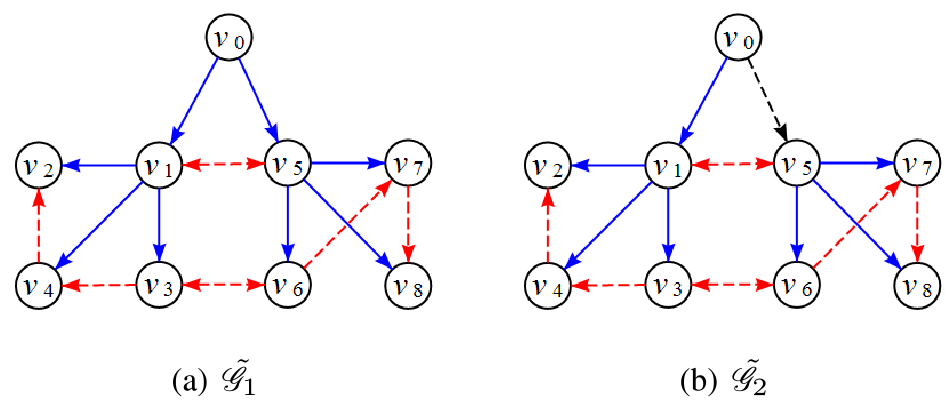 Fig 1. (a) A network aimed at consensus; (b) A network partitioned for polarization.
Two Paths: Consensus vs. Polarization
1. Reaching Consensus
Theorem 1 states that if there is a spanning tree where all paths from the leader are composed of "cooperative" (positive) edges, the entire network will eventually adopt the leader’s opinion . This is a significant upgrade from the Altafini model because the consensus value is dictated by the leader's will, not just a mathematical average of zero.
2. Driving Polarization
In many scenarios, a leader might cause a "backlash" or intentionally split a group.
- Opposite Polarization: If the leader's direct connections are negative but internal follower connections are positive, the group may converge precisely to .
- Group Splitting: By dividing followers into two sets ( and ), the leader can create a state where one group agrees with them while the other takes the diametrically opposite view.
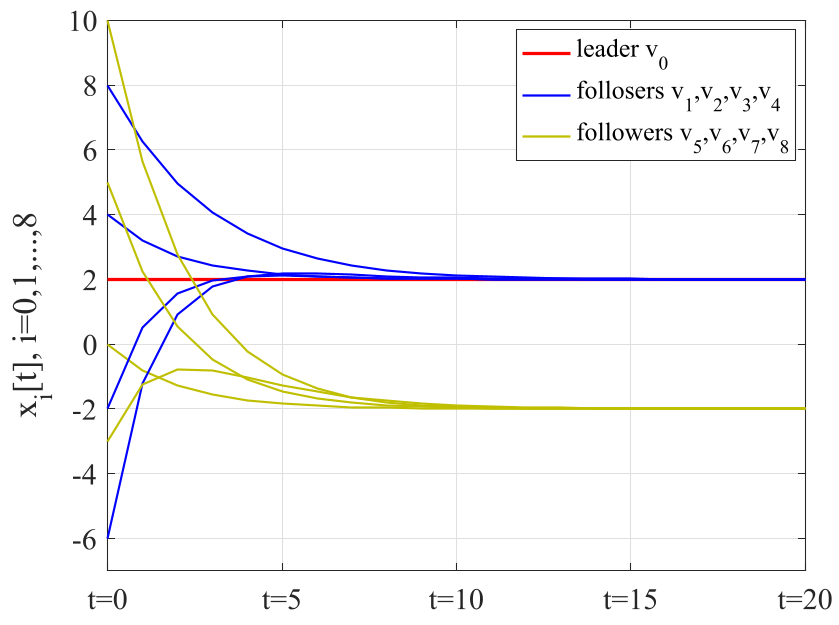 Fig 2. Simulation of polarization: Followers in V1 converge to the leader (blue), while V2 followers move to the opposite (red).
Critical Insight: Why This Matters
The most profound takeaway is that structural balance is no longer a prerequisite for meaningful opinion formation.
Previous SOTA (Altafini) suggested that if a network was "unbalanced" (contained cycles with an odd number of negative edges), opinions would always decay to neutrality. This paper proves that leadership overrides structural unbalance. As long as the algebraic conditions regarding the interaction weights and gains are met, a leader provides a "magnetic North" that prevents the system from collapsing into zero-opinion neutrality.
Conclusion & Future Work
The study demonstrates that consensus and polarization are two sides of the same mathematical coin in signed networks. The leader’s influence is the dominant factor.
Limitations: The model currently assumes a fixed, single leader and static network topology. In real-world social media, leaders (influencers) change, and "edges" (follow/unfollow) are highly dynamic. Future research integrating switching topologies with leader-driven dynamics will be the next frontier in understanding digital social movements.