
Beyond Homophily: Deciphering the Triad of Predisposition, Interaction, and Credibility in Social Networks
4624_Opinion Formation in Online Social Networks Exploiting Predisposition, Interaction, and Credibility.
This paper introduces a novel opinion formation model for Online Social Networks (OSNs) that incorporates psychological facets like predisposition and selective exposure. By integrating relative credibility and past interaction memory, the model significantly outperforms traditional Bounded Confidence Models (BCM) in predicting real-world Twitter discussion dynamics.
TL;DR
Social scientists have long used the "Homophily Principle"—the idea that we listen to like-minded people—to model how opinions change. However, this paper argues that human judgment is far more complex. By introducing Relative Credibility, Source Predisposition, and Interaction Memory, the authors created a model that predicts real-world Twitter shifts with 40% higher accuracy than classic baselines.
The Missing Pieces of Opinion Dynamics
Why do some people trust news media while others only trust their friends? Why does an argument you ignored yesterday suddenly seem convincing today? Most existing models (like the Bounded Confidence Model) treat agents as memoryless entities who only care about the "distance" between their current opinion and a neighbor's.
The authors identify three fatal flaws in this simplistic view:
- Selective Exposure: We have a "predisposition" toward certain types of sources (e.g., some prefer CNN/BBC, others prefer Reddit threads).
- History Matters: Past unconvincing interactions linger in our memory and can be "activated" by new, similar evidence.
- Authority is Relative: A source isn't just "credible" in a vacuum; its influence depends on how its expertise compares to everyone else you are listening to at that moment.
Methodology: The "Convincing Power" Engine
The core of the paper is the mathematical formulation of Convincing Power (). Instead of a binary "in or out" threshold, the authors use a Bayesian approach to calculate the probability that agent will be convinced by source .
1. Relative Credibility
The model uses Z-space probability measures to determine a source's impact. If you are listening to five people and one is significantly more expert than the others, their "Relative Credibility" gives them disproportionate weight.
2. The Algorithmic Flow
The opinion update process follows a sophisticated path:
- Selection: Agents choose between neighbors or External Sources (ES) based on their predisposition ().
- Encounter: Agents process a subset of available opinions (mimicking a social media feed).
- Memory Integration: The model checks the "History Set" (). If a new convincing opinion is similar to a past rejected one, the old opinion is "revived" and contributes to the update.
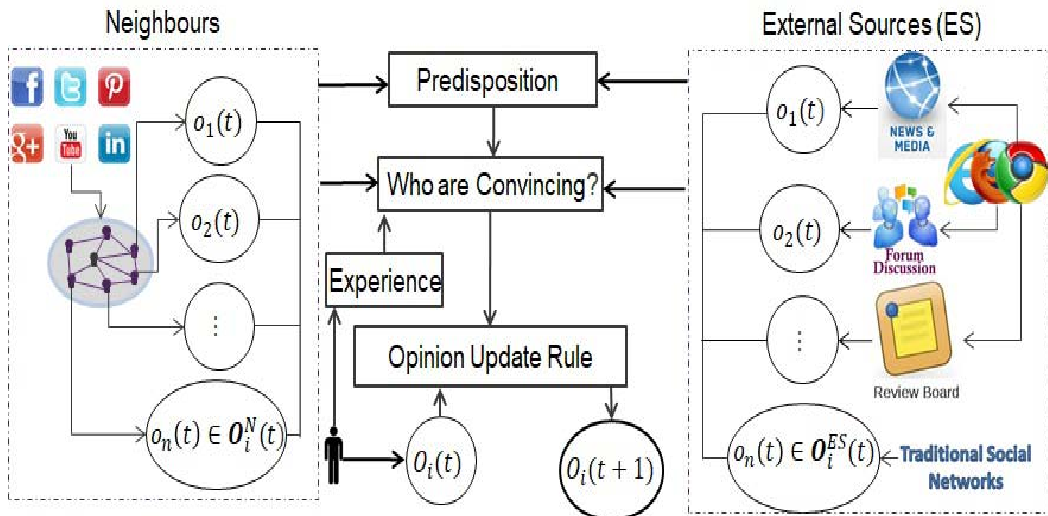 Figure 1: The proposed model framework showing the interplay between predisposition, perceived credibility, and interaction memory.
Experiments: Real-World Validation on Twitter
The researchers didn't just stay in the realm of simulation. They tracked the "Vaccination Debate" on Twitter over 30 days, analyzing 113,270 tweets from 55,930 users. They used Sentiment Analysis to turn text into numerical opinion values [0, 1] and calculated user expertise based on bio-info and content quality.
Key Performance Gains
The results were striking. When predicting how a user's opinion would shift over time:
- Accuracy: Achieved lower RMSE than the Biased Voter Model (BVM) and Bounded Confidence Model (BCM).
- Trend Prediction: The Directional Symmetry (DS)—the ability to predict if an opinion will move left or right—reached 0.35979, nearly doubling the performance of classic models (which hovered around 0.16-0.20).
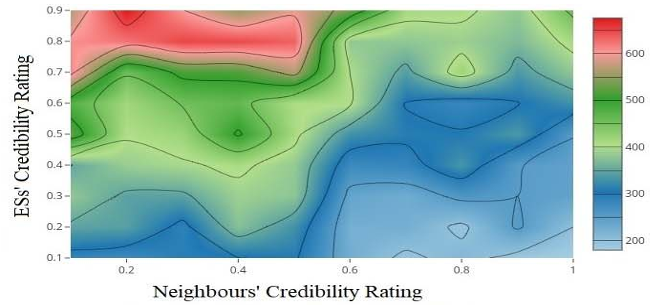 Figure 2: Simulations showing how the balance between External Source credibility and Neighbor credibility dictates whether a society reaches consensus or fragments into clusters.
Critical Insight: Path Dependency
One of the most profound conclusions is that opinion formation is path-dependent, not ergodic. This means the sequence of who you talk to and the initial positioning of credible leaders shifts the "equilibrium" of the entire network. If highly credible sources are polarized early on, the network is almost guaranteed to fragment, regardless of how much the average users talk to each other later.
Conclusion & Future Outlook
This work moves us closer to a "Computational Social Science" that respects human psychology. By acknowledging that we are biased (Predisposition), have memories (Interaction Experience), and respect authority (Relative Credibility), the model provides a powerful tool for:
- Predicting Market Trends: How consumer sentiment evolves through peer reviews vs. brand advertising.
- Crisis Communication: Understanding how to deploy "expert" voices to counter misinformation effectively.
Limitations: The model currently treats predisposition as a static trait. In reality, a series of bad experiences with the news media might shift someone's predisposition toward their neighbors—a "co-evolution" of trust and predisposition that remains a fertile ground for future research.