
Beyond Homophily: Decoding Opinion Dynamics through Credibility and Memory
11303_Opinion Formation in Online Social Networks Exploiting Predisposition, Interaction, and Credibility.
This paper introduces a novel opinion formation model for Online Social Networks (OSNs) that integrates relative credibility, agent predisposition, and past interaction experiences. By incorporating both neighbors and External Sources (ESs), the model achieves state-of-the-art accuracy in predicting real-world opinion dynamics on Twitter.
TL;DR
Researchers have developed a more human-centric opinion formation model that moves beyond the simple "distance-based" influence. By accounting for Relative Credibility, Predisposition, and Interaction History, this model significantly outperforms traditional algorithms (BVM, BCM) in predicting how opinions evolve on platforms like Twitter.
Context: While most models assume we simply average the opinions of those "close" to us, this work positions itself as a realistic bridge between sociology and computational modeling, proving that who says something matters as much as what they say.
The Missing Links in Social Influence
Why do some opinions change after years of resistance, while others shift instantly? Standard models like the Bounded Confidence Model (BCM) suggest we only listen to those within a certain "opinion distance." However, this ignores two critical human factors:
- Selective Exposure: We are inherently biased toward certain types of sources (e.g., trusting news media more than friends for medical advice).
- Memory Effect: An unconvincing argument encountered today might become persuasive tomorrow if a "credible" expert repeats it.
Methodology: The "Convincing Power" Formula
The core of this paper is the mathematical formulation of Convincing Power (). Instead of a fixed weight, the influence of a neighbor or an external source (ES) is determined via a Bayesian approach:
- Expertise (): A source's credibility is relative. If a source is much more credible than the agent, its "convincing power" spikes.
- Predisposition (): This acts as a gateway, determining whether an agent looks toward their peer network or external media first.
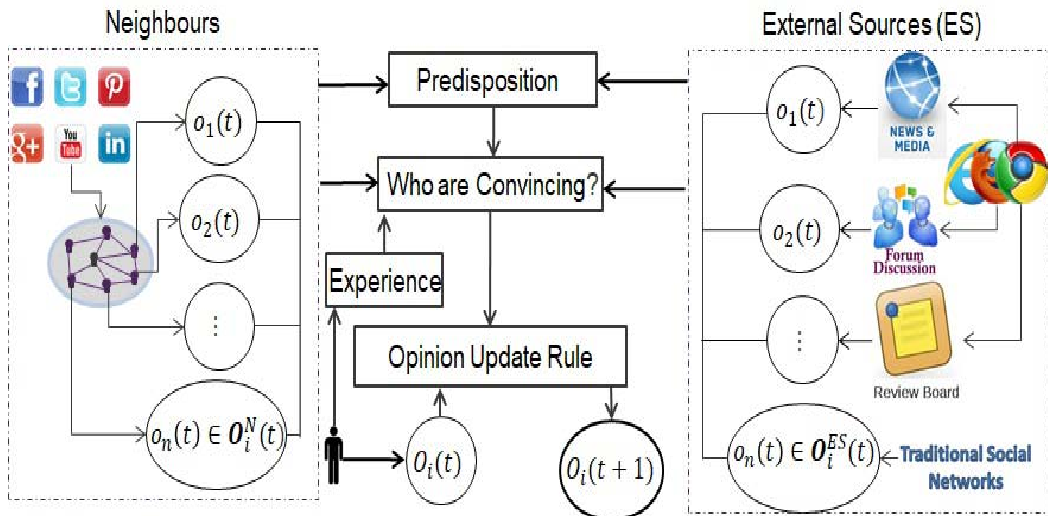 The model captures the interplay between an agent's predisposition, the perceived credibility of sources, and the accumulation of interaction history.
Real-World Validation: The Twitter Vaccination Debate
To test the model, the authors scraped 30 days of Twitter data concerning the "Vaccination Debate"—a topic rife with expert advice, peer anecdotes, and external news links.
Experimental Results
The model was tasked with predicting the "next" opinion of 299 active Twitter users.
- RMSE Improvement: Achieved a 6% lead over the Modified Deffuant Model and 13% over the Biased Voter Model.
- Directional Symmetry (DS): The model was 40% better at predicting the direction (pro vs. anti) of an opinion shift compared to baselines.
 Quantitative comparison showing the clear advantage of the proposed model in RMSE and DS metrics.
The Power of External Sources (ES)
Simulation results revealed a fascinating "Phase Transition." When the credibility of External Sources (like news outlets) is high, they can dominate the network even if agents have a low predisposition toward them.
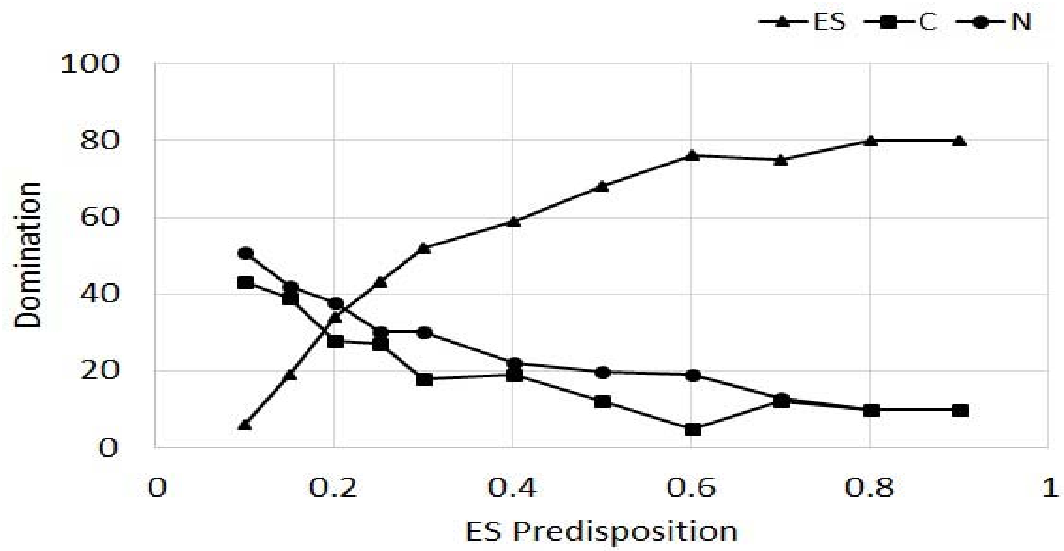 Simulation results showing how high-credibility ESs (left column) can "pull" the entire network's opinion toward their own, whereas peer-dominance leads to localized clusters.
Critical Insight & Conclusion
This research highlights that Opinion Consistency and Relative Credibility are the twin engines of social change. The model's ability to incorporate "memory" of unconvincing interactions provides a breakthrough in understanding how long-term persuasion works in digital echo chambers.
Limitations: While powerful, the model relies on sentiment analysis tools to convert text to numerical values, which currently suffer from an 80% accuracy ceiling. Additionally, the "Relative Credibility" is perceived by agents, which remains a difficult parameter to estimate without direct user profiling.
Future Outlook: This framework is a goldmine for analyzing the "Social and Economic Values" of influence—from predicting product popularity to understanding the breakdown of social consensus in polarized political climates.