
Beyond Consensus: How the "Silent Majority" and Network Segregation Shape Public Opinion
Opinion Formation in the Social Web: Agent-Based Simulations of Opinion Convergence and Divergence
This paper presents an agent-based simulation model for opinion formation in social networks, integrating epidemic diffusion and cascading mechanisms. It introduces the "silent majority" (neutral agents) and focuses on the nonlinear interplay between opinion convergence and the divergence caused by network segregation, achieving a more realistic representation of persistent social polarization.
TL;DR
Why do some online discussions lead to agreement while others end in "unfriending" and deeper polarization? This research moves beyond simplistic "averaging" models to show that opinion formation is a tug-of-war between two forces: the desire to fit in (convergence) and the tendency to cut ties with opponents (segregation). By introducing neutral agents into a dynamic scale-free network, the authors demonstrate how a "silent majority" acts as a critical buffer that delays—but sometimes accelerates—the formation of ideological echo chambers.
The "Consensus" Trap
Most classical sociophysical models operate on a flawed assumption: if two people talk long enough, they will eventually meet in the middle. In reality, modern digital interactions often produce the opposite. Whether it's political strife on X (formerly Twitter) or heated debates in blog comments, individuals frequently reinforce their own resolve or simply leave the conversation.
The researchers argue that we must decouple technical interactions (who can talk to whom) from social dynamics (who wants to talk to whom). The persistence of minority groups isn't a failure of the model; it's a fundamental feature of human sociality that allows extremist views to survive despite massive social pressure.
Methodology: Peer Pressure in Concentric Spheres
The model abandons the idea of random binary encounters. Instead, it treats opinion change as a response to Cumulative Peer Pressure.
1. The Sphere of Influence
Each agent calculates the "discomfort" of their current opinion by looking at four concentric spheres:
- S1 (Direct Neighbors): Holds 70.5% of the influence weight.
- S2 to S4 (Distant Network): Weights decrease geometrically.
2. The Power to Disconnect
Unlike static models, agents here are "opportunistic." If they disagree with a neighbor, they can cut that link and forge a new one with a like-minded peer. This rewiring maintains the "scale-free" nature of the network (where a few influencers hold massive connections) but changes the topology into clusters.
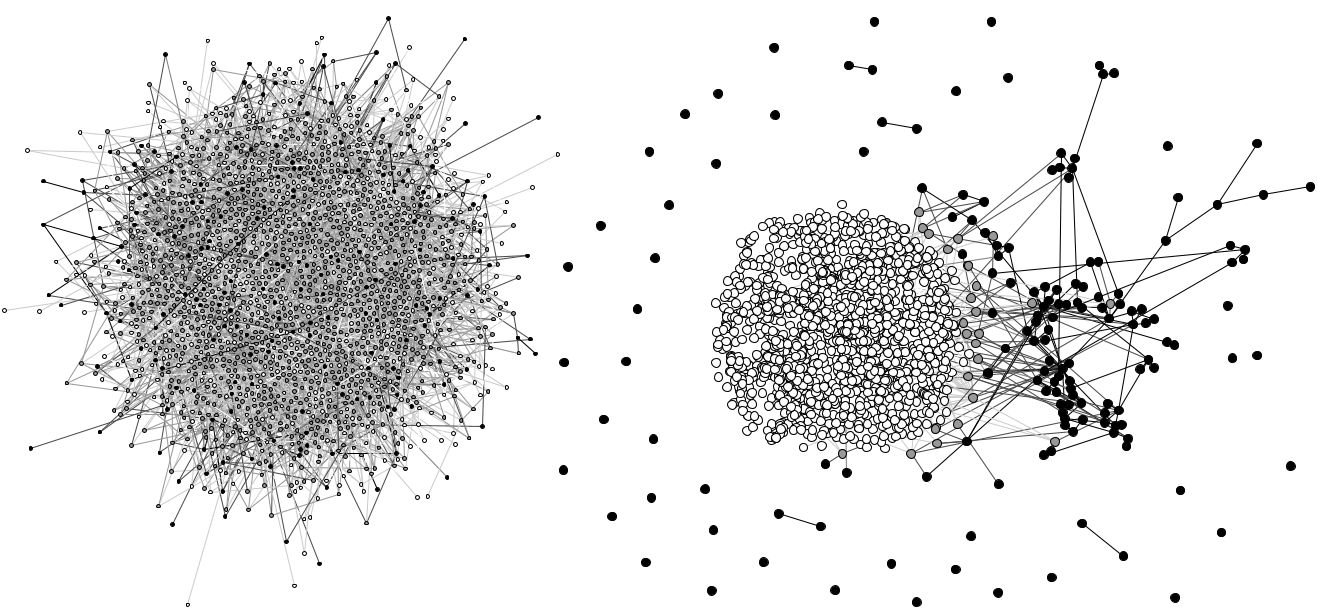 Figure 1: Conceptual view of how proponents (light grey) and opponents (black) interact within a sea of neutral participants (grey).
Key Insight: The Role of Neutrals
The most striking finding is the role of the "undecided." In a polarized world, neutral agents act as "Social Glue." By maintaining links with both opposing factions, they prevent the network from shattering into two completely isolated components.
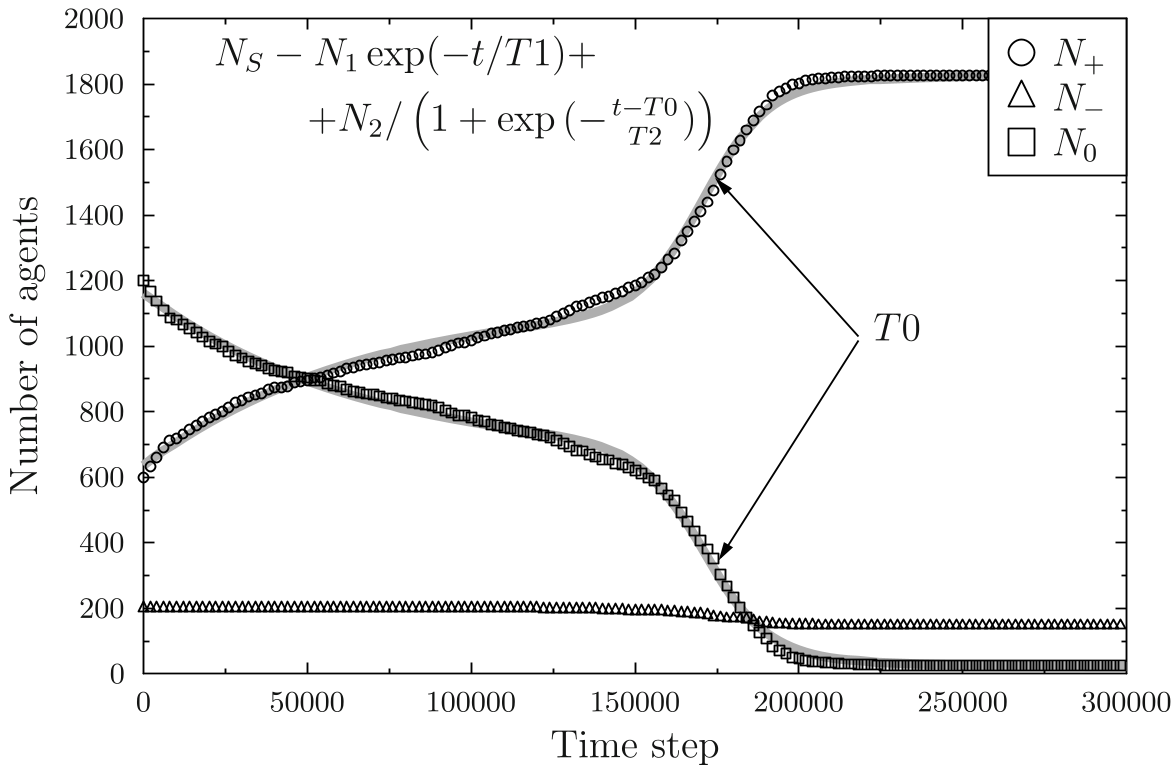 Figure 2: The evolution of opinions showing the sudden "logistic" switch. As neutrals choose a side, the "bridge" disappears, often leaving the minority completely isolated.
Two-Phase Evolution
The simulation reveals that public opinion shifts don't happen linearly. They follow two distinct phases:
- Phase 1 (Exponential Decay): A slow, steady conversion of a few neutral agents. The society remains relatively stable and mixed.
- Phase 2 (The Tipping Point): Once a majority reaches a critical mass, a "logistic switch" occurs. The remaining neutrals flee to the majority side at an almost explosive rate.
During this second phase, the minority group realizes it is being overwhelmed and "severs and cuts most of the information links with the majority." This is the birth of an Echo Chamber.
Critical Analysis & Conclusion
This work provides a sophisticated lens through which to view current social media dynamics. The "fat-tailed" distribution of the transition time () suggests that societal shifts are highly unpredictable—small changes in the initial network setup can lead to vastly different durations of peace before a sudden shift to polarization.
Limitations: While the model accounts for "static" links (family/work), it may still underestimate the power of algorithmic "recommender systems" that automate the rewiring process far more efficiently than humans can.
Future Outlook: For digital platforms and governments, the message is clear: protecting the "neutral" middle-ground isn't just about moderation; it's about maintaining the structural connectivity of society itself. Once the neutral bridge collapses, consensus becomes mathematically nearly impossible.