
Controlling the Social Pulse: High-Dimensional Markov Models for Algorithmic Opinion Influence
Opinion influence and evolution in social networks: A Markovian agents model
This paper introduces a continuous-time stochastic multi-agent model to investigate how centralized filtering algorithms (like those on Facebook) influence collective opinion dynamics. It models the social network as a high-dimensional Markov chain where individual transition rates are dynamically tuned by the opinions of neighbors and centralized influence parameters.
TL;DR
Social media platforms don't just host conversations; they tune them. This paper provides a rigorous mathematical framework to model how centralized filtering—represented as a tuning parameter —affects social contagion. It reveals that while an algorithm might not change the average opinion, it can drastically manipulate the certainty and volatility of the public discourse, potentially triggering massive "herding" behaviors.
Background: The Hidden Hand of the News Feed
We often view social networks as organic, horizontal diffusion processes. However, experiments like Facebook’s "Emotional Contagion" study prove that platform algorithms exert a content-specific control on interactions. The core scientific question is: How do we mathematically represent this centralized "tuning knob" and its effect on the stability of collective opinions?
Methodology: The Master Markov Model
The authors treat each individual as a Markov agent. When isolated, an agent's opinion drifts based on a transition rate matrix . When connected, this matrix is modified by the Linear Emulative Influence:
Here, is the crucial centralized parameter. If a platform wants to promote opinion , it increases . The entire network becomes a Master Markov Model, a massive state-space of dimension .
The Peer Assembly: Simplifying Complexity
To make this tractable, the authors introduce the Peer Assembly (PA)—a complete graph of identical agents. By applying the concept of "lumping," they condense the astronomical configurations into a simple Birth-Death Chain where the state is merely the number of people holding a specific opinion.
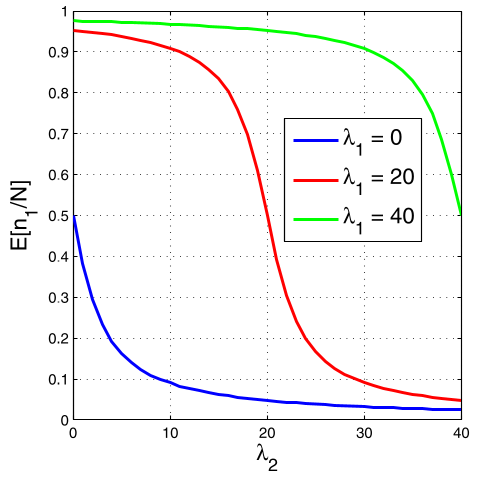 Fig 1: Effect of unilateral promotion () on steady-state distributions: as influence increases, the distribution shifts from the center to a deterministic consensus.
Key Insights: Mean vs. Variance
The paper’s most striking theoretical finding is the Unbiased Influence Invariance.
- The Mean: If the platform treats all opinions equally (unbiased ), the average number of people holding an opinion remains identical to the "stand-alone" case. The algorithm doesn't "change minds" on average.
- The Variance: However, as increases, the variance explodes. High interaction strength leads to "Herding"—moments where the entire network suddenly flips to a single opinion, staying there for a long time before flipping back.
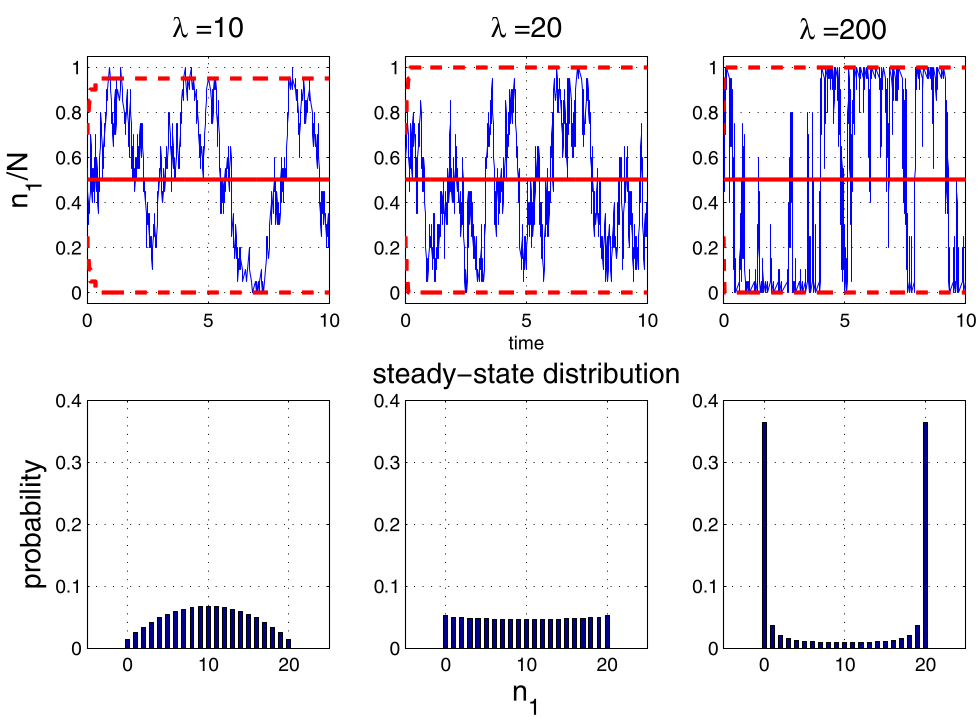 Fig 2: Evolution of herding behavior. As moves from 10 to 200, the distribution becomes bimodal—the community is either 100% in Favor or 100% Against, with nothing in between.
Topology Matters: From Small-Worlds to Stars
While the Peer Assembly is analytically beautiful, real networks are messy. The authors simulate more complex structures:
- Small-World: Shows lower variance than complete graphs because of limited connectivity.
- Star Topology: The most volatile. A single central agent acts as a "super-spreader," triggering massive opinion waves and a bimodal (unanimous) distribution.
Critical Analysis & Conclusion
This work provides a sober look at algorithmic "neutrality." A platform can claim it is "unbiased" because it doesn't change the average sentiment, yet by tuning the interaction strength (), it can effectively silence minority fluctuations or "freeze" the majority in place.
Limitations: The model assumes agents are relatively simple Markov chains. It does not yet account for "stubborn agents" who never change their minds, or "contrarian agents" who react negatively to the majority.
Future Outlook: The next frontier is Feedback Control. Can a platform monitor the current state of a network and dynamically adjust to prevent polarization or "burst" a filter bubble? This paper provides the first stone in the bridge toward a control-theoretic approach to social engineering.