
Competing Voices: Navigating the Dynamics of Opinion Leaders and Advertising Strategy
Influence identification of opinion leaders in social networks: an agent-based simulation on competing advertisements
2021-06-10
Summary
Problem
Method
Results
Takeaways
Abstract
This study proposes an integrated bounded confidence model to simulate the influence of competing advertisement opinion leaders in social networks. By utilizing agent-based simulation on ER random graphs, the research identifies how "advertisement weight" and "transmission probability" dictate the evolution of follower opinions.
## TL;DR
In the digital economy, opinion leaders are the gatekeepers of consumer trust. This research explores what happens when two rival brands compete for the same audience through these influencers. By using agent-based simulations, the study reveals a counter-intuitive truth: pushing an advertisement too hard can actually drive your customers into the arms of your competitors.
## The Battle for the Social Mind
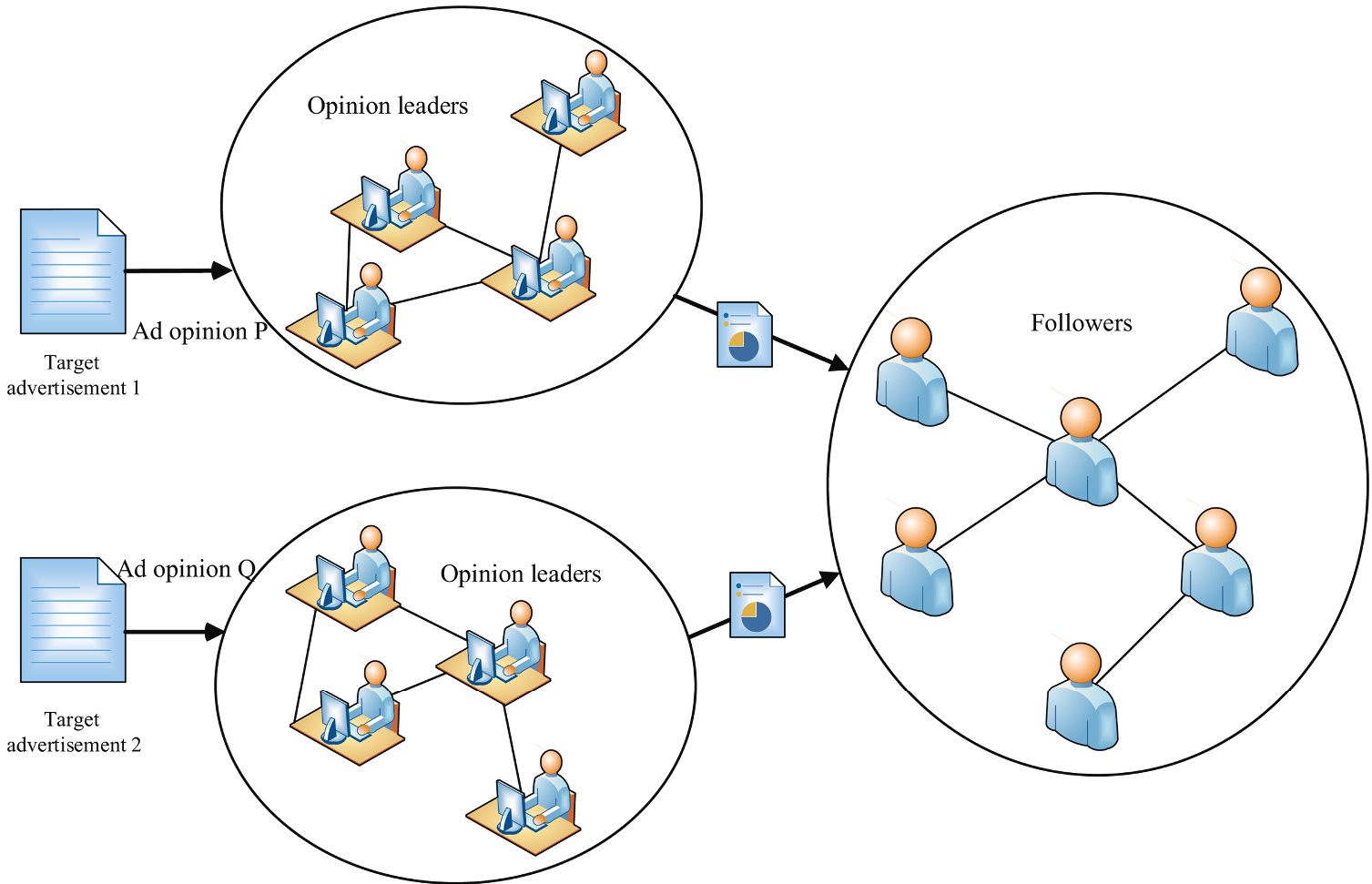
The modern marketplace is no longer a one-way street of brand-to-consumer communication. It is a complex web where **Opinion Leaders** (influencers) filter corporate messages. The central challenge for companies is not just "getting the word out," but understanding the **Opinion Dynamics**—the mathematical evolution of how a crowd reaches a consensus or splits into polarized camps.
Existing research often treats opinion formation as an isolated process. This paper argues that we must account for:
1. **Ad Intensity**: The psychological "weight" a message carries.
2. **Transmission Success**: The probability that an influencer actually manages to convince a follower during an interaction.
## Methodology: The Extended Bounded Confidence Model
The authors utilize the **Hegselmann-Krause (HK) model** as their foundation. In this world, an agent only listens to others whose opinions are within a certain "confidence level" ($\epsilon$).
The innovation here is the **Integrated Updating Rule**. Opinion leaders are "anchored" to a specific advertisement value ($P_A$ or $P_B$), while followers update their views based on aweighted sum of their peers and the influencers they trust.
### The Mathematical Intuition
The model defines the probability of a follower $i$ accepting an ad from leader $j$ as a function of their network connection ($\lambda_{ij}$) and a transmission success rate ($\xi$). This recognizes that not every post by an influencer results in a successful "opinion transfer."
## Key Insights from Simulation
### 1. The "Too Much of a Good Thing" Trap
One might assume that the more weight (budget/intensity) you put behind an ad, the more followers you gain. The simulation proves otherwise.
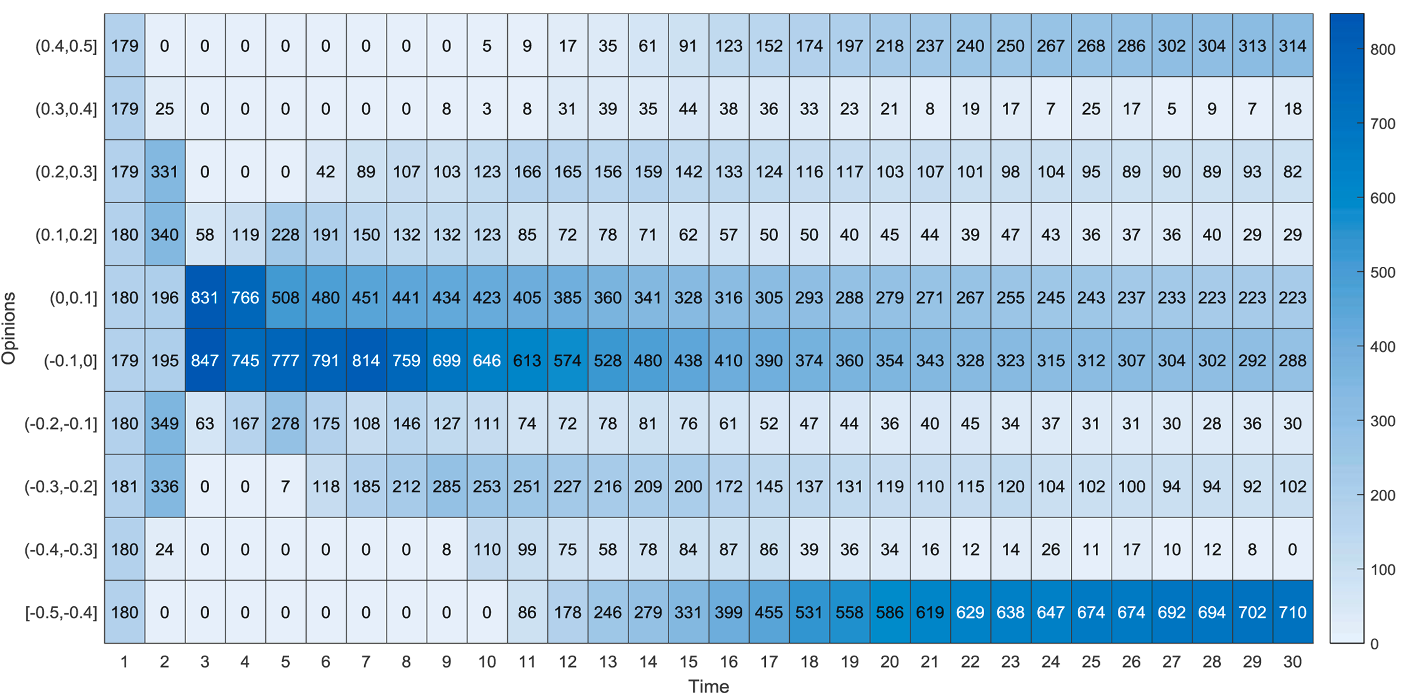
* **Convergence Zone**: At moderate weights ($\omega_A \approx 0.2$ to $0.6$), followers move toward the brand.
* **Polarization & Reversal**: When $\omega_A$ exceeds $0.8$, the followers' opinions diverge. Surprisingly, at extreme weights, the crowd may eventually converge to the *competitor's* opinion. This mimics real-world "skepticism" where overt manipulation causes a backlash.
### 2. Efficiency Over Intensity
The probability of successful transmission ($\xi$) was found to be a more stable lever for influence than mere intensity. Increasing the efficiency of an opinion leader allows a brand to achieve consensus even if they start with a smaller base of supporters.
## Critical Analysis & Conclusion
This paper provides a sobering lesson for digital marketers: **Precision beats Power.**
**Strategic Takeaways:**
* **Rational Intensity**: Marketers must find the "effective range" for their campaigns. Beyond this threshold, you aren't just wasting money; you're actively damaging your brand's trust.
* **Focus on Transmission**: Instead of demanding influencers post more frequently (increasing weight), brands should focus on the *quality* of the interaction (increasing transmission probability).
**Limitations**: The study uses an ER random graph, which may not capture the "echo chamber" effects found in real-world Scale-Free (SF) social networks. Future research should test these dynamics in architectures where a few "super-hubs" dominate the landscape.
In the war of information, the loudest voice isn't always the winner—the most trusted one is.