
SNUO: Merging Opinion Mining and Semantic SNA for Next-Gen Tourism Governance
Opinion mining and semantic analysis of touristic social networks
The paper introduces a novel interdisciplinary model for Social Networks of Uses and Opinions (SNUO), combining Opinion Mining with Semantic Social Network Analysis (SNA). It provides a decision support system for territorial tourism governance by mapping relationships between users, territorial uses, and web-derived sentiments.
TL;DR
In the era of Big Data, understanding a territory's "social ecosystem" requires more than just counting hotel bookings. This paper introduces the Social Network of Uses and Opinions (SNUO), a framework that blends Natural Language Processing (NLP) with graph theory to map how people use a territory and how they feel about it. By propagating web-crawled sentiments through social graphs, it identifies "central" influencers and hidden market niches.
The Motivation: Moving Beyond Quantitative BI
Traditional Business Intelligence can tell you that women like e-books on the beach, but it can't tell you how that preference interacts with specific territorial services or how a negative sentiment about "accessibility" might fracture the tourist community.
The authors identified a gap: Semantic Social Network Analysis (SNA) often ignores the axiological (evaluative) dimension of content—essentially, it knows what people are talking about, but not the intensity or polarity of their feelings.
Methodology: The SNUO Architecture
The core contribution is a heterogeneous graph structure composed of two interconnected layers:
- Networks of Opinions: Concepts and terms are nodes weighted by polarity (positive/negative) and intensity, derived from web testimonials.
- Networks of Uses: Nodes represent users and physical activities (tracked via QR codes, bookings, etc.).
Bridging the Gap through Propagation
To link these, the authors define a Semantic Degree Centrality. Instead of just counting connections, it uses a modified TF-IDF to measure "predominance"—how significant a term (like "Sea" or "Camping") is to a specific user.
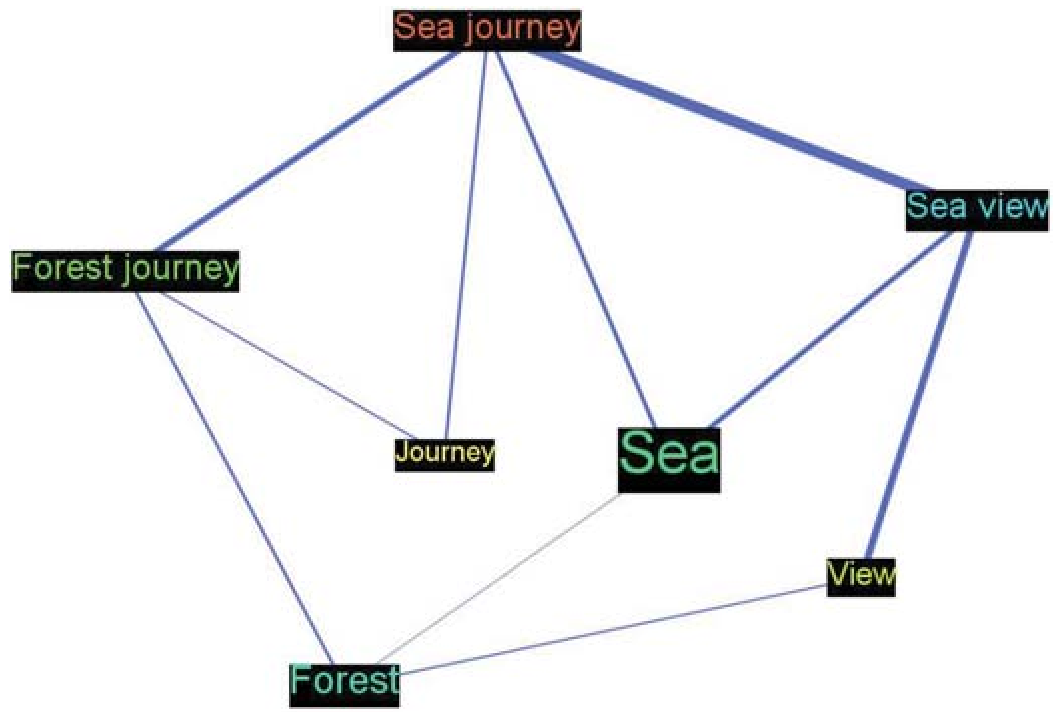
The propagation process follows a logical flow:
- Step 1: Calculate (interface weight) by combining semantic centrality with the concept's opinion score.
- Step 2: Propagate these values to terms, then to users.
- Result: Each user in the graph eventually receives an "opinion score," identifying influential but unsatisfied "mediators."
Visualizing Territorial Governance
The paper provides a practical simulation (Fig. 3) of tourists interested in "hosting" (hébergement).
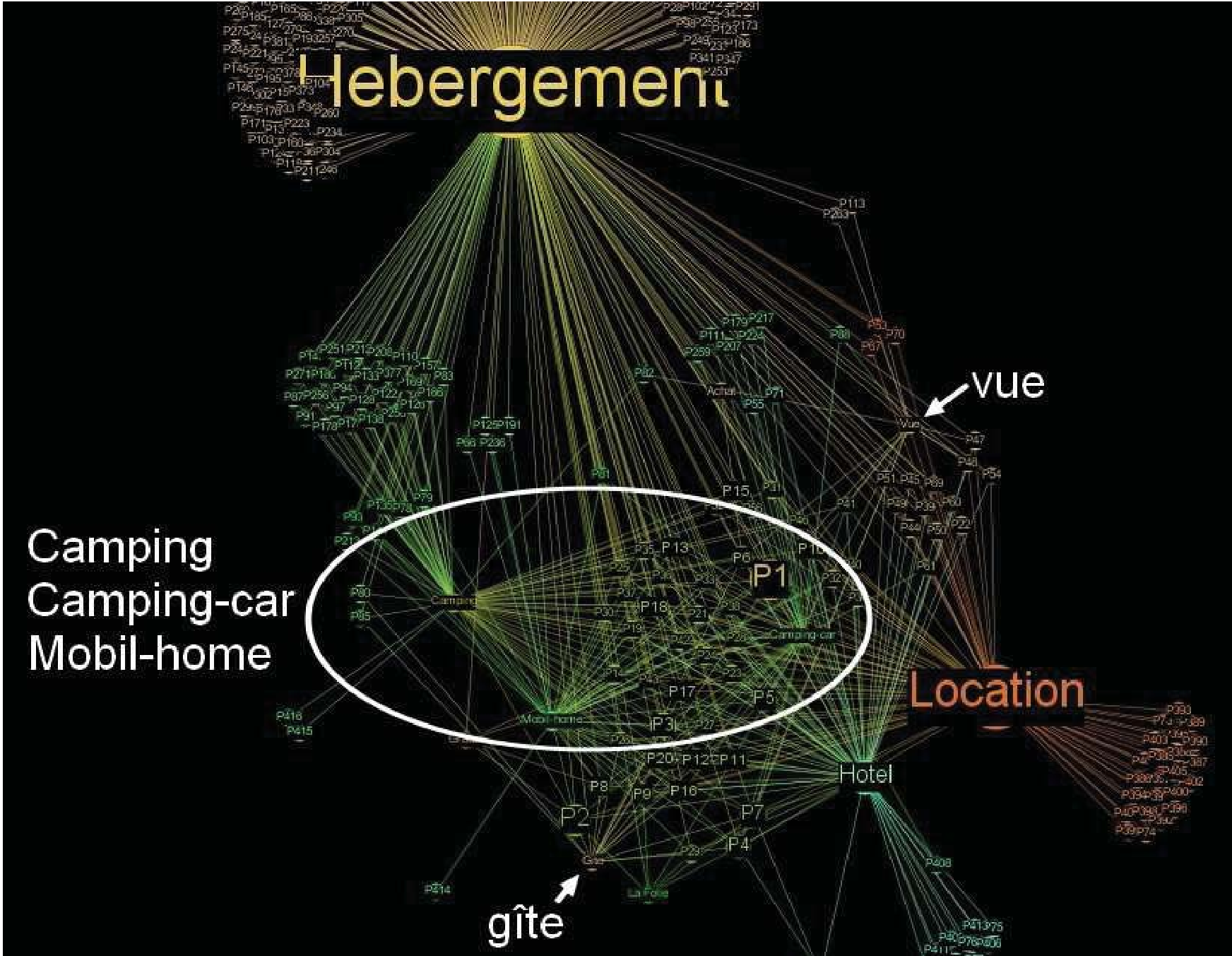
Insights derived from the graph:
- Large-scale dissatisfaction: A cluster at the top reveals a community unhappy with traditional rentals.
- Central Success: A core group is highly satisfied with "outdoor hosting" (mobile homes), suggesting a shift in demand.
- Strategic Action: By identifying user "P1"—a central but unsatisfied mediator—authorities can target them with specific offers (e.g., a free weekend) to flip their sentiment and leverage their influence.
Critical Analysis & Future Outlook
While technically sound, the methodology relies heavily on the coverage of prominent concepts. If the NLP module fails to capture a specific niche sentiment from the web, the propagation through the "network of uses" will be incomplete.
Future Work: From Static to Predictive
The authors plan to extend this into a predictive model. By treating information flow like a physical current in a network, they aim to anticipate opinion shifts before they manifest in economic downturns. This moves "Business Intelligence" from a reactive reporting tool to a proactive steering mechanism for regional innovation.
Conclusion
The SNUO model represents a significant evolution in SNA. By treating sentiments not as isolated data points but as "charges" that flow through a network of actual uses, it provides a vivid, actionable map of human behavior within a territory.