
Opinion Mining and Social Networks: The Strategic Match for Sentiment Intelligence
Opinion Mining and Social Networks: A Promising Match
The paper explores the synergy between Social Network Analysis (SNA) and Opinion Mining, proposing a "Proportional Method" for sentiment classification. Tested on Polish e-commerce and social datasets (Merlin, Ceneo, Znany lekarz), it demonstrates that social network contexts and long n-gram representations significantly enhance sentiment detection.
TL;DR
This research highlights that opinions do not exist in a vacuum; they are products of social environments. By proposing a Proportional Method for term scoring and leveraging the structural richness of social networks, the authors demonstrate a more robust way to handle sentiment classification in morphologically complex languages like Polish, significantly reducing noise compared to traditional frequency-based models.
Context: Why Social Networks Matter for Opinions
The core insight of this paper is that social networks offer more than just text—they provide context. The authors argue that an opinion's weight should be modulated by the creator's "prestige" (Centrality) and their "social milieu" (Community).
- Prestige: Opinions from highly central nodes (high degree or betweenness centrality) should carry more weight.
- Community Structure: Humans tend to conform to group norms. Knowing a user's community allows algorithms to account for group-specific nomenclature and biases.
Methodology: Beyond Simple Frequency
The authors identify a major flaw in the standard Score Method: it assigns extreme values to rare words that happen to appear only in one class. To fix this, they introduced the Proportional Method.
The Proportional Scoring Formula
The method uses the ratio of conditional probabilities rather than simple differences:
By using (the reciprocal of the majority class size), the influence of "one-hit-wonder" terms is suppressed. This allows the model to prioritize terms that are statistically significant across the corpus.
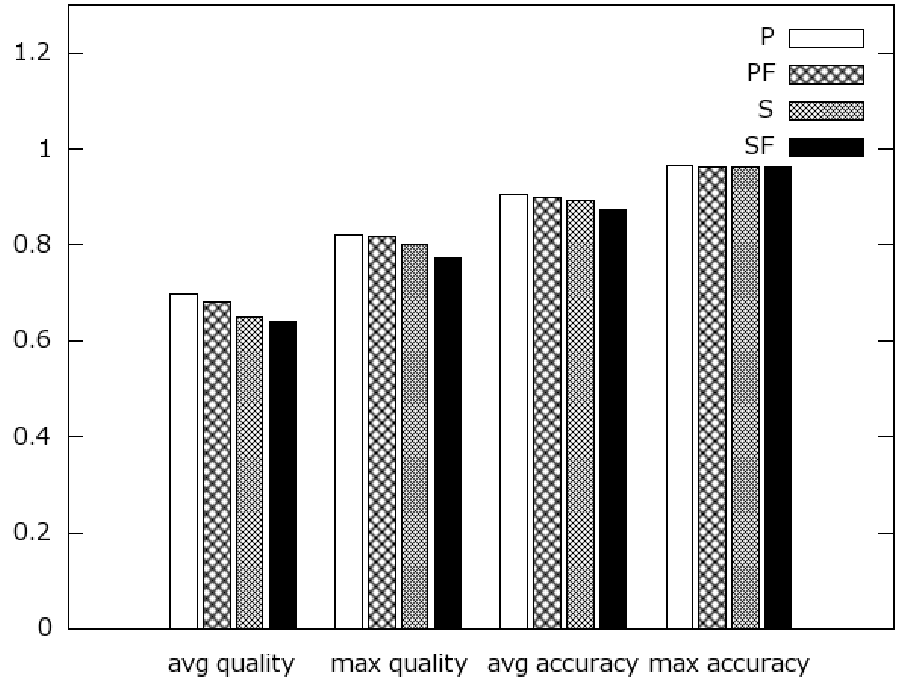 Figure 1: Comparison of Accuracy (A) and Quality (Q) between the Proportional (P) and Score (S) methods.
Linguistic Intuition: The Case for N-Grams
One of the paper's most interesting findings involves the Polish language. Unlike English, where lemmatization (reducing words to their base form) often helps, the authors found that no pre-processing sometimes yielded better results.
Why? Because in Polish, the grammatical form itself can carry sentiment. A word used in a specific case might appear more often in negative complaints than in positive praise.
To capture this, they used N-grams. They found that 7-grams and 8-grams were the "sweet spot." These long sequences effectively captured phrases like "szczerze odradzam" (strongly discourage) as single units, which is much more powerful than analyzing the words individually.
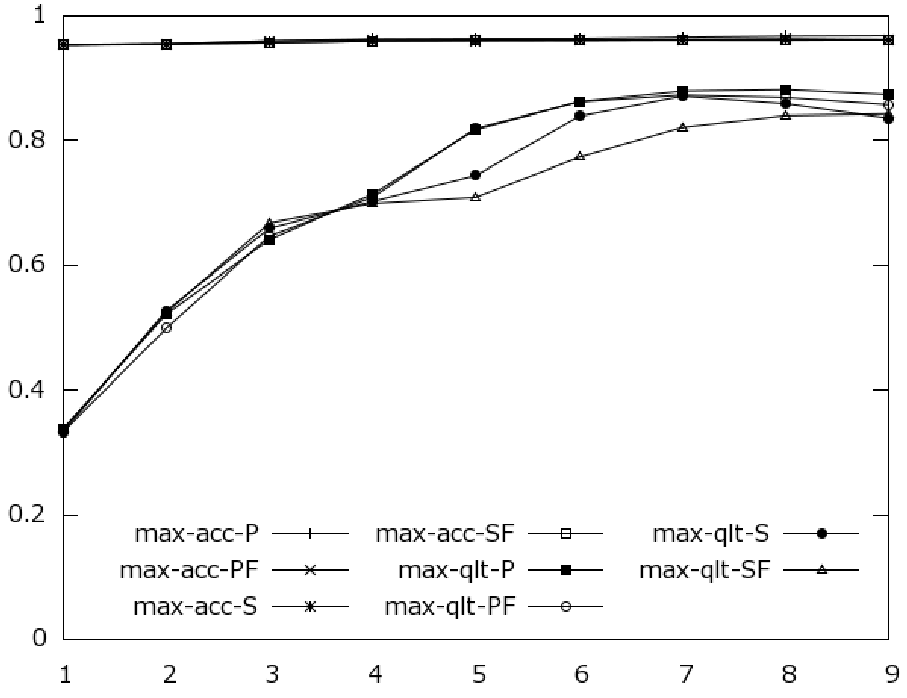 Figure 2: Maximal quality and accuracy achieved using n-gram representations.
Experimental Validation
The authors tested their approach on three distinct datasets:
- Merlin: Movie reviews.
- Ceneo: Consumer products.
- Znany lekarz: Healthcare provider reviews.
Across the board, the Proportional Method showed superior "Quality (Q)"—a metric similar to the F1-score that accounts for class imbalance. This is crucial because, in the real world, positive reviews often vastly outnumber negative ones.
Critical Insight & Future Outlook
While the paper successfully proves that social data improves sentiment analysis, the authors admit they haven't yet fully integrated the graph topology (like actual link-prediction or follower-graphs) into the classifier's inner loop.
The Takeaway: For AI engineers, this paper suggests that when building sentiment engines for social platforms, we should look beyond the text box. The "who" and "where" (the social link) are just as important as the "what" (the text).
Limitations
- Morphology vs. Logic: The reliance on raw forms over lemmatization might lead to data sparsity in smaller datasets.
- Social Integration: The current model uses social data as a "filter" or "context" rather than a primary feature in the mathematical scoring.
Conclusion
This work serves as a bridge between structural network science and linguistic sentiment analysis. As we move toward more complex AI models, the "Social Match" described here remains a foundational principle for building context-aware intelligence.