
Deciphering the Echo Chamber: A Survey of Opinion Propagation in Social Networks
Opinion Propagation in Online Social Networks: A Survey
This paper provides a comprehensive survey of opinion propagation models in Online Social Networks (OSNs), categorizing them into undirected and directed graph-based approaches. It systematically reviews foundational models like the Voter, Deffuant, and Hegselmann-Krause models, alongside information-centric models like Independent Cascade (IC) and Linear Threshold (LT).
TL;DR
This seminal survey explores how individual viewpoints transform into collective movements within Online Social Networks (OSNs). By bridging the gap between social psychology and graph theory, the authors dissect the mathematical mechanics of persuasion, contrasting classic physics-inspired models (like the Voter model) with modern algorithmic approaches used in viral marketing and election campaigns.
The Motivation: Why Modeling Opinions is Hard
Unlike the spread of a virus (which is physiological) or information (which is factual), an opinion is a subjective judgment often divorced from truth. The authors argue that prior work often oversimplifies this by treating opinions as mere "bits" of data. In reality, the propagation of a viewpoint is a battle of Social Influence, where factors like Homophily (the tendency to associate with similar people) and Opinion Leaders (highly influential hubs) dictate whether a community reaches a consensus or fragments into polarized clusters.
Methodology: The Taxonomy of Influence
The paper categorizes opinion propagation models into two primary architectural families based on the underlying social graph.
1. Undirected Graph Models (Symmetric Relationships)
These models, often used for platforms like Facebook (friendship-based), focus on equilibrium and consensus.
- Voter Model: A node simply adopts the opinion of a random neighbor.
- Deffuant & Hegselmann-Krause Models: These introduce the concept of Bounded Confidence (ε). Individuals only interact if their opinions are already somewhat similar. This explains the "Echo Chamber" effect: if you are too far apart in viewpoint, no persuasion occurs.
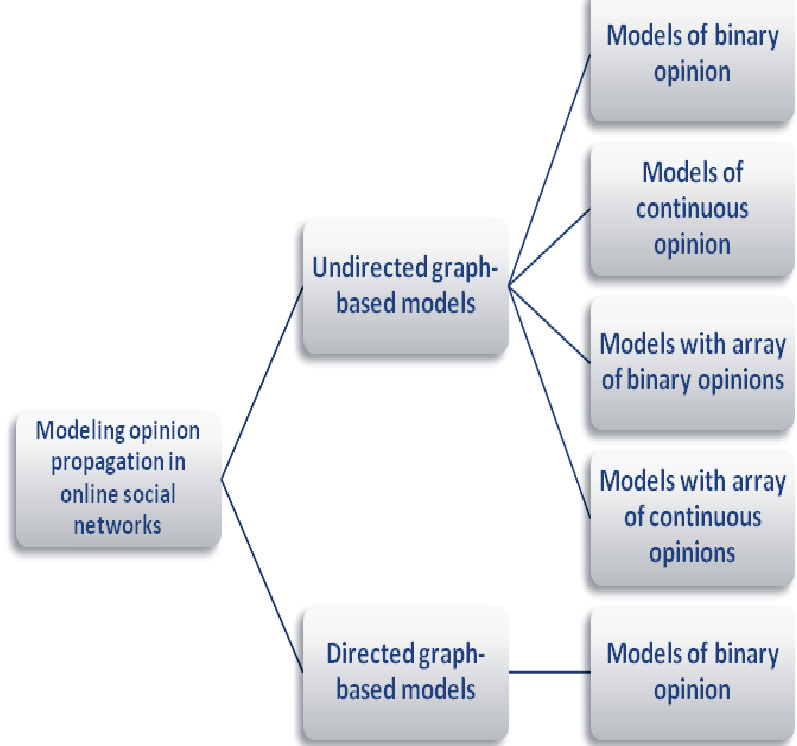
2. Directed Graph Models (Asymmetric Influence)
Ideal for Twitter or LinkedIn, these models focus on the "flow" of influence from leaders to followers.
- Independent Cascade (IC): Each "active" neighbor has a single chance to trigger an activation in their followers with a probability .
- Linear Threshold (LT): A node changes its opinion only if the cumulative influence of its active neighbors exceeds a specific threshold .
Key Insights from the Results
The survey synthesizes several critical findings regarding the "Physics" of social networks:
- The Consensus Threshold: In continuous opinion models (like Deffuant), the parameter acts as a phase transition point. Above this, the whole network usually agrees; below it, the network splits into multiple unyielding "opinion clusters."
- The Power of Hubs: Drawing from the Barabási-Albert (BA) model, the authors emphasize that "scale-free" networks are dominated by hubs. These Opinion Leaders act as the primary engines of propagation, supporting the "Two-Step Flow" theory where ideas flow from media to leaders, and then to the masses.
 Equation 1: Demonstrating the conditions under which an individual is considered influenced by a subset , emphasizing that the target opinion must migrate closer to the initiator's viewpoint over time.
Critical Analysis & Future Outlook
The authors conclude with a sobering reality check: most existing models rely on numerical abstractions (e.g., an opinion is just a number between 0 and 1). To advance the field, we must move toward:
- Sentiment-Aware Extraction: Integrating NLP to derive these numbers from actual text rather than assuming initial distributions.
- Dynamic Topographies: Modeling networks where edges (friendships) are broken specifically because of opinion disagreement—a phenomenon frequently observed in modern political discourse.
Conclusion
This survey serves as a fundamental map for anyone looking to understand the "Social Physics" of the 21st century. It warns us that without a sufficient "Confidence Bound," social networks are mathematically destined to fragment, providing a formal explanation for the polarization we see today.