
COF: Optimizing Mobile Social Networks through Weighted Characteristic Forwarding
Opportunistic Forwarding based on the weighted social characteristics in MSNs
This paper introduces the Characteristic-based Opportunistic Forwarding (COF) scheme, a novel routing strategy for Mobile Social Networks (MSNs) that leverages weighted social attributes. By quantifying the influence of different social characteristics on node contact frequency, COF achieves superior delivery ratios and lower latency compared to benchmarks like PeopleRank and Spray&Wait.
TL;DR
Communication in Mobile Social Networks (MSNs) is often erratic due to intermittent connectivity. The Characteristic-based Opportunistic Forwarding (COF) scheme optimizes data delivery by recognizing that not all social ties are equal. By weighting attributes like "Affiliation" or "Country" based on their real-world impact on contact frequency, COF achieves faster delivery and higher reliability than legacy flooding or basic social ranking algorithms.
Background & Motivation: Beyond Random Encounters
In MSNs, human mobility isn't random; it's driven by social intent. While prior work like Epidemic routing brute-forces delivery through flooding, and PeopleRank uses social importance, they often ignore the heterogeneity of social attributes.
The authors observed that nodes with more common characteristics contact each other more frequently (as seen in Figure 1). However, "Affiliation" might be a much stronger predictor of a future meeting than "Position." The challenge lies in quantifying this "strength" and using it to make smarter forwarding decisions without the overhead of maintaining complex contact histories.
Methodology: The Logic of Weighted Characteristics
1. Feature Selection and Independence
To avoid overcounting, the authors use Mutual Information to identify dependencies. For instance, since "City" and "Country" are highly correlated, they select a single representative to prevent redundant weighting.
2. Computing the Weights
The core innovation is the weight calculation formula. A characteristic's weight () is determined by comparing the actual contact frequency of nodes sharing that attribute against a Nodes Equivalent Contact Model (a baseline where everyone meets randomly).
Attributes that significantly "boost" contact probability get higher weights (e.g., Country = 2.89, while Position = 1.35).
3. Forwarding Logic (Algorithm 1)
When two nodes meet, the message carrier calculates the Common Characteristics Weight () of itself vs. the destination, and the encounter node vs. the destination. The message is only passed if the new node has a higher total weight, indicating a statistically higher probability of meeting the destination soon.
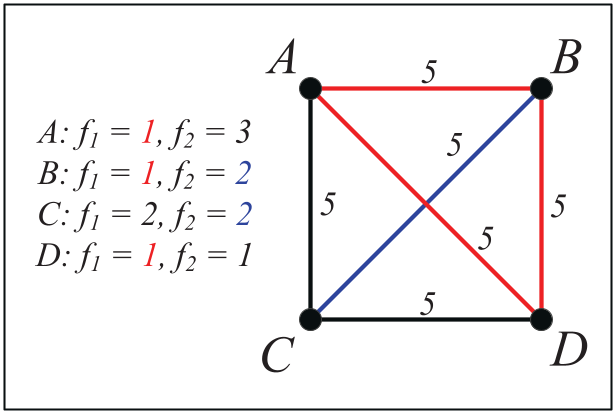 Figure 1: Verification that increased common characteristics correlate with higher contact frequency and duration.
Experiments & Performance
The researchers tested COF against PeopleRank, Spray&Wait, and Epidemic using the Infocom06 trace (Bluetooth sightings of 70 conference participants).
- Latency: COF significantly outperformed non-social algorithms. While Epidemic is theoretically the fastest (at the cost of infinite overhead), COF was the most efficient social-aware alternative.
- Delivery Ratio & Traffic: In "Heavy Traffic" simulations (shown in Figure 5), COF maintained high delivery ratios while others plummeted. This is because COF avoids "bottleneck nodes"—a common problem in PeopleRank where messages converge on a few "popular" nodes and cause buffer overflows.
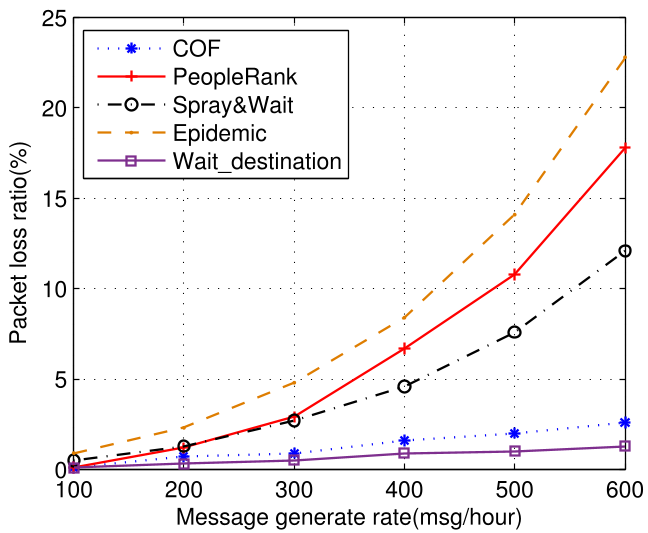 Figure 2: COF maintains superior delivery ratios and lower packet loss as network load increases.
Critical Insight: Why COF Wins
The brilliance of COF is its Implicit Load Balancing. By focusing on specific characteristic weights rather than global node popularity (centrality), the traffic is distributed among various "social clusters." This prevents the network congestion typically seen in "hotspot" based routing.
Conclusion & Limitations
The COF scheme proves that weighting social attributes provides a more surgical approach to opportunistic forwarding. However, its current limitation is the static nature of weights. In dynamic environments where social patterns shift (e.g., moving from a conference to a city-wide setting), these weights might need real-time recalculation using online learning methods.
Final Takeaway
For developers of delay-tolerant applications (disaster recovery, wilderness tracking), the COF strategy offers a blueprint: Don't just track who met whom; track why they met.