
OMSN: Transforming Smart Campuses into Internet-Independent Knowledge Hubs
Opportunistic mobile social networks: Challenges survey and application in smart campus
This paper explores Opportunistic Mobile Social Networks (OMSN) and proposes a novel architecture for collaborative learning in smart campuses. The authors introduce a prototype that leverages Wi-Fi Direct for high-speed, internet-independent data sharing, addressing key challenges in decentralized mobile environments.
TL;DR
The pervasive use of smartphones hasn't solved the "dead zone" or "high traffic" problem of campus Wi-Fi. This paper introduces an Opportunistic Mobile Social Network (OMSN) architecture that allows students to share course materials and posts directly through their phones using Wi-Fi Direct. By mimicking human social interactions, the system bypasses the need for internet while addressing the critical challenges of battery life, trust, and disconnection.
The "Infrastructure" Dependency Problem
We often take internet connectivity for granted, but in a sprawling smart campus, reliance on a central infrastructure creates bottlenecks:
- Congestion: High density of users can saturate building-wide Wi-Fi.
- Coverage Gaps: Outdoor areas or basements often lack stable signals.
- Resource Waste: Why download a 10MB syllabus from a remote server if the student sitting next to you already has it?
Current decentralized approaches (like Delay Tolerant Networks) often suffer from high latency and the "Selfishness" problem—where users disable sharing to save their own battery.
Methodology: A Socially-Aware Architecture
The authors propose a six-component framework designed to turn every smartphone into a smart "relay" node.
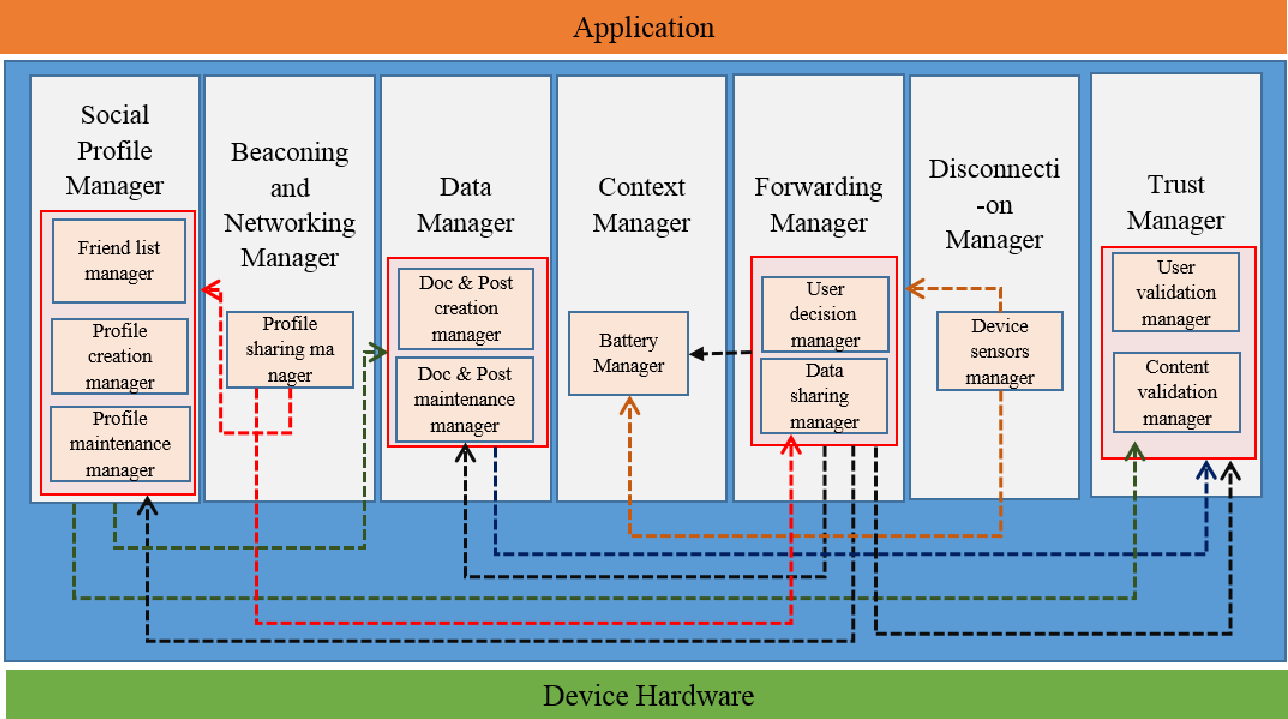
Core Innovations:
- Context-Aware Management: The system monitors battery and memory. If the battery is low, it shuts down non-essential relaying; if it's critical, it prompts the user to "offload" data to neighbors to prevent information loss.
- Wi-Fi Direct Service Discovery: Unlike Bluetooth, which is energy-efficient but slow, the authors utilized Wi-Fi Direct. This allows for discovery and high-speed transfer (up to 250 Mbps) without the devices ever being "paired" in the traditional sense.
- The Trust & Content Manager: To solve the issues of spam or malicious data, the system implements a "Like" mechanism. Higher likes increase a user's reputation, moving them from an "untrusted" list to a "Friends" list.
Experimental Results: Fast and Feasible
The research team deployed a prototype across several Android devices (Samsung S6, Huawei ALE-l21, etc.).
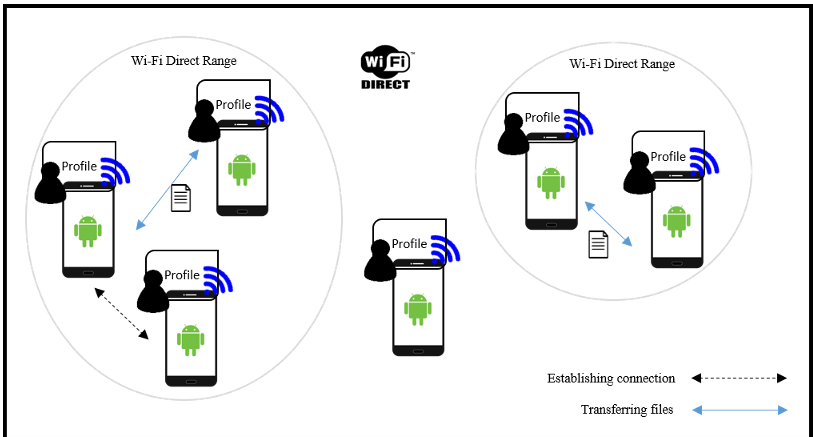
Key Findings:
- Battery Impact: Sending a package of various files (up to 10MB) consumed only 0-2% of the battery.
- Discovery Time: It took between 7 to 18 seconds to discover and connect to a neighbor. Given the slow walking pace of students on campus, this "opportunistic window" is more than sufficient for high-speed data transfer.
- Reliability: The "Disconnection Manager" effectively predicted battery drainage, ensuring data survived even if the original source went offline.
Critical Insight: Beyond Simple File Sharing
The real value of this work isn't just "sharing files without internet." It’s the Social Feature-Based Routing. By treating users as a "Hypercube" of interests (e.g., "Operating Systems," "Midterm Prep"), the network becomes an intelligent, self-organizing entity.
Limitations & Future Work
While the prototype is robust, the authors acknowledge that mobility prediction could be improved. Future iterations plan to integrate the user's calendar—if the system knows you have a class in 5 minutes, it can predict you are about to move and will prioritize finding a relay node in your next location.
Conclusion
This study proves that OMSN is a viable addition to the smart campus ecosystem. By turning social similarity into a routing metric, we can build networks that are faster, more resilient, and less dependent on the "cloud."