
Beyond Words: Does Visual OCR and Captioning Decode Microblog Emotions?
Does Optical Character Recognition and Caption Generation Improve Emotion Detection in Microblog Posts?
This paper investigates whether visual information—specifically via Optical Character Recognition (OCR) and automatic caption generation—improves emotion detection in microblog posts (Twitter). The study utilizes off-the-shelf tools like Tesseract and NeuralTalk2 to augment text-based classifiers, achieving significant performance gains in specific emotion categories.
TL;DR
While "a picture is worth a thousand words," in the world of Twitter emotion recognition, the actual words inside the picture might be worth even more. This paper evaluates whether extracting text from images (OCR) and generating automated descriptions (Captions) improves emotion classification. The verdict? OCR is a game-changer for emotions like Fear and Trust, while standard image captioning provides only a slight nudge.
Motivation: The "Hidden" Emotion Problem
In microblogging, the 140-280 character limit often forces users to "hide" their message or emotional outburst within an image. Whether it's a screenshot of a notes app or a meme, the emotional signal is frequently invisible to traditional NLP models that only look at the post's text.
The author identifies two critical gaps:
- Textual bypass: Users put their primary message in an image to circumvent length constraints.
- Situational context: Photos of specific events (e.g., a "selfie" or a protest) carry inherent emotional weight that text alone may not capture.
Methodology: The Three-Pronged Approach
The study treats emotion detection as a multi-class classification problem using a Maximum Entropy model. It extracts features from three distinct channels:
- (The Tweet): Standard Bag-of-Words from the raw tweet text.
- (The Embedded Text): Text extracted via Tesseract OCR from attached images.
- (The Scene): Natural language descriptions generated by NeuralTalk2 (a CNN+RNN architecture).
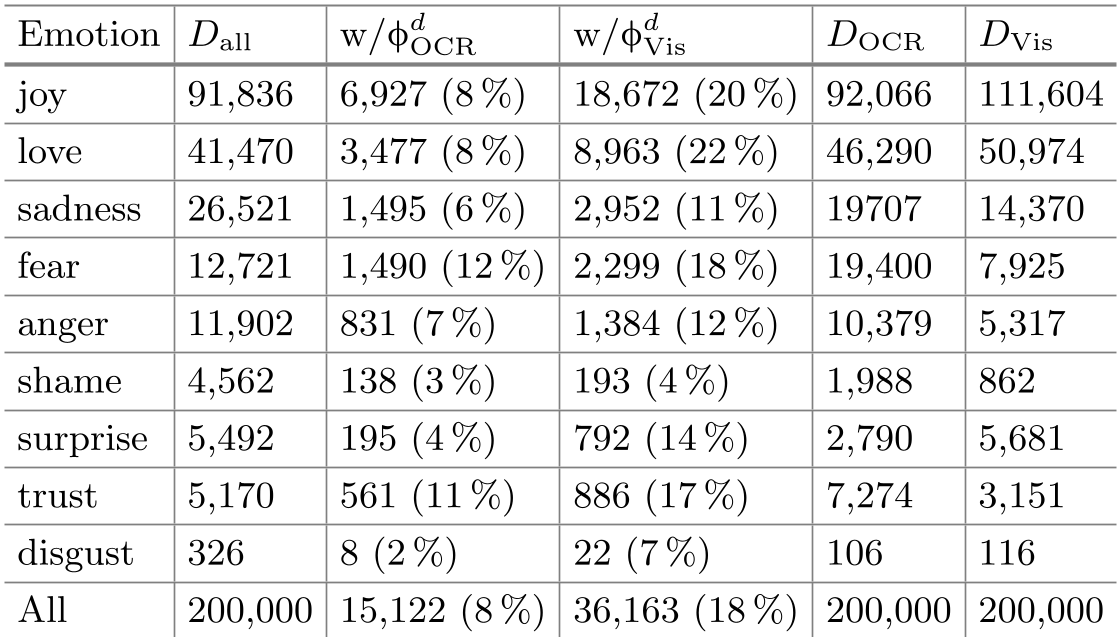 Table 1: Distribution of emotions across the different feature sets. Note that "Joy" and "Love" dominate the image-heavy posts.
Experiments & Key Findings
1. OCR is a Powerhouse for Specific Emotions
One of the most striking findings is the impact of OCR on "Trust," "Fear," and "Anger." When OCR features were added to the tweet text, the F1-score for Trust increased by 7 percentage points. This suggests that "Trust" is often communicated through structured textual content within images (e.g., certificates, quotes, or formal announcements).
2. The Limits of Captioning
Interestingly, automatic captions (NeuralTalk2) were not as effective as expected. While they helped slightly with "Disgust" and "Fear," they generally struggled. The author posits that the generated captions were too abstract. For instance, a caption saying "a group of people" doesn't distinguish between a joyful party and a fearful protest.
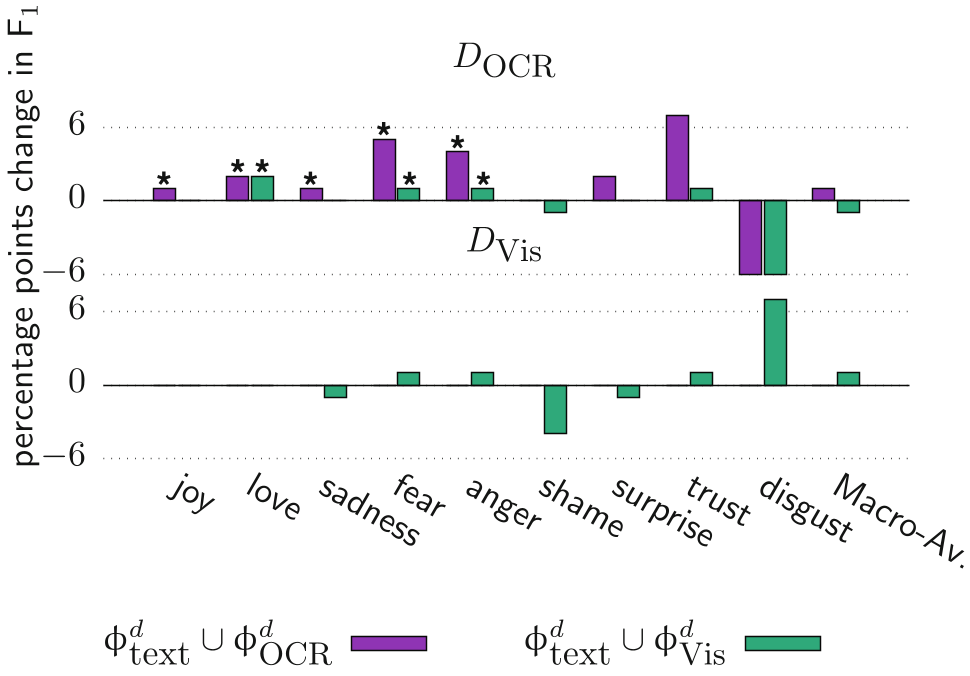 Figure 1: The delta in F1-score when adding OCR or Vision features. OCR (left) shows a clear positive impact compared to the baseline.
Critical Insight: The "Shame" and "Surprise" Paradox
The study reveals that tweets containing images are often harder to classify using only the tweet text (D_Vis and D_OCR subsets) compared to text-only tweets. This confirms the Inductive Bias that people use images when the text doesn't tell the whole story. For emotions like "Shame" and "Surprise," even adding OCR couldn't fully recover the performance lost from the brevity of the text.
Conclusion & Future Directions
The takeaway for developers and researchers is clear: OCR is a low-hanging fruit for multimodal sentiment analysis. If you are ignoring the text inside images, you are missing substantial emotional signals, particularly for complex social emotions like Trust or Fear.
Future Outlook: Generic captions fail because they lose visual nuances. The road ahead lies in using intermediate neural features (latent space representations) rather than translating images into words first, which causes an "information bottleneck."
Takeaway for Practitioners:
- OCR is mandatory for high-accuracy social media monitoring.
- Standard captioning is insufficient; specialized "Affective Vision" models are required to capture the true emotional tone of a scene.