
To Seed or to Build? Navigating the Quality-Seeding Tradeoff in Social Networks
Optimal budget allocation in social networks: Quality or seeding?
This paper investigates the optimal budget allocation strategy for two competing firms in a social network, balancing product quality enhancement vs. initial "seeding" (free offers). Using a myopic best-response dynamic and linear update models, the authors derive a threshold rule based on network centrality that dictates the Nash equilibrium for market share maximization.
TL;DR
In the digital marketplace, firms face a constant dilemma: Do I spend my next $1M making my product better (Quality), or do I give it away for free to influencers (Seeding)? This paper provides a rigorous mathematical framework to solve this. It reveals that the decision depends on a specific centrality threshold, the existing quality gap between competitors, and the underlying structure of the social network.
Academic Context: This work moves beyond simple "influence maximization" by treating product quality as a strategic variable, providing exact solutions for Nash equilibria in networked duopolies.
The Core Conflict: Quality vs. Influence
Most marketing literature treats "viral growth" as a byproduct of a product's inherent "virality" or the "seeding" of key nodes. However, quality isn't static. Firms can invest in R&D to increase the "isolation payoff" of a product.
The authors identify a critical tension:
- Quality improvement increases the value for every user regardless of their position.
- Seeding leverages the Network Effect, where one person's consumption incentivizes their neighbors.
Methodology: The Linear Update and Centrality
The paper assumes agents follow a myopic best response. If your neighbors use "Product A," your utility for using "Product A" increases. This leads to a linear update rule for consumption:

By solving this system, the authors derive a Centrality Vector () that represents the long-term influence of each node. The total utility for Firm A is then expressed as:
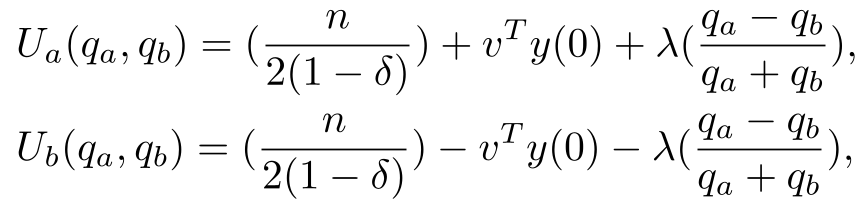
The genius of this approach is that it decouples the competitors' actions. Each firm maximizes its own marginal payoff by checking node centralities against a threshold ().
The Optimal Strategy: The Threshold Rule
The paper’s most significant contribution is Theorem 1, which establishes a simple rule:
Seed agent if their network centrality is higher than the critical threshold . Otherwise, put all remaining budget into Quality.
The threshold is determined by the cost of seeding (), cost of quality (), and the competitor’s quality.
Insights from Network Topology
The researchers tested this on two extremes: Star Graphs (centralized) and Balanced Graphs (decentralized).
- The Star Graph Rule: If seeding is so expensive that you wouldn't even seed the center of a Star Graph, don't bother seeding anyone in any network.
- The Quality Gap Paradox: When the qualities of two products are very close, firms compete fiercely on quality to "break the tie." But if your rival has a significantly better (or worse) product, quality investment has diminishing returns; you should pivot to seeding.
Experimental Proof: Seeding Capacity
The paper defines "Seeding Capacity" as how much a network can be effectively seeded.
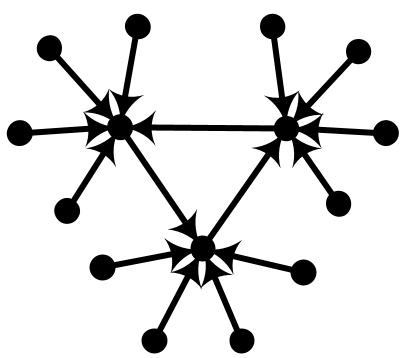 Fig 1: A 3-star graph configuration that maximizes seeding capacity under specific threshold conditions.
In Example 1, the authors demonstrate that for a network of 15 agents, a "3-star" configuration (three central hubs) allows for much higher seeding efficiency than a balanced network where every node has equal, but low, centrality.
Critical Analysis & Conclusion
Takeaways
- Don't seed "average" nodes: If an agent's centrality is below the threshold, the "ripples" they create in the network are worth less than the global value of a quality boost.
- Watch the Gap: If you are significantly behind a technical leader (like a smaller LLM provider vs. OpenAI), spending money on "quality parity" might be less effective than aggressive seeding in specific developer communities.
Limitations
The model assumes myopic agents—users who only look at the current state, not the future. In the real world, "early adopters" are often strategic and forward-looking. Furthermore, the model assumes a fixed budget received at a single point in time, whereas real-world marketing budgets are often dynamic and performance-based.
Future Outlook
This threshold logic provides a "North Star" for algorithmic marketing. As we gain better access to real-time social graph data, companies could dynamically adjust the threshold to decide minute-by-minute whether to push a software update (Quality) or a referral discount (Seeding).