
d-SNO: Balancing the Brainpower of Heterogeneous Sensor Networks
Optimal Computational Distribution of Social Network Optimization in Wireless Sensor Networks
The paper introduces Social Network Optimization (SNO), a population-based evolutionary algorithm inspired by social interaction, and presents its distributed variant, d-SNO. The work focuses on achieving optimal computational distribution within a Wireless Sensor Network (WSN) to minimize total execution time in heterogeneous environments.
TL;DR
This paper presents Social Network Optimization (SNO), an evolutionary algorithm that mimics social dynamics (influencers, peers, and reputation) to solve complex engineering problems. By distributing this algorithm (d-SNO) across a Wireless Sensor Network (WSN) and mathematically optimizing the workload based on each sensor's processing speed, the authors reduced computational time by over 60%, turning a collection of weak sensors into a powerful distributed computer.
Background: Why Social Networks for Sensors?
In the world of Wireless Sensor Networks (WSN), we are moving from simple data collection to "on-line optimization"—where the network must make complex decisions in real-time. However, sensors are heterogeneous: some are fast, others are legacy slow, and all have limited battery.
The authors argue that traditional Evolutionary Algorithms (EAs) like Genetic Algorithms (GA) or Particle Swarm Optimization (PSO) are often limited by low population sizes, which restricts their parallel efficiency. SNO, however, thrives with larger populations (150+ individuals), making it a "hidden gem" for distributed cloud and edge computing.
Methodology: The Mechanics of Social Evolution
SNO treats each candidate solution as a "member" of a social network.
- Status: The current solution (coordinates in the search space).
- Character: The direction of search (the "personality" of the mover).
- Reputation: The fitness value (how "popular" the solution is).
The core update logic involves individuals looking at Influencers (high-fitness statuses) and adjusting their trajectory based on a "desideratum"—an ideal state.
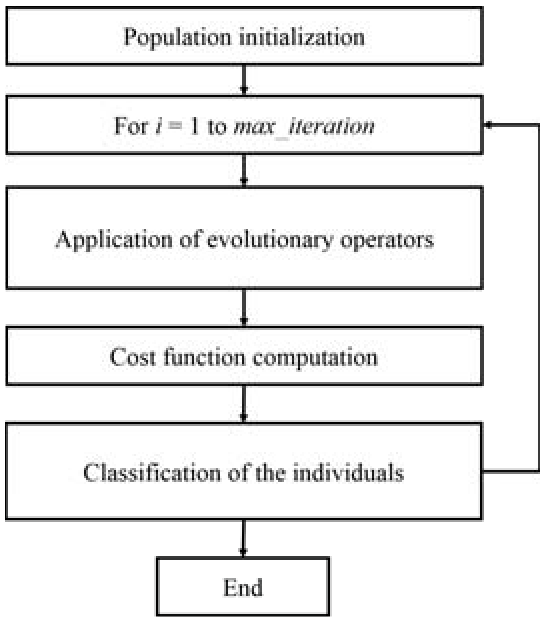 The iterative loop of SNO allows for independent individual updates, which is the key to its parallelizability.
To make this work in a WSN, the authors formulated a Distributed SNO (d-SNO). The challenge here is the "bottleneck problem": if one sensor node is 10x slower than the rest, the entire population update lags. The paper solves this by using an off-line optimization to pre-calculate exactly how many "individuals" each sensor should handle based on its recorded operations per second.
Experiments & Results: Crushing the Baselines
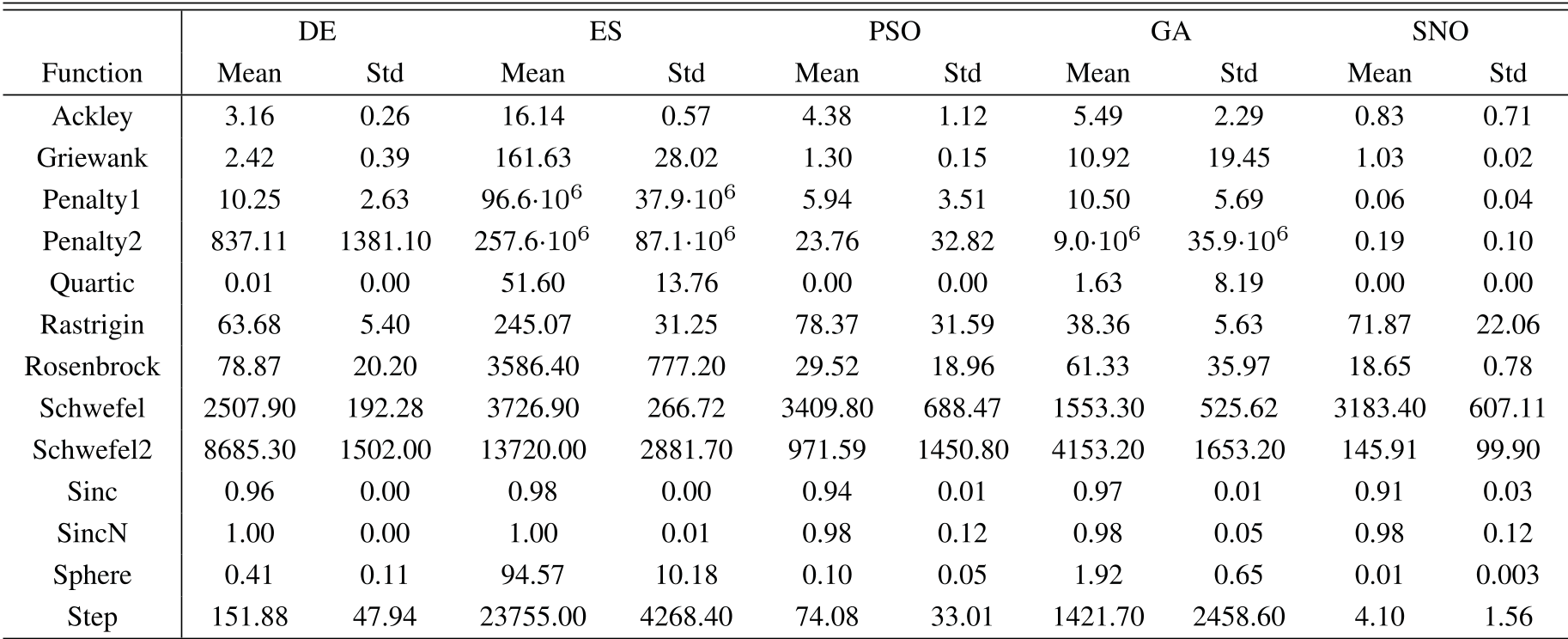
The authors first proved SNO’s superiority on 13 standard benchmarks (Ackley, Rosenbrock, etc.). As shown in the performance table, SNO "won" against DE, ES, PSO, and GA in the vast majority of scenarios.
The real highlight, however, was the Microstrip Filter optimization. By moving from a single-core SNO to a distributed d-SNO, the execution time for 100,000 function calls dropped from 2211 seconds to 748 seconds (a 66% improvement).
When applied to a simulated network of 100 heterogeneous sensors (varying speeds), the optimized distribution smoothed out the computational peaks.
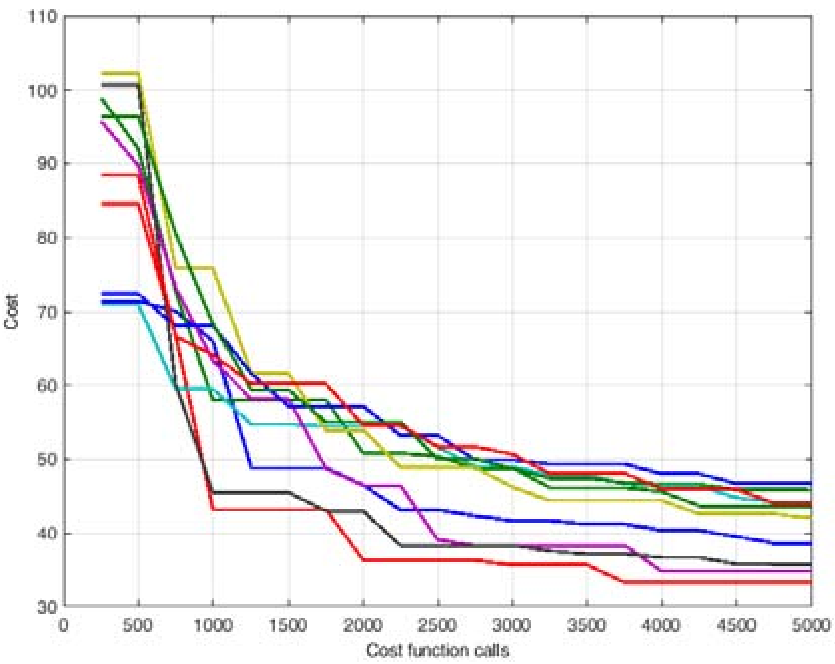 Fig 6: The optimized computational time shows a balanced load, preventing any single sensor from stalling the network.
Critical Insight: The "Social" Advantage
The "Secret Sauce" of SNO in this context is its high optimal population size. While a Genetic Algorithm might only need 50 individuals to converge, SNO performs best with 350. In a distributed environment, a larger population isn't a burden—it's an opportunity. It allows the workload to be sliced thinner across more sensors, maximizing the Parallel Efficiency.
Conclusion
The paper successfully bridges the gap between high-level heuristic optimization and low-level hardware constraints. By treating the WSN as a social network of processors, the authors have provided a blueprint for more resilient and faster "Edge AI" applications.
Future Directions: The next step would be applying this to dynamic networks where nodes move or battery levels fluctuate, requiring the "off-line" optimization to become a real-time adaptive process.