
Optimal Containment: A Math-Programming Shield Against Misinformation
Optimal Containment of Misinformation in Social Media: A Scenario-Based Approach
The paper introduces a scenario-based mathematical programming approach to minimize misinformation spread in social networks by optimally removing links. Unlike previous methods, it utilizes actual historical cascades rather than relying on difficult-to-estimate diffusion model parameters, formulating the task as a Mixed-Integer Programming (MIP) problem.
TL;DR
Researchers have developed a new mathematical framework to stop the spread of rumors in social media by surgically removing network links. By shifting from theoretical diffusion models to "scenario-based" historical data, they have created a Branch-and-Cut algorithm capable of finding exact optimal solutions for networks with thousands of nodes—a massive leap over previous methods that stalled at just 50 nodes.
Context: The Failure of Theoretical Models
Most efforts to contain misinformation (incorrect news, panic-inducing rumors) rely on the Independent Cascade or Linear Threshold models. While mathematically elegant, these models suffer from a "parameter gap": we rarely know the exact probability of one user influencing another. If the parameters are wrong, the containment strategy fails.
The authors of Optimal Containment of Misinformation in Social Media argue that we should stop guessing parameters and start looking at actual cascades—the historical traces of how information has already flowed through the network.
Methodology: The Scenario-Based MIP
The authors transform the link removal problem into a Mixed-Integer Programming (MIP) problem. The core intuition is to treat each information spread event as a "scenario" (a subgraph where specific paths are active).
1. The Objective Function
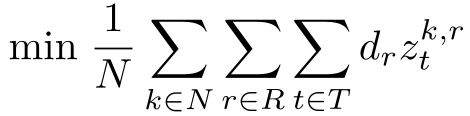
The goal is to minimize the expected damage (the number of "terminal" users reached by a rumor) across all observed scenarios given a budget for link removals.
2. Path Inequalities
The model uses path-based constraints to ensure that if a path exists from a rumor source to a target in a given scenario, at least one edge on that path must be "interdicted" (removed) to protect the target.
3. Branch-and-Cut Efficiency
Since there are an exponential number of possible paths in a network, the authors don't list them all. Instead, they use a Branch-and-Cut approach:
- Start with a simplified model.
- Check if the current solution allows a rumor to reach a target.
- If it does, find the shortest path (the "violated constraint") and add it back to the model as a new cut.
Evaluation & Results
The researchers tested their approach on both synthetic topologies (like Barabasi-Albert scale-free networks) and real-world collaboration networks.
Key Findings:
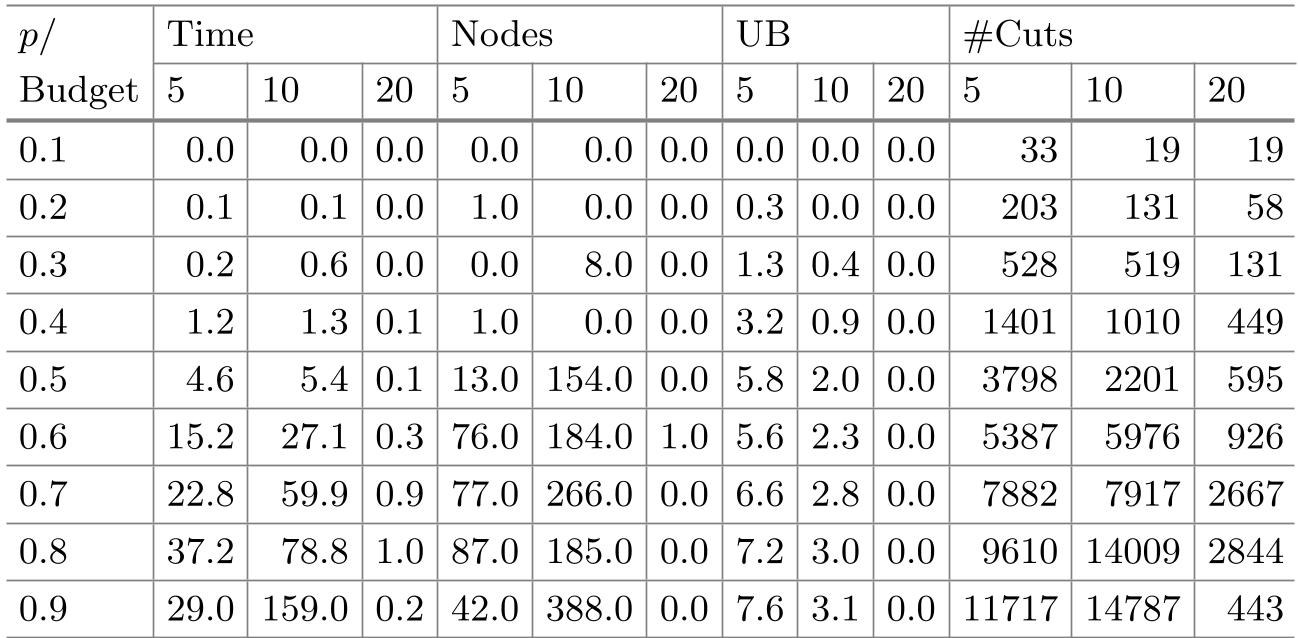
- Scalability: They solved instances with 1,589 nodes, whereas previous state-of-the-art exact methods could only handle about 50 nodes.
- Topological Insight: Erdos-Reyni (random) networks proved the hardest to defend because they lack the "hub" structure of scale-free networks, making it difficult to find critical links to cut.
- Efficiency: Most optimal solutions were found in under 60 seconds, even when thousands of cuts were dynamically generated.
Critical Insight: Why This Matters
The "Scenario-Based" approach provides a bridge between theory and practice. If historical data is available, the model uses it directly. If no data exists, it can still use traditional models (like IC or LT) to generate scenarios, making it a universal wrapper for misinformation defense.
Limitations & Future Work
While a significant improvement, the method is still an "exact" solver meant for moderate-sized networks. For global-scale platforms like X (Twitter) or Facebook with millions of nodes, the authors suggest that the next frontier is developing scalable approximation algorithms that maintain the logic of this scenario-based MIP while reducing computational overhead.
Conclusion
By treating misinformation as a robust optimization problem over scenarios, this research moves us closer to automated, mathematically-proven tools for protecting the integrity of online discourse.